
THE CHAIR: A CHAIR: A LINE-UP OF FOURTEEN CHAIRS
With the following quote in mind
“When everyone is a librarian, the library is everywhere” (from Why and How to Become an Amateur Librarian by Marcell Mars)
teacher Ronny Duquenne set the following assignment in 2025
“Start with a basic chair and build a nomadic reading space”
for second-year Bachelor’s students in graphic design.
They were given Bruno Munari’s Fancy Goods, excerpts from Norman Potter’s What is a Designer and Enter the Matrix: An Interview with Ken Isaacs as initial reading material. The students built on this with three texts of their own choosing.
Taking Potter’s Advice for Beginners as their starting point,
“Attitude: if you climb on top of a job, trying to master it, the work will suffocate. Let it take you, play with it, search for its own life.”
The result is a collection of fourteen unique chairs, skilfully crafted with the help of lecturers Arthur Haegeman and Harold Vergucht.
Complemented by the accompanying texts in publication form, their creation can be described as a surprising interplay between content and form.
We placed all the chairs in front of the camera and asked the students to summarize the idea behind them and their creation in a few sentences, as well as to give their chair a title.
We present: a line-up of fourteen variations on The Chair
The Chair as a chair,
as a prop,
as gender,
as a witness,
as a posture,
as an archive,
as a source of balance,
as a source of warmth,
as social commentary,
as a conversation starter,
as a showcase of craftsmanship…
With
Elsie Cooper, A measurement is not unlike a metaphor


“This publication brings together two essays which, each in their own way, question the integrity of measurement systems and our perception of them. How did the measurement systems we use come about, and how do they influence the way we perceive the world? Through its visual confusion, the chair seeks to explore this issue. As a viewer, you are forced to engage with the imbalance of the legs; the visual weight of the largest leg in relation to the narrowest one. To what extent do dimensions hold power over our visual reality?”
To Cobbaert, Privilege
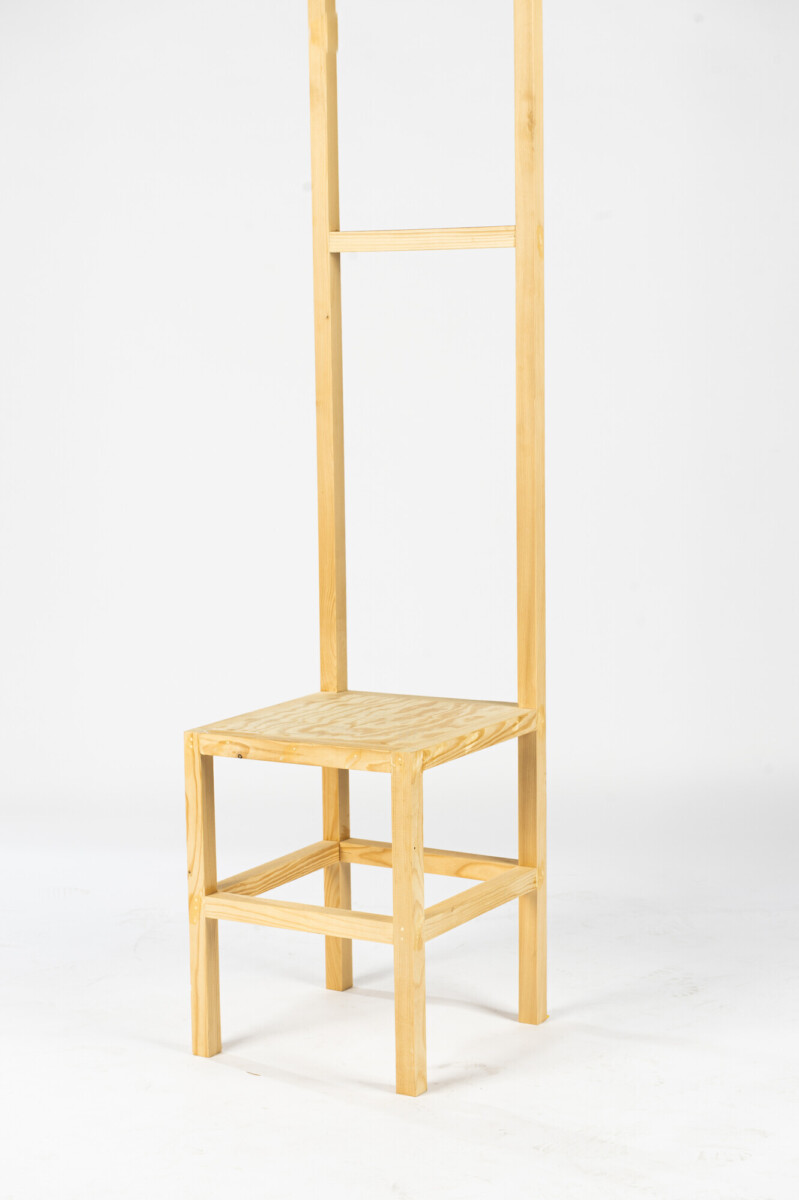
“The chair embodies the idea of privilege and inaccessibility. A literal representation of how people of different backgrounds, classes, genders, etc. occupy entirely different positions in society. I aim to demonstrate this by making the chair as tall as possible, thereby portraying a literal inaccessibility.”
Gitta Van den Eede, Fold – Unfold


“The nomadic chair unfolds both as an object and in practice – a malleable space has been created that invites the reader to adopt a shifting posture. Each text has its own choreography of handling and positioning, meaning that reading takes on an ever-shifting position.”
Robbe Sengers, Manspread
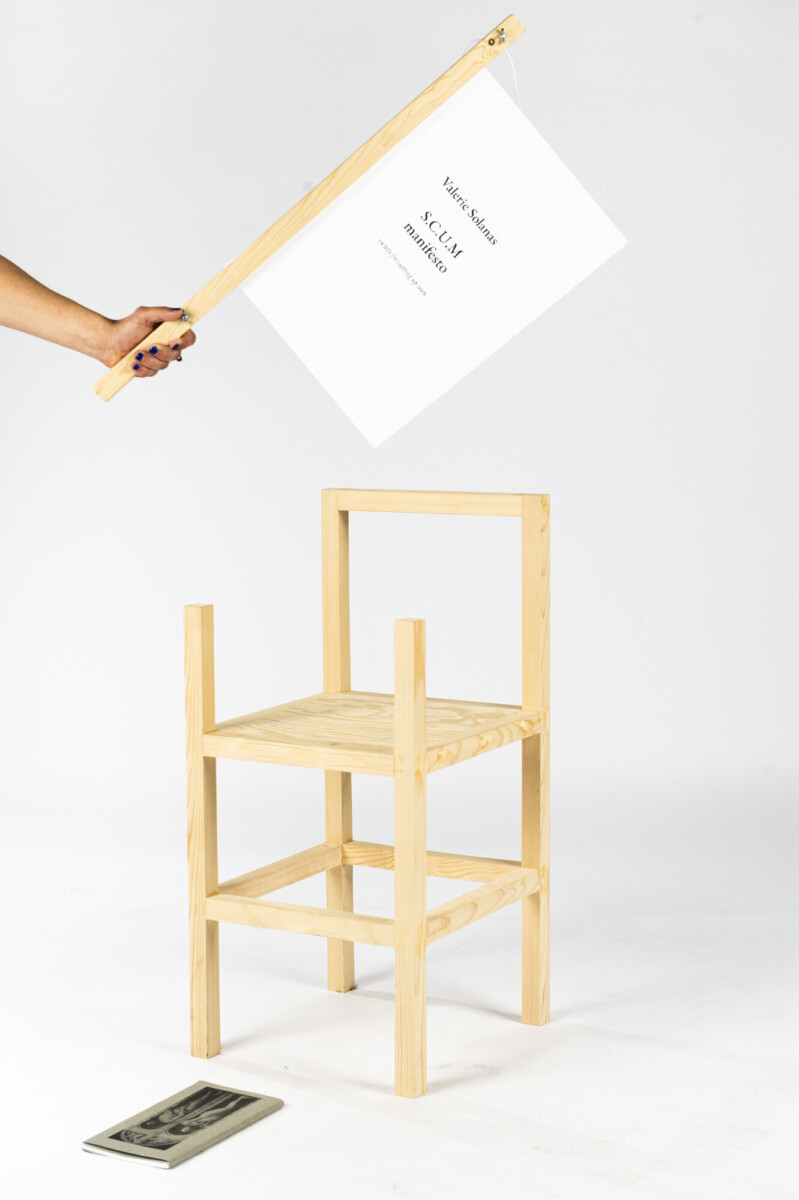
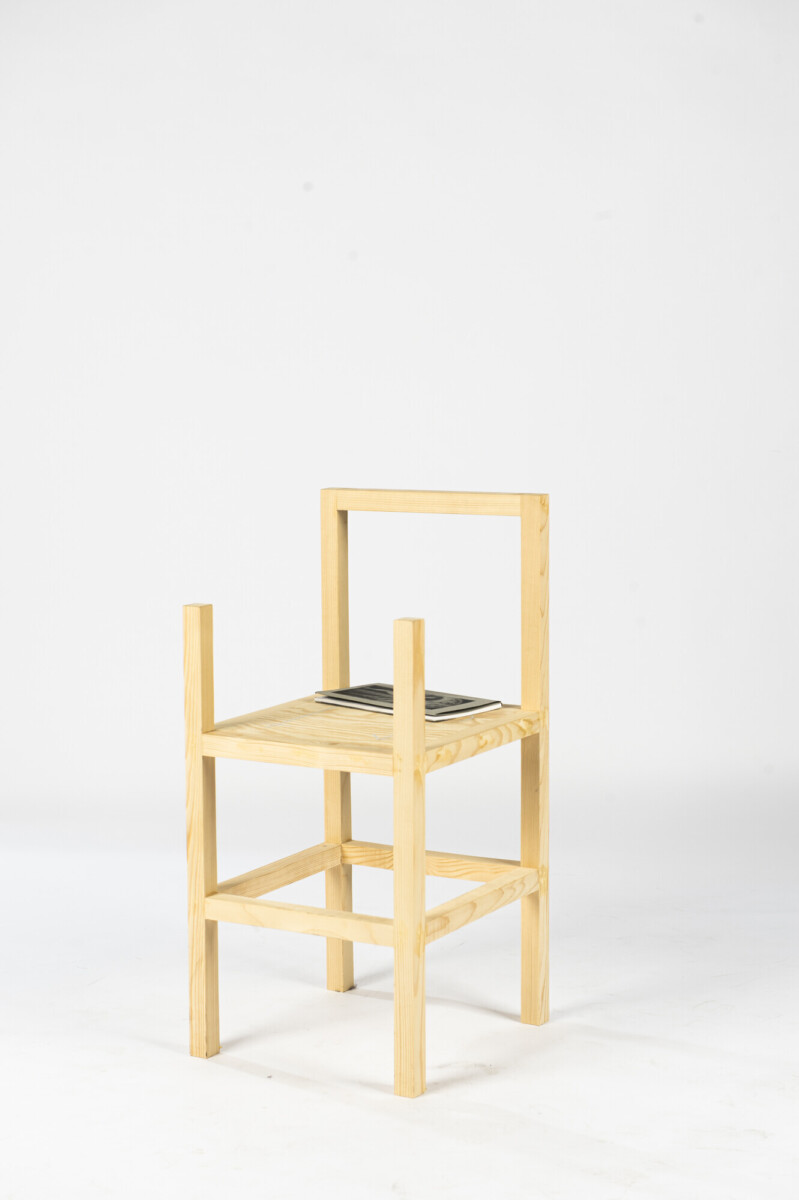


“My chair is designed as a reflection on physicality and gender expression. The design invites or compels you to constantly adjust your posture, depending on the publication you are reading or looking at. In this way, sitting becomes an active experience. For one publication, you humbly lean forward with your legs crossed, whilst for another you must sit tall and wide by ‘manspreading’.”
Ewa Yasebo, People tend to sit where there are places to sit

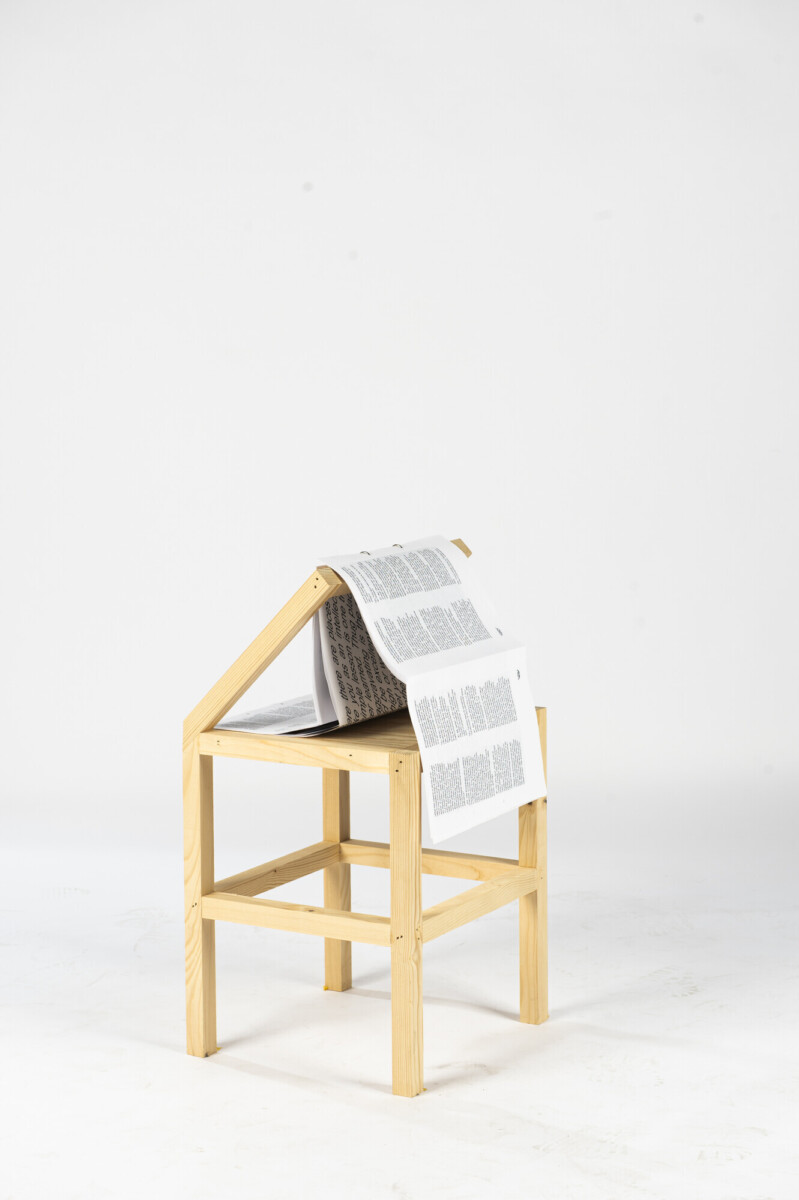
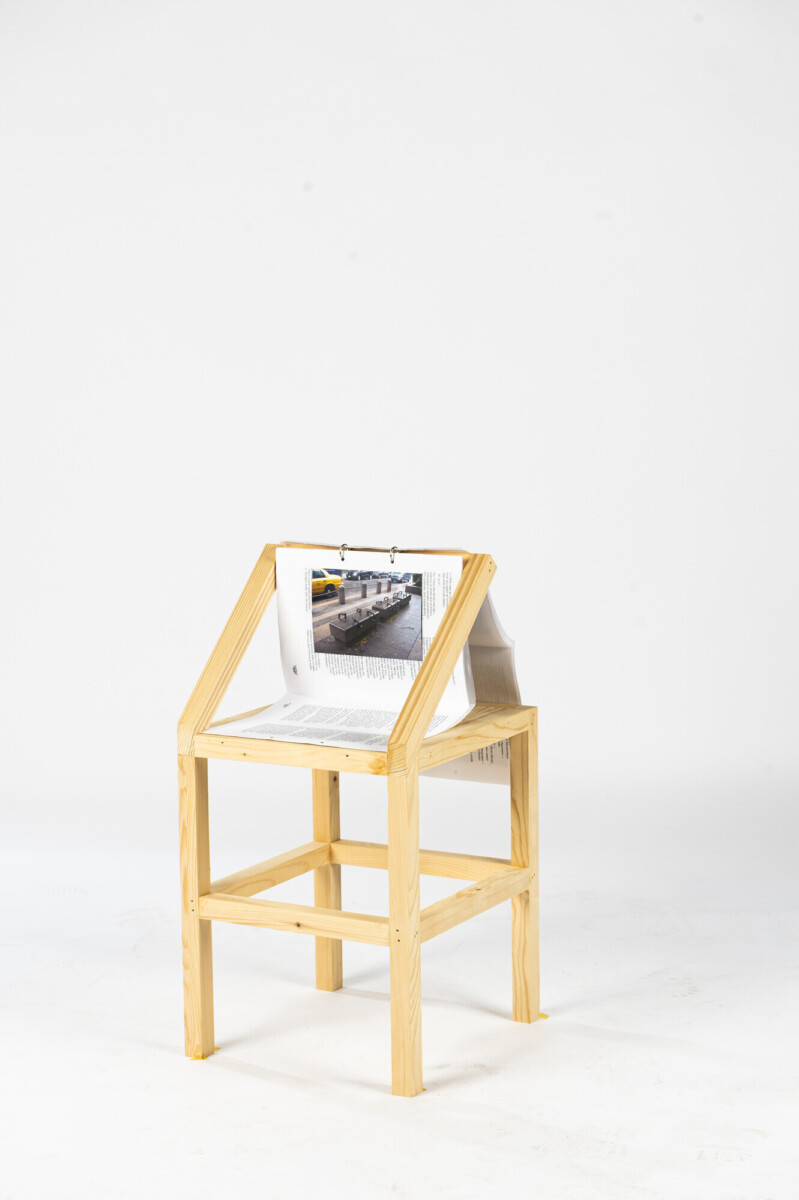

“This chair is designed as a social commentary on the hostile architecture in our environment and how third spaces are slowly disappearing as a result. But nevertheless, it stays important to continue to use and claim these public spaces even though these uncomfortable and exclusionary designs are present.”
Renée Cauwelier , To Family, To Archive, To Build
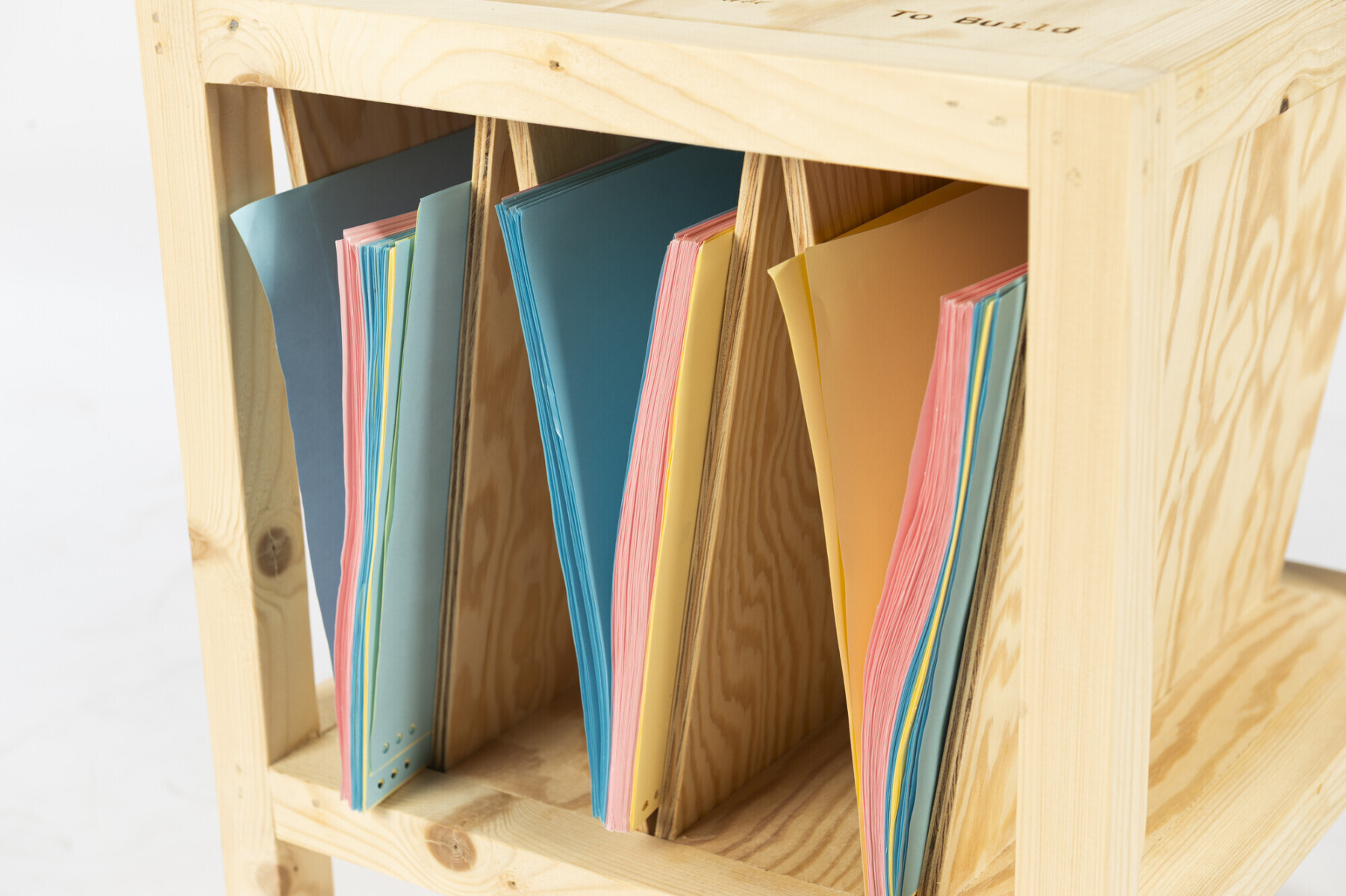


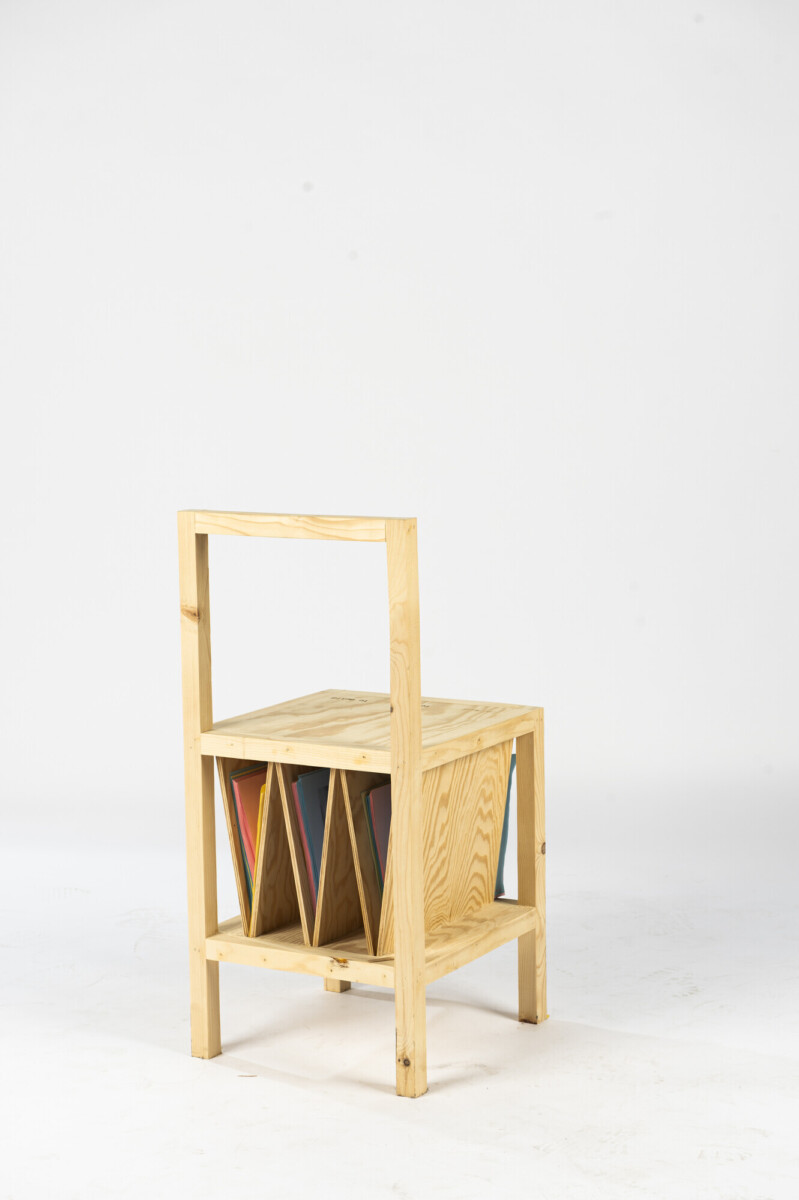
“The chair as an archive. In this archive you’ll find text, images and – inspirational content.
These have been categorised using a colour code:
Text is yellow
Images are blue
Inspiration is pink
This archive is a collection of everything that has fascinated, inspired and intrigued me over the past year...”
Mara Bogaert, Erase


“My chair features the names of the artists discussed in the publications. For one reason or another, all these artists and their work have come into contact with ‘censorship’. Their work was partially erased or restricted. The publications feature interviews, analyses and visual material relating to these artists. The idea of this ‘erasing’ is embodied by an action carried out both on the chair and within the publications, namely the crossing out of names, texts (such as when an artist is speaking in an interview) and images.”
Arwen François, This is not a chair

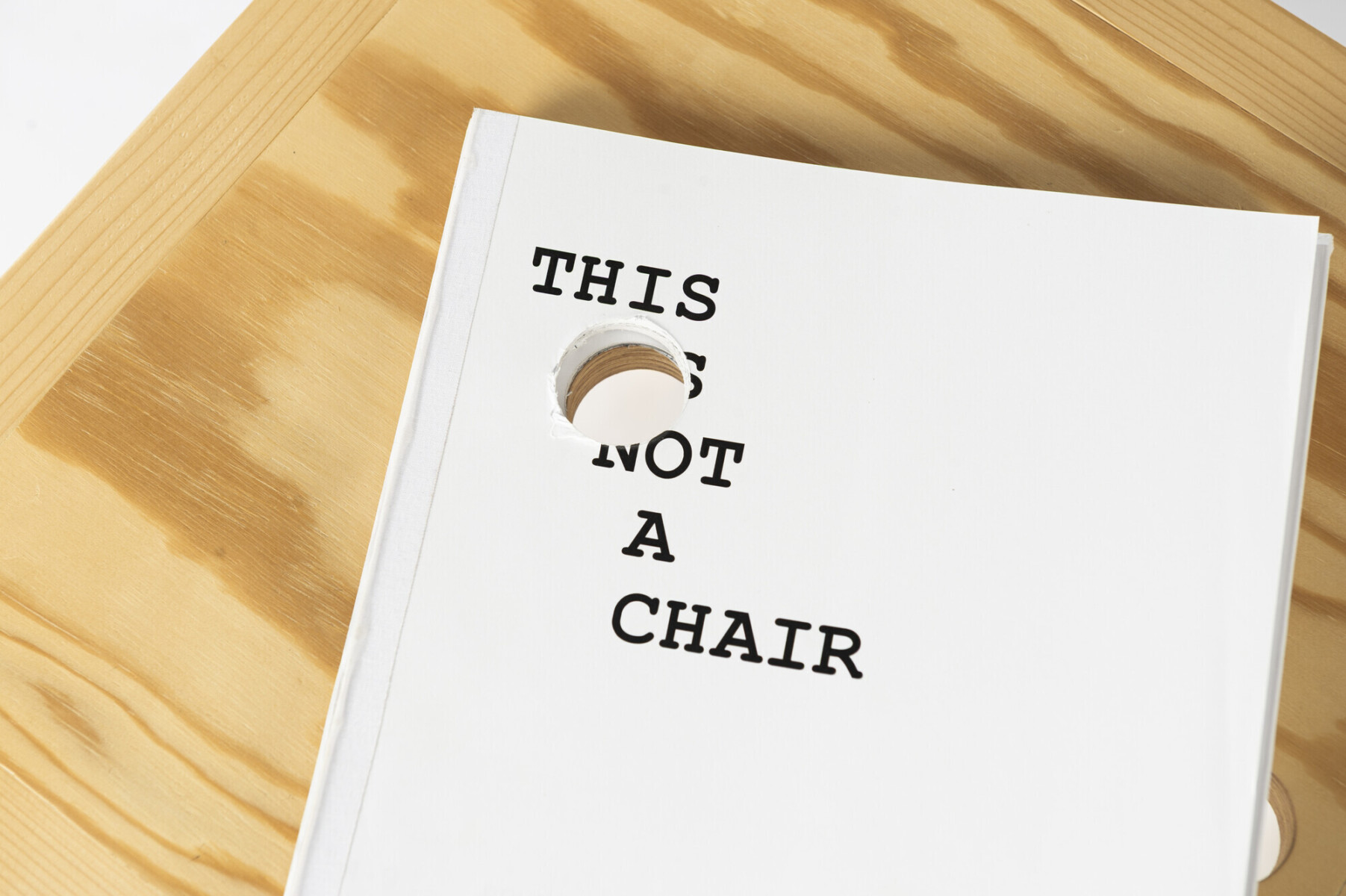
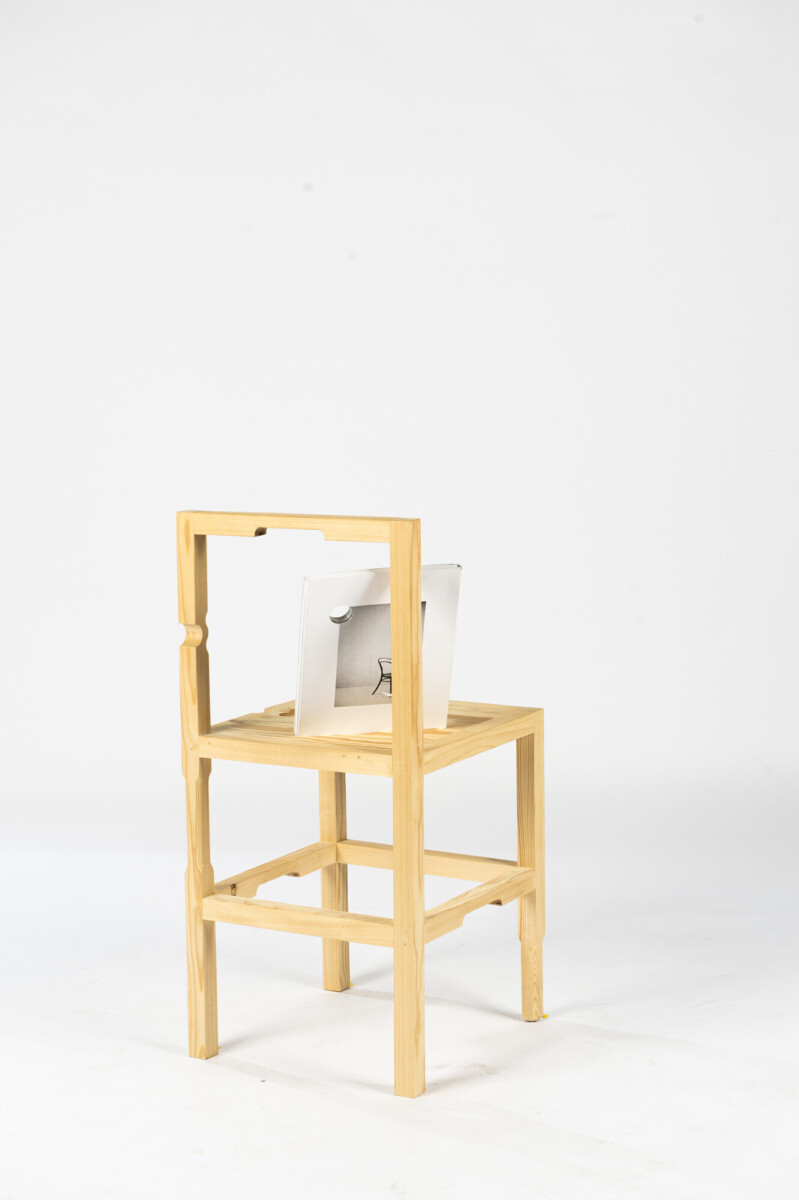

“It is about the chair being seen as a prop in a play. The chair is intended to be used as all sorts of objects, not just a chair. By making use of the various handles, the instructions and your imagination, you can interpret the chair in multiple ways.”
Marthe Lambrecht, Untitled
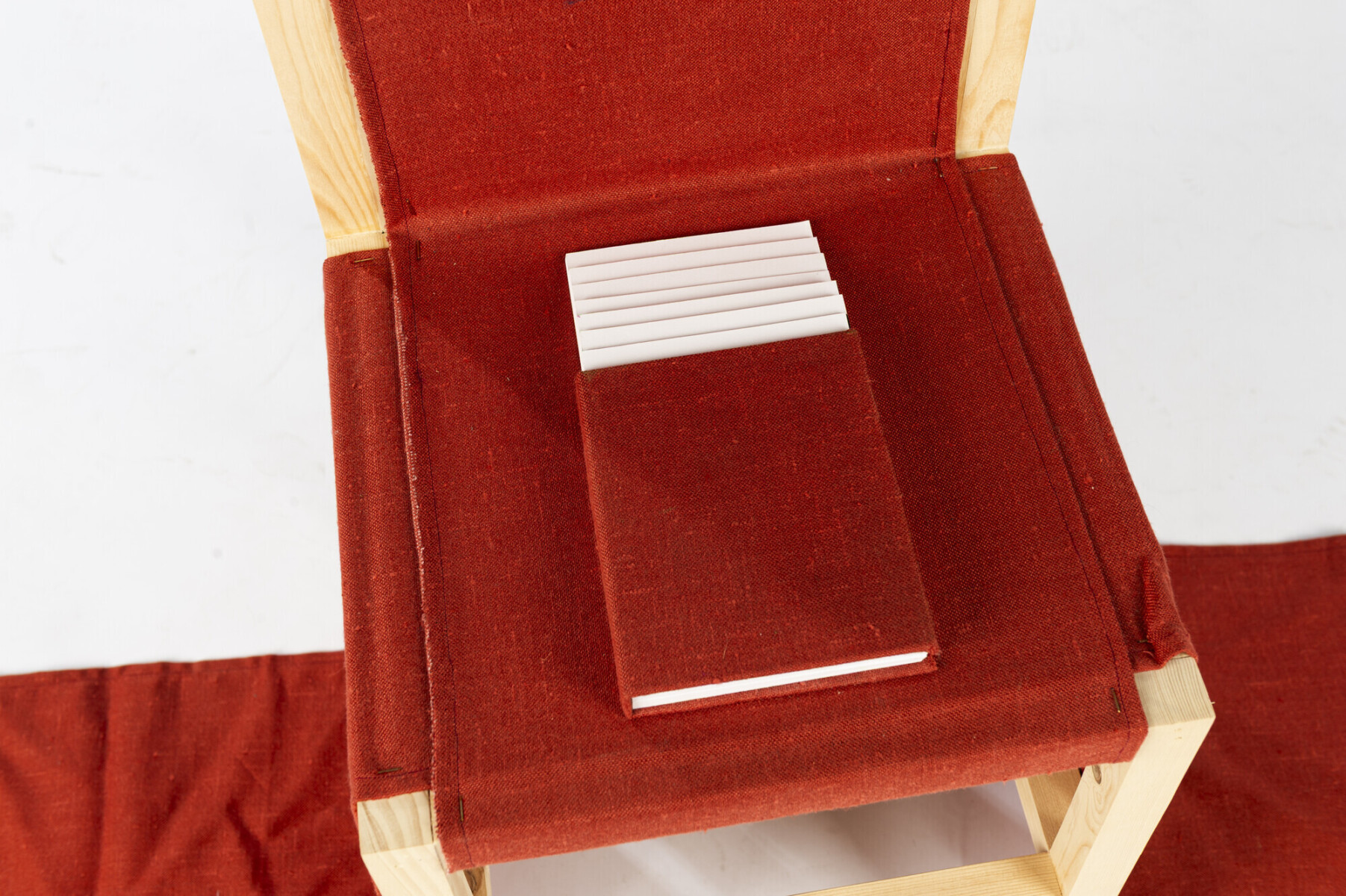


“This chair and accompanying publication were designed around the theme of ‘heart-warming’. The chair embraces the user and creates a sense of warmth, comfort and security. The publication complements this, bringing together, amongst other things, a nature diary, atmospheric film scripts centred on warmth, and musical scores that evoke the same warm atmosphere.”
Estelle Demaré, Silence
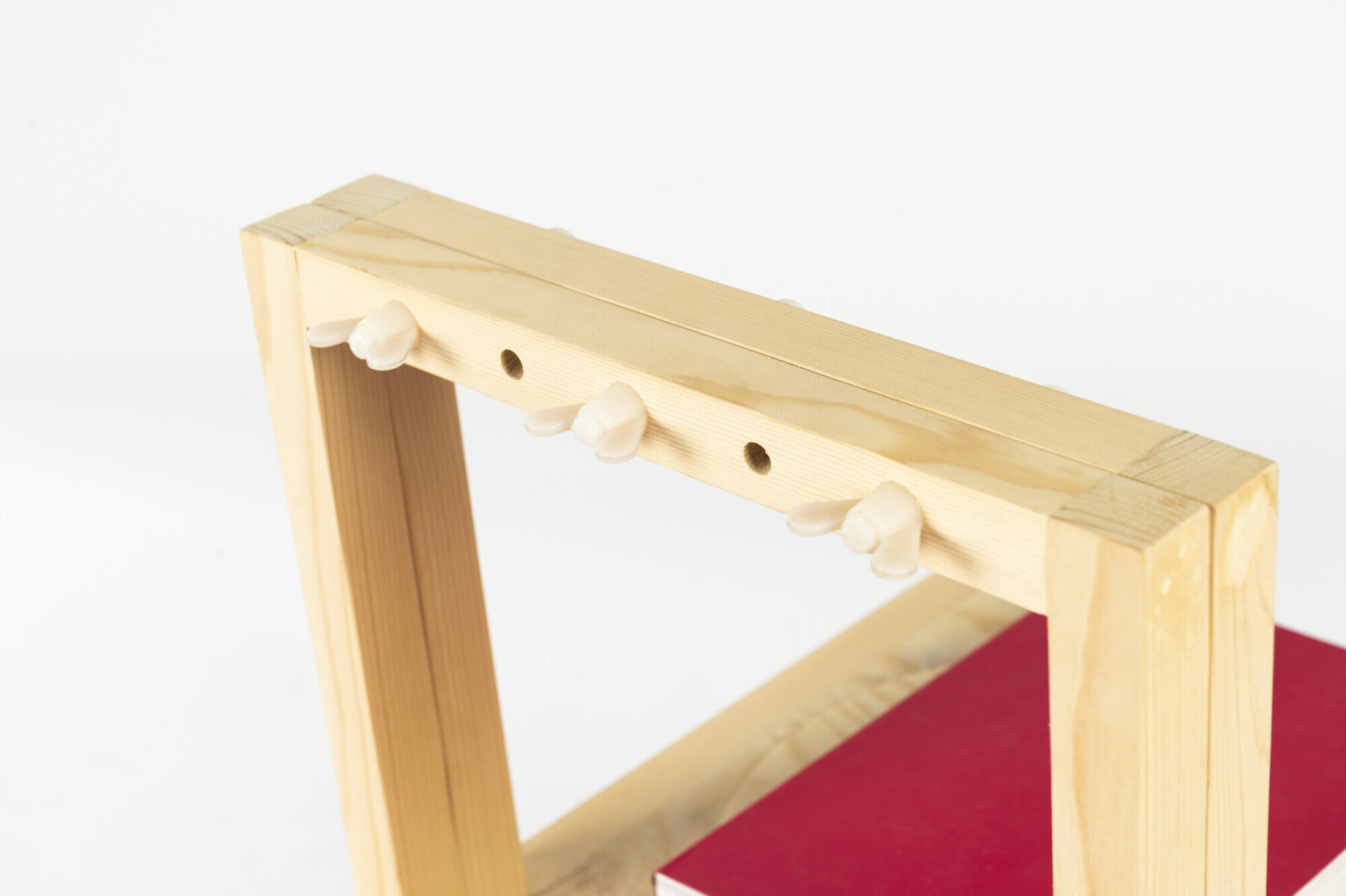

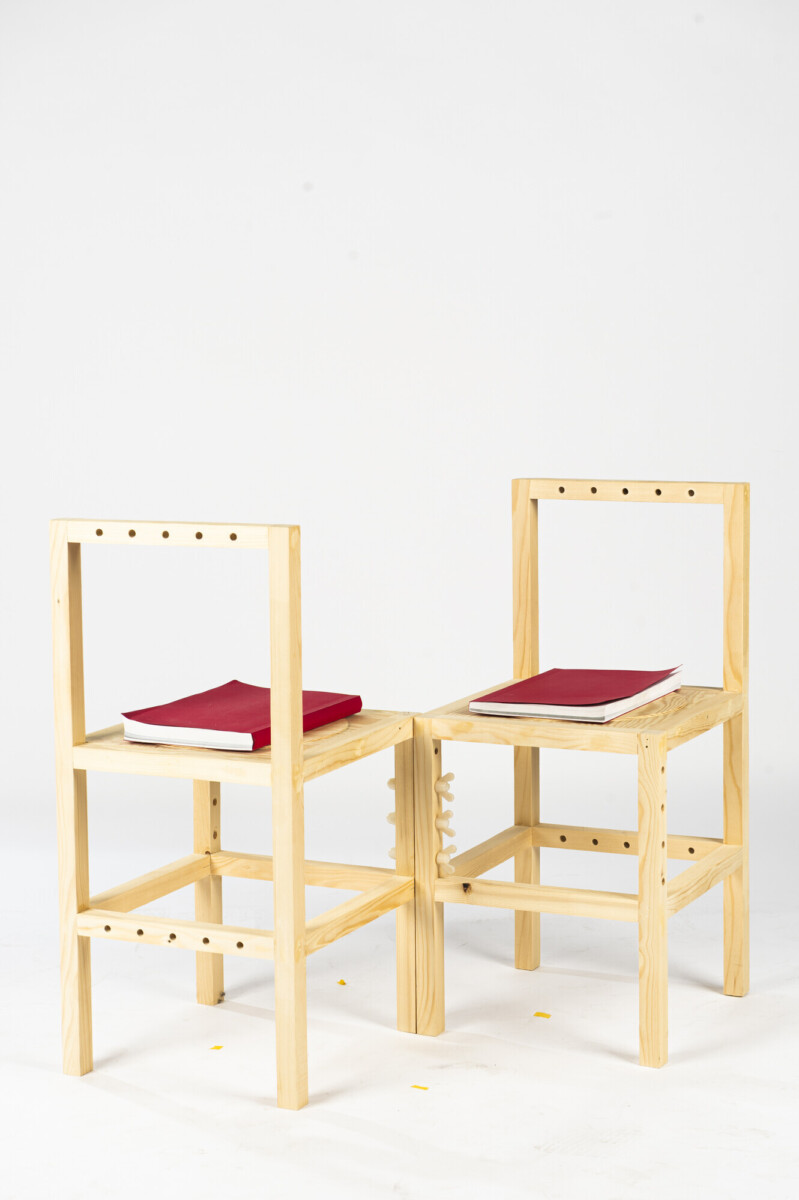

“This publication explores what happens when people no longer communicate. Inspired by Ik ga naar de schapen by Marieke De Maré, I looked into how living next to, rather than with each other, can be translated into a book. The book is bound using a Japanese binding technique. With the text hidden along the inner folds, the seemingly empty book does not speak. There are two versions of the same book, a symbolization of a message that can be interpreted in two or more ways. They are presented on two chairs, placed back to back. However, the setup invites change. The bolts connecting the chairs can be removed, allowing them to be placed side by side. The pages of the book can be torn open, revealing the text, showing that understanding is still possible.”
Ischa Mestdagh, About Workmanship
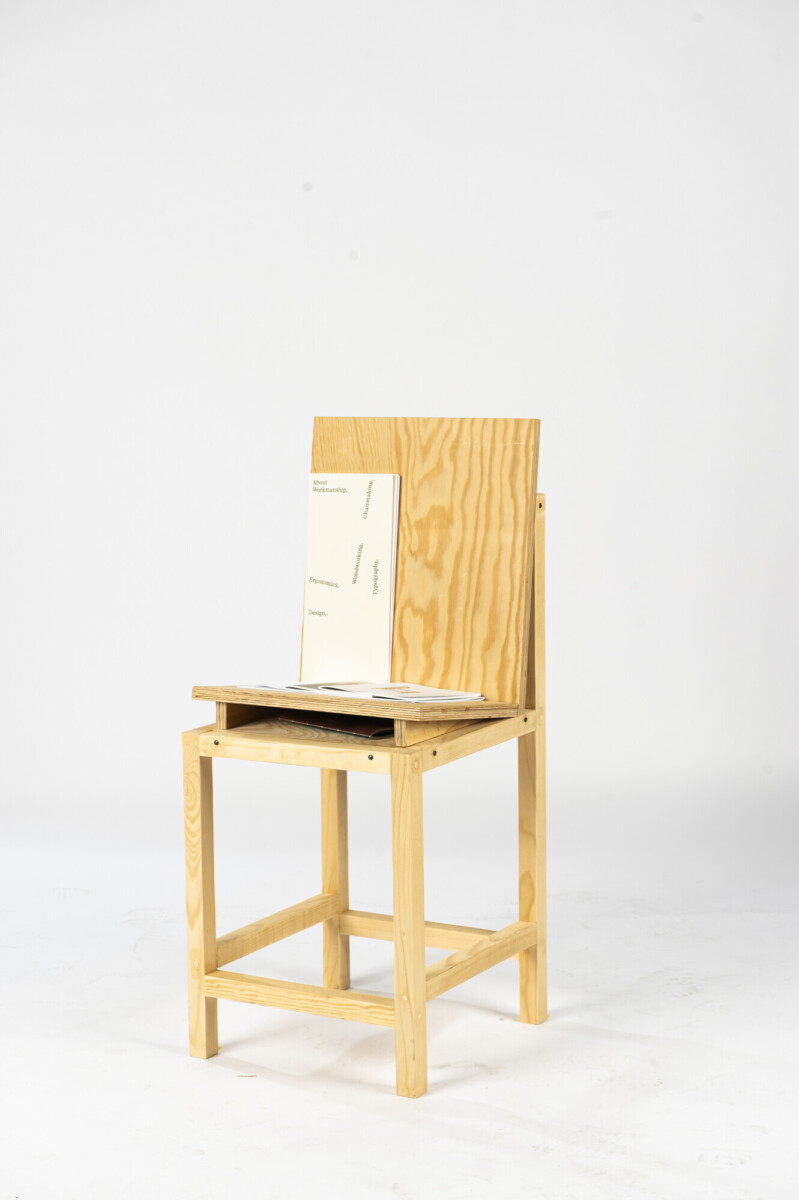
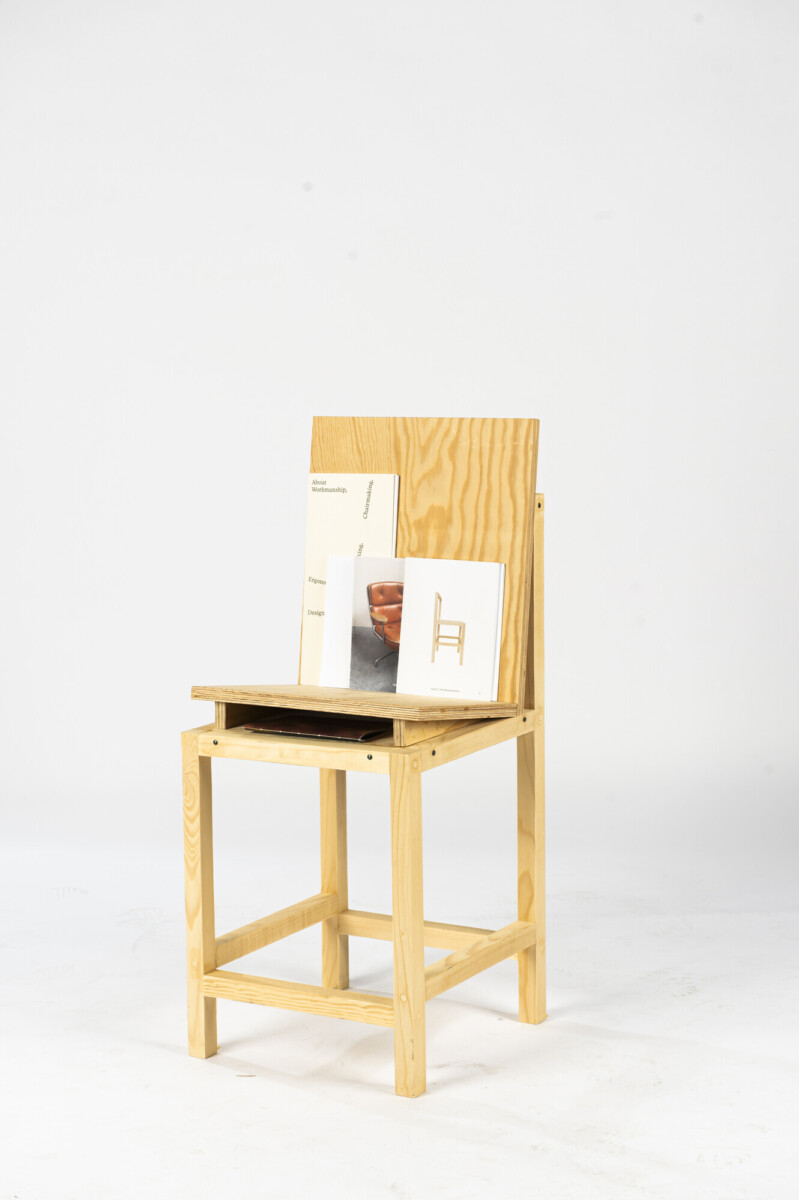
“My chair is a reflection on craftsmanship. How can a small intervention in a basic piece of furniture make a big difference? How does this intervention affect ergonomics, and how does this influence the readability of an accompanying publication?”
Ize De Smet, The Chair: A Chair


“The chair examines itself as an object of existence. Starting from the banality of the chair as an everyday object, the project questions what a chair actually is and how meaning arises through context, use, repetition and observation. Through collecting, classifying and recontextualizing, the chair is approached as more than just an object to sit on; rather, as an archetype that refers to design history, personal memory and everyday life.”
Elvira Houben, Spirit level


“The chair is about balance. With the publications placed under its legs, it remains balanced. Once the publications are used, the chair is thrown off balance. The publications invite you to live more in harmony with nature once again. They make it clear that, as humans, we have drifted too far away from nature and that there is a need to reconnect.”
text: Ronny Duquenne
photos: Sander Van Damme