


Book launch: Tju|ho — Thoughtful Ways of Making and Walking
The British Library, London — 9 October 2025
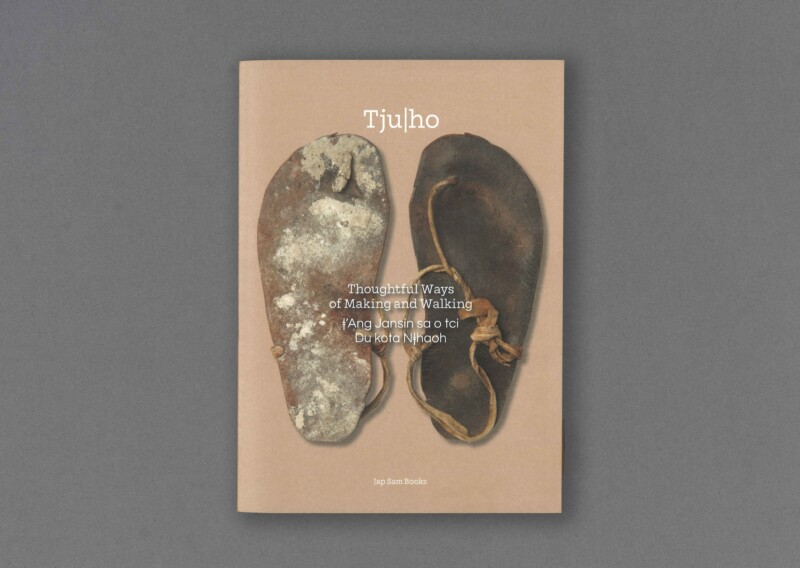
Earlier in October, Tju|ho: Thoughtful Ways of Making and Walking was launched at The British Library in London. The bilingual publication, co-created with the Ju|’hoansi community in Namibia, marks over a decade of collaboration with Indigenous cobblers around the world.
Edited by Catherine Willems, Festus Soroab, and Anca Ușurelu, the book brings together voices from design, anthropology, and education, exploring footwear as a form of knowledge exchange.
The event featured contributions from the editors, Lambros Malafouris, Galahad Clark, Kristiaan D’Août, Darla-Jane Gilroy, moderated by Liz Ciokajlo.
More than a publication, Tju|ho continues a conversation on regenerative collaboration and the living heritage of making and walking.
published by Jap Sam Books
EN / Ju|'hoan, 2025
ISBN 978-94-93329-42-3
 Booklaunch Tju|horesearch presentationAgendaOnderzoek
On 16 September 2026, the Namibian launch of the book Tju|ho - Thoughtful Ways of Making and Walking takes place at the Namibian Arts Association in Windhoek, during Heritage Week.
The launch event will be an opportunity to share stories from the project, together with the shoemakers, and reflect on broader questions around craft, heritage, memory, and regenerative practices of making and walking.
Speakers:
- Kileni Fernando (moderator), Co-founding member of an Indigenous San organization - //Ana-Djeh San Trust
- Catherine Willems, PhD - Design anthropologist and researcher at KASK & Conservatorium (HOGENT, Belgium), where she teaches footwear design and coordinates the Body Plural cluster; also research fellow at the University of Liverpool and head of the Future Footwear Foundation; main editor of Tju|ho.
- Festus Soroab, Head of Nyae Nyae Village Schools in Namibia, supporting Ju|’hoan language and culture, and co-editor of Tju|ho.
- Andreas Muronga, Co-lead of the San-dal project and atelier in Nhoma, Namibia.
- Cislé Jacobs, Legal and cultural policy specialist with a focus on intellectual property and the arts; Executive Manager of the Namibian Arts Association.
 Book launch Tju|horesearch presentationAgendaOnderzoek
Together with the Ju|’hoansi community of Nhoma and Tsumkwe (Namibia), Future Footwear Foundation is happy to announce that the book Tju|ho: Thoughtful Ways of Making and Walking, is ready for world-wide orders and will be launched on 9 October 2025 at The British Library.
The launch will bring together voices from design, anthropology, cognitive archaeology, community building and regenerative practices of knowledge exchange.
With an introduction by Darla-Jane Gilroy and moderated by Liz Ciokajlo, the event brings together voices from education, research, and industry: Festus Soroab (Village Schools, Nyae Nyae Conservancy, Namibia), Anca Usurelu(KASK & Conservatorium, FFF), Galahad Clark (Vivobarefoot), Lambros Malafouris (University of Oxford), Kristiaan D'Août D’Août (University of Liverpool), and Catherine Willems (KASK & Conservatorium, FFF). Looking forward to a lively exchange across disciplines and geographies.
The event is affiliated with the research cluster The Body Plural and The British Library, and co-organised by the Future Footwear Foundation and the Global Footwear Future Coalition.
British Library
96 Euston Road
London, UK
 Disobedient Bodiesresearch presentationAgendaOnderzoek
Three recently completed book projects inspire an evening of reflection. From very different angles these projects look for ways to think and act beyond anthropocentrism. They challenge the idea of the human as a singular, dominant maker of the world, seeking to demonstrate a rich plurality of perspectives instead. How can artists and designers be receptive in their work to the voices of the non-human entities we live among?
Disobedient Bodies marks the first public moment for two newly formed research clusters at KASK & Conservatorium: The Body Plural and Disobedient Practices. Members of both clusters will present their work and engage in dialogue around these themes, inviting new ways of imagining our relationships with the entities around us.
The event will consist of a small exhibition, informal presentations and an in-depth conversation about the areas where the books and the research clusters overlap. The evening will be moderated by curator and researcher Edith Doove.
The following books will be subject of discussion:
- Tju|ho – Thoughtful Ways of Making and Walking
Published by Jap Sam Books, Tju|ho – Thoughtful Ways of Making and Walking is a fully bilingual (English and Ju|’hoan) publication that explores thoughtful design, showing how place and community shape sustainable ways of making and walking.
The book centres on the re-creation of the traditional hunting sandal N!ang N|osi in Nhoma, Namibia, and its true owner, the Eland. Since 2021, the project has evolved through close collaboration with the Ju|’hoan communities of Nhoma and Tsumkwe.
At its heart, Tju|ho is a living process of annotation and re-narration, aimed at showing different ways of perceiving and relating to the environment.
The publication is edited by Catherine Willems, Festus Soroab, Anca Ușurelu, and the Ju|’hoan Transcription Group in Tsumkwe, Namibia. Catherine Willems is affiliated with the research cluster The Body Plural.
- Decentering Design – Practice in a More-than-human World
An invitation to journey beyondhuman-centric thinking and into the more-than-human world. By merging theory with practice, the publication offers strategies, insights, and exercises that cultivate a deeper sensitivity to the interconnected more-than-human community we form with all living beings. With diverse contributions by architects, landscape architects, product- and interaction designers, artists, photographers, philosophers, academics, curators, policy makers and policy officers. Contributions include FormaFantasma, Superflux, Eva Meijer, Clemens Driessen, Mihnea Tanasescu, Dries Segers and Jacopo Leveratto, among others.
This publication is the outcome of a research project by Bert De Roo, Giliam Ganzevles, Mirte van Aalst and Glenn Deliège, and edited and designed by Jurgen Maelfeyt. Published by APE (Art Paper Editions). A new project, Intermediate Zones, by Bert De Roo, Giliam Ganzevles and Jerry Galle Galle is affiliated with the research cluster Disobedient Practices.
- Liberate the Machines!
A personal experience of a dialogue with machines, narrated through the making of the experimental film Mechanisms Common to Disparate Phenomena; #59. Through this narration the book develops a view on how humans can learn from the devices they constructed. The human technical milieu is a collective product, a long-term external memory to which each generation contributes and the design and development of technology is therefore a form of politics. Media archaeology is presented as a method to investigate this collective construction.
By Joost Rekveld, design by Isabelle Vigier. Published by Studio Joost Rekveld and KASK & Conservatorium. Joost Rekveld is affiliated with the research cluster Disobedient Practices.
Lange Steenstraat 14
9000 Gent
start: 20:30
 The first Cobbleration eventresearch presentationAgendaOnderzoek
- COBBLERATION is a playful blend of “cobblers” (shoemakers) and “collaboration.” It is part of a new vocabulary we draw out to describe our practices.
- COBBLERATION is a groundbreaking global movement that unites artisans and researchers to revolutionize footwear production.
- COBBLERATION seeks to combine Indigenous craftsmanship with cutting-edge technology to explore sustainable, healthy, and just alternatives for making and wearing shoes.
Where are we at?
Footwear production has a high carbon footprint (around 700 million metric tons of CO2 annually) and generates waste billions of non-biodegradable shoes discarded yearly, contributing to environmental degradation. With the rise of fast-fashion and mass production, traditional craftsmanship is in steep decline, threatening centuries-old artisanal skills and the livelihoods of craftspeople.
But it doesn't have to be this way.
More than a decade of working with cobblers—through making, walking, and talking—has revealed common threads in traditional footwear practices. Despite their diverse origins, these traditions share a deep understanding of natural materials, an intuitive respect for foot biomechanics, and a view of walking as both a physical act and a meaningful practice. These insights have led to a set of footwear guidelines. And now, for the first time, cobblers from different traditions will come together at !Khwa ttu, the San Heritage Centre in South Africa, to ask some fundamental questions:
How can traditional cobblers shape the future of sustainable footwear?
What collective actions can be taken to ensure both protection and promotion of footwear related heritage?
During a week of collective making, walking and talking, we - the cobblers - hope to reach some possible answers to these questions, and many others that will emerge from our exchanges.
COLLABORATING COMMUNITIES
- San | Namibia/S-Africa
Common Antilope/eland - Saami Sapmi | Inari, Finland
Reindeer hides - Kolhapuri | Atahani, India
Buffalo hides - Diné | Navajo Nation, USA
Buffalo and deer hides - Mongolian | Ulaanbaatar, Mongolia
Sheep wool
This first COBBLERATION event will highlight the San heritage linked to the making and wearing of the eland hunting sandal and connected storytelling. Ju|’hoan cobblers will share their skills in an active N!ang N|osi (traditional hunting sandal) workshop. The first part of the event is closed, being focused on creating space for exchanges between the cobblers through making, walking and talking practices.
 videoLees, kijk, luisterresearchfashion students Project Week with Crip Theory and Wearable Utopias
 newsLees, kijk, luistereducationresearchresearchers Tju|ho, Thoughtful ways of making and walking
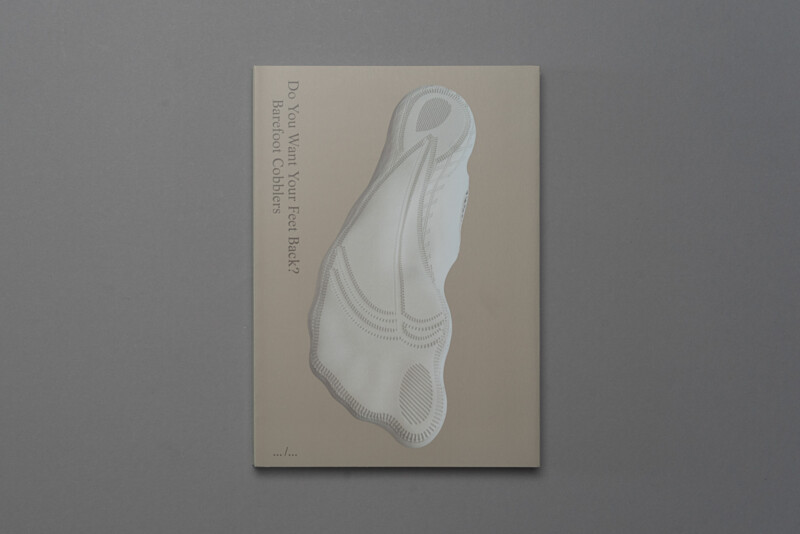
 publicationLees, kijk, luisterresearchresearchers Do You Want Your Feet Back? Barefoot Cobblers
 publicationLees, kijk, luisterresearch