Talking Filthy?
Around the table with Filthy Brunette and co
I look at Filthy Brunette's online profile and see that she hosts exhibitions under the name “artist-run space”. Filthy intrigues me. She seems to me to be an inspiration for students and recent graduates, a mysterious figure for whom anything, if not everything, is possible, a contour drawing yet to be coloured in, a sticker image for everything we want her to be. I would like to get to know her better and asked if a conversation would be possible.
Two weeks later, I am sitting on the first floor of the exhibition space on Bijlokevest. Across the table from me are the four facilitators of Filthy Brunette.
LIENE AERTS
Filthy, could you briefly introduce yourself?
Difficult. Which one of us is going to do that for her?
What started as a name has grown into a character. Almost a mythical figure. She allows it not to be about us. We are not an art space where the initiators take centre stage. It's about the artists and the work that is shown here. Filthy is a kind of lightning rod.
LA
An alter ego?
More like a body that others can relate to. She creates herself. We are still getting to know her ourselves. Anyone who does something here connects with Filthy Brunette – not with any of us personally. She lowers the threshold. People spontaneously start talking about “Filthy” or “the Filthy”. Even the locksmith.
LA
She seems to be constantly in flux. Does she have a fixed look after all?
There is a basis: a black-and-white vectorised image of a woman, a yellow star, that specific “ugly” blue on stickers, logos and Instagram. But in terms of content, nothing is fixed. Anyone who exhibits here becomes Filthy Brunette for a while. There is a lot of freedom. Sometimes she even disappears completely from view.
LA
So it's not her identity that determines the content, but the other way around?
Yes, the content informs her. Antonia, who takes care of the graphic design, always enters into dialogue with the artist: how can Filthy still be present here? How far can she shift towards someone else's practice?


LA
Who does Filthy consist of?
The idea is that anyone can be Filthy.
The facilitators are Zoë Dejonghe (who graduated with a master's degree in fine arts from KASK & Conservatorium and is now studying to become a teacher at LUCA School of Arts), Antonia D'hauwer (master student graphic design), Kevin Vergult (who has a master's degree in fine arts from LUCA School of Arts and is now a free student at Ghent University) and Charlotte Bracke (master student autonomous design).
We are all in a kind of grey area. Just graduated, still studying, searching. And you can feel that in Filthy too: nothing is set in stone yet.
LA
Are you a collective?
We're not really sure ourselves. We don't want to curate, but we do want to treat people and things with care. Whoever does something here decides for themselves what happens. We provide practical support: communication, transport, posters, etc. It's a collaboration.
LA
What does Filthy Brunette stand for?
‘Anything is possible. Do what you want with the room. We'll help.’
A classic painting exhibition? Fine. Wrap the room in aluminium foil for a week? Also fine. We don't have an opinion on the content. Do your thing.
LA
So it's a feeling of freedom, without anything being non-committal?
Freedom does not mean that it should not cost anything. For many artists, this is their first solo presentation. That brings stress. We guide that process. It is a learning experience, for them and for us.
LA
Who is it for?Who shows work at Filthy?
Vaak benaderen mensen ons zelf. We focussen op afstuderenden en pas afgestudeerden. Net op dat moment dat ze waarschijnlijk het meest nood hebben aan een plek en een doel. We horen vaak dat het activerend werkt. Dat iemand eindelijk een deadline heeft, een reden om werk af te maken.
LA
And who do you want to reach as an audience?
We hope to be accessible. But how do you know if you really are accessible? How do you know if a first-year student feels welcome? Right now, it's often our generation – friends of friends. We're thinking about how we can broaden our reach without losing our openness.

LA
How did Filthy come about?
There was room. And enthusiasm. And we often heard people say: “Nothing ever happens in Ghent, we have to go to other cities.” But we didn't want to believe that. Rather, we are the generation that has to do it. We're not going to sit around waiting for someone else to do it for us, we can do it ourselves. That's how the first exhibition came about. The name came later.
LA
So no preconceived plan, just started? You just jumped in?
Indeed, it originated at this table. From conversations. From our different backgrounds: painting, graphic design, autonomous design, social engagement. That difference makes it interesting.
LA
How does Filthy give you the energy to continue? Does it give you the energy to continue? Are you going to continue?
The feedback in particular pushes us forward. Artists who say they felt supported. Visitors who find the place welcoming. That's why we do it: to provide a platform for people who need a place.
For us, Filthy functions as a simple gesture, an invitation: set something up, in your room, your bedroom, your boiler room.
LA
But it's also exciting?
Very. We are nervous before every opening. We are not extroverts. Hosting, inviting, talking — it's still scary.
Perhaps that's the interaction: Filthy also forces us to step out of our comfort zone.
LA
What are the biggest challenges? What does Filthy struggle with?
Structure.
Organising an exhibition every month is a lot. We're looking for a system that is both open and clear. We're thinking of an open call, so we can plan for the longer term and reach people we don't know yet, to be surprised.
But even then: we don't curate, so to speak, and yet you make choices together. How do you avoid exclusion? Who are we to say that something is not allowed?
Practically speaking, a lot has to be coordinated, schedules and communication. That's why there are four of us. If someone is feeling low on energy, someone else picks up the slack.


LA
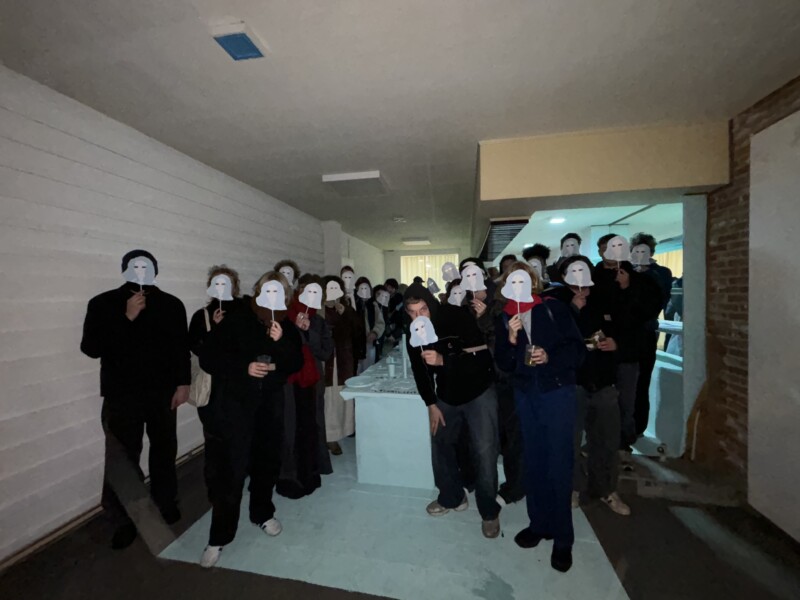
Charlotte and Zoë, you organised the performance/exhibition There's no party without Filthy together. What did that moment mean?
It was only the second project. We wanted to introduce her as a character. A secret birthday party for her, but in the end she couldn't be there herself...
Everyone got masks. Everyone became Filthy. We did too. Everything was recreated in blue paper: masks, party poppers, drinks, biscuits. Two weeks of preparation for a short, explosive moment. It was a search for what she means to us. In the end, it became an absurd group event.
Even afterwards, without people, the installation continued to live on. With all the lights on, a full blue shop window. An intense image — that's Filthy. That's the energy we're looking for.
LA
What does she dream of?
Again, more structure, without losing the openness. We want to continue to facilitate, but also not cross our boundaries. Filthy has become bigger than we thought. And sometimes it's difficult to keep enough distance from her.
What we like to do is do things together and respond to shared interests such as staging and playing with room in an absurd way. That's how we want to lure Filthy out of her shell even more often. The same goes for the artists: we hereby invite them to approach us with a request to collaborate.
Can you feel her? Would you like to be her for a moment? Embrace her? Do you dare?
LA
Finally: what could be a slogan or baseline for Filthy Brunette?
#STAYFILTHY