The erasure of class from contemporary cultural discourse has led to increasing difficulty in discussing artistic production and consumption's material and social conditions. This project will create an understanding of what it means to be a working-class artist working with moving images. By linking the historical experience of working-class artists to those working today, the project will develop a language for working-class artists to articulate their experiences around both material and immaterial challenges within the field of cultural production. Through archival research and conversations with filmmakers with working-class backgrounds, the research will explore the role of class within filmmaking, remaining intersectional with other theories of identity, such as race, gender, and sexuality. Further, this research examines the class barriers within art education, offering students and teachers a developed understanding of class issues.
in focus
08.10.26 – 18.10.26, Jean-Luc Godard, Kunstenbibliotheekexporesearch presentationAgendaArtistic activitiesOnderzoek
Whilst working on his final major project, Livre d’image, Godard decided that the ideal place and way to watch this film was in his own studio. It is now possible to visit his workplace, albeit relocated to Milan at the Fondazione Prada. Even after his death, the film itself continues to tour and be screened as an installation. To evoke the atmosphere of the studio, the screening space is scented with cigars from his favourite brand.
In the Zwarte Zaal, Fabrice Aragno presents Sentiments, Signes, Passions, a dynamic projection of Jean-Luc Godard’s final film Le livre d’image (2018). Out of deep respect for his mentor, Aragno travels the world, each time presenting a different version of the installation. This time, he captures Godard’s personal workspace: Et la nuit le jour. This can be seen in the cellarium of the Kunstenbibliotheek.
Godshuizenlaan 2A
9000 Gent
Thu 09:00 – 20:00
Fri 09:00 – 16:00
 Jacob Kirkegaardconcertresearch presentationAgendaArtistic activities
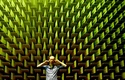
The work of Jacob Kirkegaard explores ways to reflect on complex, unnoticed or unapproachable conditions and environments. His works have treated themes such as radioactivity in Chernobyl, melting ice in the Arctic, border walls in global and metaphorical contexts, immersive acoustic explorations into global waste management, and processes related to when a human being dies. Using his recordings of firearms, grenades and tanks his recent work explores the sound of warfare orchestrated for the Royal Lifeguard's Music Corps. Another recent work unfolds the mechanical elements of agriculture and food production. Since 2006 Kirkegaard has also been extensively researching, recording and creating works using otoacoustic emissions; tones generated from the actual human ear. The core element and method of Jacob Kirkegaard's work derive from the use of sound recordings of the tangible aspects from its intangible themes.
On the morning of 28 October, Jacob Kirkegaard will also lead an otoacoustic workshop at the media arts programme of KASK & Conservatorium.
 Melting into the backgroundresearch presentationAgendaOnderzoek
“We force our stories on a world that doesn’t fit them,” wrote the environmental historian William Cronon in 1992.
Now that we are becoming increasingly aware of the intermingling of human and non-human worlds, influenced by phenomena such as global warming, artificial intelligence, microplastics and pandemics, the question arises as to who or what should populate our stories.
What is narrative realism today? And what is gradually, albeit unintentionally, becoming the realm of fantasy?
Over two days, in and around the Cirque, the 19th-century anatomical theatre on the campus of KASK & Conservatorium, stories will be told, performances staged, and lectures and workshops held. Be inspired by unexpected narrative perspectives, territorial and apocalyptic tales, micro- and macro-scaled stories, full of creatures who behave in ways entirely different from those of us who identify as humans.
With contributions by Amsterdam Poet’s Theatre (Artun Alaska Arasli & Joachim Robbrecht) feat. Gudrun Moreau, Lars Bernakiewicz, Liliane Campos, Marco Caracciolo, Decentering Design (Jo Boonen, Pippa Dekinder, Glenn Deliège, Bert De Roo & Giliam Ganzevles), Anne Dekeyser, Lisa Doeland, Carolin Gieszner, Sébastien Hendrickx, Toine Horvers, MM (Marcus Bergner & Myriam Van Imschoot), Nitzan Shafran, Benedikte Zitouni, a.o.
Curated by Sébastien Hendrickx.
Cloquet
Louis Pasteurlaan 2
9000 Gent
Accessible for wheelchair users.
English spoken.