
22.01.26 – 01.02.26, #187 Luka Van der Putten, AAN/UIT
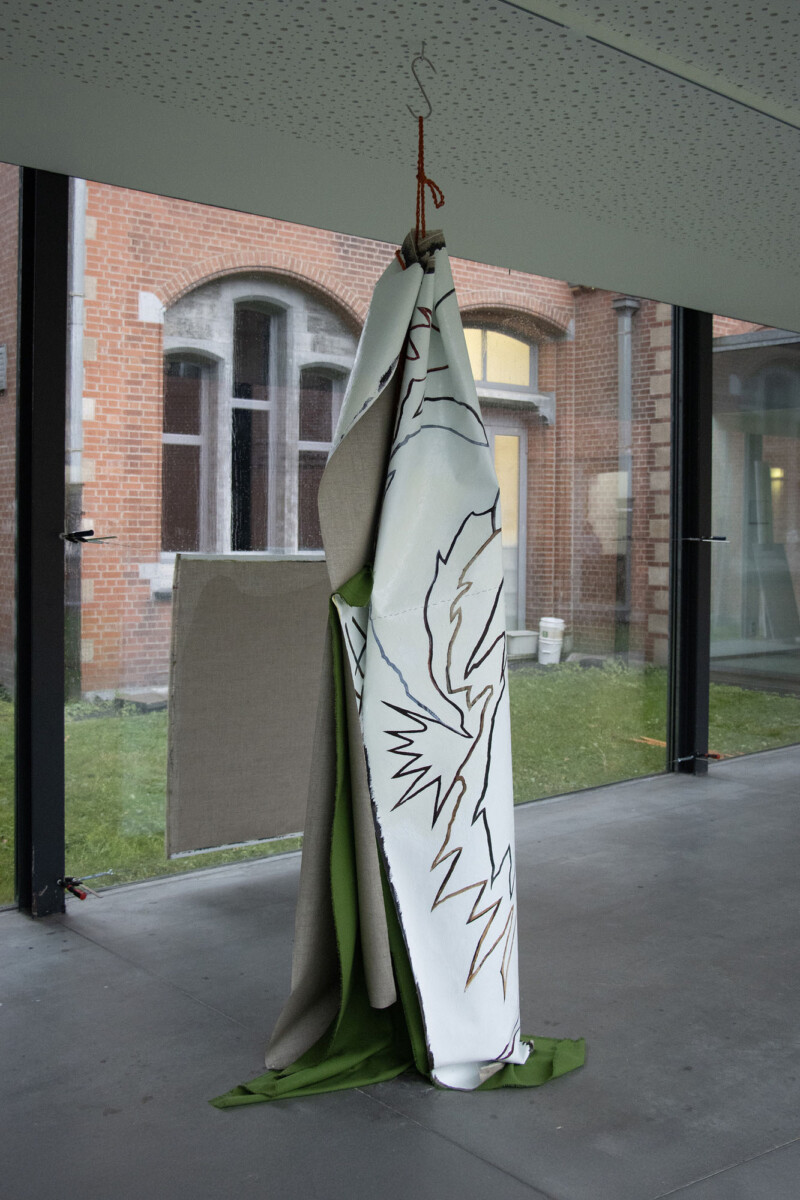
Voor er nog maar sprake is van een schilderij, is er het object.
Deze objecten zijn vaak strak, een beetje afgeleefd en industrieel van aard.
Ik vind ze op straat, in afvalcontainers of ik krijg ze.
Ik verzamel ze en gebruik ze om een stilleven mee te bouwen, vanuit dit stilleven start ik dan met schilderen.
In deze MAP probeer ik hun aanwezigheid in mijn praktijk verder te onderzoeken door te kijken naar wat er gebeurt als ik mijn stillevens op zichzelf tentoonstel, in mijn schilderijen te spelen met hun aanwezig- en afwezigheid alsof ze ingeschakeld zijn of juist uitgevallen, door zelfgemaakte objecten te laten zien en te kijken wat er gebeurt wanneer dit samenkomt.
Marissal
Louis Pasteurlaan 2
9000 Gent
Mon-Thu: 08:00 – 22:00
Fri: 08:00 – 18:00
Sat-Sun: 12:00 – 18:00
 presentationLees, kijk, luistereducationstudents fine arts loose ends: meeting, meandering, wandering
 articleLees, kijk, luistereducationstudenten grafisch ontwerp To un-fold
 presentationLees, kijk, luistereducationartistic activities Inside Conversations
 articleLees, kijk, luistereducationartistic activities MAP#127: Emma Onghena & Kas Wellens, Blikveld
 articleLees, kijk, luistereducationartistic activities MAP#128: Anna Schlooz & Paula Vicente, Intra-action
 articleLees, kijk, luistereducationartistic activities MAP#130: Teodora Oita & Kei Sendak, I cannot translate, I cannot send either
 articleLees, kijk, luistereducationartistic activities MAP#134: George Chinnery & Reza Yavari
 articleLees, kijk, luistereducationartistic activities
 #197 Matts Nauwelaers, Masterprojecten (MAP)expoAgendaArtistic activities
‘Fabricate Nature’ is an exploration of the way in which we, as human beings, relate to a natural world that is becoming increasingly distorted, yet on which we have simultaneously come to depend to a great extent. This alienation is visible everywhere. The forests we walk through are often man-made and consist of monocultures that take their toll on flora and fauna. The food on shop shelves contains ingredients whose names we can barely read or understand. The landscape around us, too, is increasingly defined by a mechanical, man-made environment. It is precisely this alienation that Matts Nauwelaers seeks to portray in his exhibition. ‘Fabricate Nature’ explores the boundary between the natural and the man-made, and asks how we relate today to a natural world that is increasingly being shaped, adapted and replaced by our own hands.
Marissal
Louis Pasteurlaan 2
9000 Gent
Mon-Thu: 08:00 – 22:00
Fri: 08:00 – 18:00
Sat-Sun: 12:00 – 18:00
 #196 Mo Paeleman, Masterprojecten (MAP)expoAgendaArtistic activities
Beste Jack,
We kennen elkaar niet. Dit is een uitnodiging. Een instructieboekje. Zo een die je tegenkomt bij je nieuwe aangekochte monopolydoos. Iets wat je niet opent omdat je allang de spelregels, of je eigen versie kent. Beste Jack, ik vraag: wil jij met mij dit spel spelen?
Het spel van het onwetende, van vrijheid en van ontdekking.
Ik speel niet graag alleen. Lees jij de instructies?
Dus Jack, wat is spel voor jou? Speel jij wel volgens de spelregels? Of ga je mee met mij de spelregels overtreden. Dan kunnen we op het einde samen onze onverdiende overwinning vieren. Je moet wel weten, wie graag de regels breekt, botst natuurlijk wel op muren, want valspelers worden uiteindelijk altijd uitgesloten.
Groetjes
Marissal
Louis Pasteurlaan 2
9000 Gent
Mon-Thu: 08:00 – 22:00
Fri: 08:00 – 18:00
Sat-Sun: 12:00 – 18:00
 #195 Kyra Voordeckers, Masterprojecten (MAP)expoAgendaArtistic activities
Curated by Nora Franco
A scenography of memories
This place refers to a space beyond itself
A space that no longer exists as it once did
This is how I remember it
At least, I think it is
This is a desperate attempt to hold on
Onto something temporary
keep writing
keep drawing
And above all, to keep dreaming
Of how everything once looked
Until I can no longer distinguish
What is still real
And what I have imagined
But does that still matter?
A memory is temporary. They fade, they deform and eventually, they disappear. We cannot perceive or recall time as merely a physical dimension, but only through its traces, places, images, and events.
We remember through space, especially through the intimacy of the house. To remember is to dream; to dream is to create memory. In trying to translate this, we encounter limits. Walls, details, and sharpness cannot contain the multidimensionality of memory. Incompleteness and fragmentation hold a suggestive, emotional power. They force us toward memory and imagination. Shadows, as reductions, leave space to complete what is missing.
Within this, I question textile as a material for scenography. Rather than filling space, I explore how it can expand through shadow, transparency, and reflection, existing beyond its physical form.
As a costly and temporary medium, textile calls for adaptability rather than fixed, site-specific design. Atmosphere emerges not from covering a space, but from engaging with it, working in relation to what is already there.
In this project, scenography is simply a space that refers to a place outside itself. It does so without imitating it, without creating an exact copy. The opportunity to fantasize is stronger than the realistic image.
Marissal
Louis Pasteurlaan 2
9000 Gent
Mon-Thu: 08:00 – 22:00
Fri: 08:00 – 18:00
Sat-Sun: 12:00 – 18:00
 #194 Louis Locus, Jonas Van Geel, Masterprojecten (MAP)expoAgendaArtistic activities
Marissal
Louis Pasteurlaan 2
9000 Gent
Mon-Thu: 08:00 – 22:00
Fri: 08:00 – 18:00
Sat-Sun: 12:00 – 18:00
 #192 Rosa Lut, Masterprojecten (MAP)expoAgendaArtistic activities
‘Have you ever heard a nightingale scream?’, tells the story of Philomela, one of the many women in Greek mythology whose voice has been silenced. Through audio works, Anne Rosa Lut explores how women, just like songbirds, have altered their voice in order to be heard within a patriarchal society filled with noise.
Thu: 09:00-20:00
Fri: 09:00-16:00
 #193 Margaux De Pauw, Charlotte Bracke, Masterprojecten (MAP)expoAgendaArtistic activities
RANDVOORWAARDE is a collaboration between Margaux De Pauw and Charlotte Bracke.
Together, they explore the role of fire extinguishers within an exhibition space and how they can relate to paintings without being perceived as a distraction. Rather than ignoring the fire extinguisher, Charlotte aims to draw attention to it. We are all familiar with the accompanying pictograms, but they often disappear from view until danger threatens.
In this exhibition, they bring the fire extinguisher, pictogram and painting together. What is normally ignored becomes a playful interaction here. For perhaps the fire extinguisher is the most successful object in the art world: it hangs in every museum.
In Margaux’s paintings, spatiality plays a central role. The works function as tools for spatial thinking: they create a field in which depth is simultaneously suggested and counteracted. It is a process of constant reformulation. It is precisely in this that Margaux and Charlotte find common ground: in reformulating reality, in seeking depth in places where it does not seem to be found at first glance.Marissal
Louis Pasteurlaan 2
9000 Gent
Mon-Thu: 08:00 – 22:00
Fri: 08:00 – 18:00
Sat-Sun: 12:00 – 18:00
 #191 Lotte Vanpuyvelde, Riet Van Lysebettens, Masterprojecten (MAP)expoAgendaArtistic activities
Frilly Blouse Syndrome takes its cue from Linda Nochlin’s essay Why Have There Been No Great Women Artists? (1971), and examines the representation and visibility of women within art history.
Taking Rosa Bonheur as a starting point, we encounter a 19th-century female artist who did not so much find her place as take it — and then simply stayed there.
Marissal
Louis Pasteurlaan 2
9000 Gent
Mon-Thu: 08:00 – 22:00
Fri: 08:00 – 18:00
Sat-Sun: 12:00 – 18:00
 #189 Lâle Lootens, Masterprojecten (MAP), Het PaviljoenexpoAgendaArtistic activities
In een ademende, veranderlijke ruimte raakt Washing The Soul aan een innerlijke verschuiving, een beweging van loslaten en terugkeren. In die omwenteling wordt het zelf zachter, ontvankelijk voor wat het overstijgt. Wat hier resoneert, is een stille toenadering tot het onnoembare.
Louis Pasteurlaan 2
9000 Gent
Mon-Thu: 08:00 – 22:00
Fri: 08:00 – 18:00
Sat-Sun: 12:00 – 18:00
Marissal
Louis Pasteurlaan 2
9000 Gent
Fri: 08:00 – 18:00
Sat-Sun: 12:00 – 18:00
 #188 Alyssia Reale, Lenie Van Asten, Masterprojecten (MAP)expoAgendaArtistic activities
Dit project brengt het werk van twee beeldhouwers samen. Lenie creëert witte, humoristische mengwezens: combinaties van verschillende levende wezens die samen een nieuw, eigen universum vormen.
Alyssia Reale vertrekt vanuit alledaagse consumptieobjecten, vaak speelgoed, en onderzoekt hoe hun betekenis vervaagt door tijd, gebruik en herinnering. Met felle kleuren en speelse vormen balanceert haar werk tussen herkenbaarheid en abstractie.
Rippelstippel fungeert als verbindend element in de ruimte en versterkt de samenhorigheid tussen beide oeuvres. Het sobere kleurgebruik van Lenie vormt een spannend contrast met Alyssia’s opvallende kleuren, waardoor hun werken elkaar aanvullen en versterken.
Marissal
Louis Pasteurlaan 2
9000 Gent
Mon-Thu: 08:00 – 22:00
Fri: 08:00 – 18:00
Sat-Sun: 12:00 – 18:00
 #186 Arne Verschaeren & Eva De Vilder, Masterprojecten (MAP)expoAgendaArtistic activities
White picket fence: a typical family, a typical house, typical actions. What happens if these typicality’s were broken or forgotten?
Two unlikely image-worlds are brought together: the staged American nuclear-test families and the simplified domestic scenes found in children’s drawings. Both operate as fictions – idealized models of family life rehearsed rather than lived.Within the fragile structure of the cardboard house, fragments of this script unfold. These are not moments of intimacy, but the residue of gestures remembered from elsewhere.What follows is not collapse, nor the emergence of a new narrative. Bodies keep rehearsing, as if repetition alone might hold the fiction together.
Marissal
Louis Pasteurlaan 2
9000 Gent
Mon-Thu: 08:00 – 22:00
Fri: 08:00 – 18:00
Sat-Sun: 12:00 – 18:00