Masterclass Spinvis
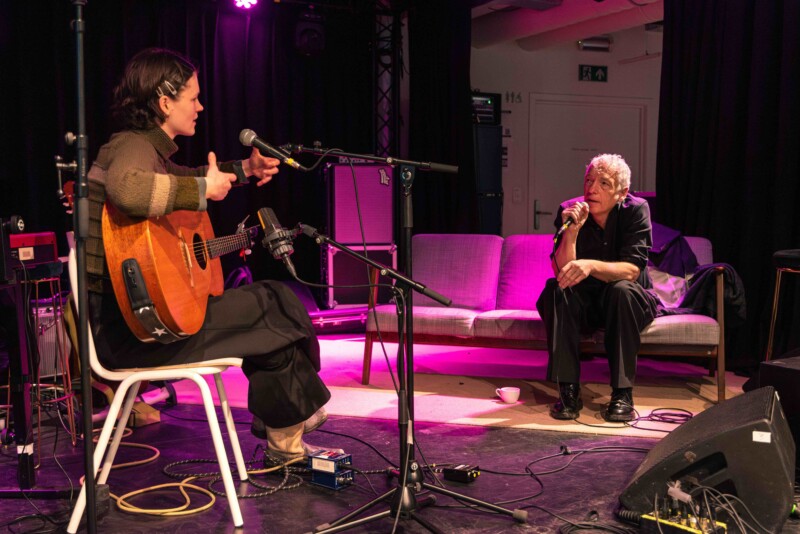
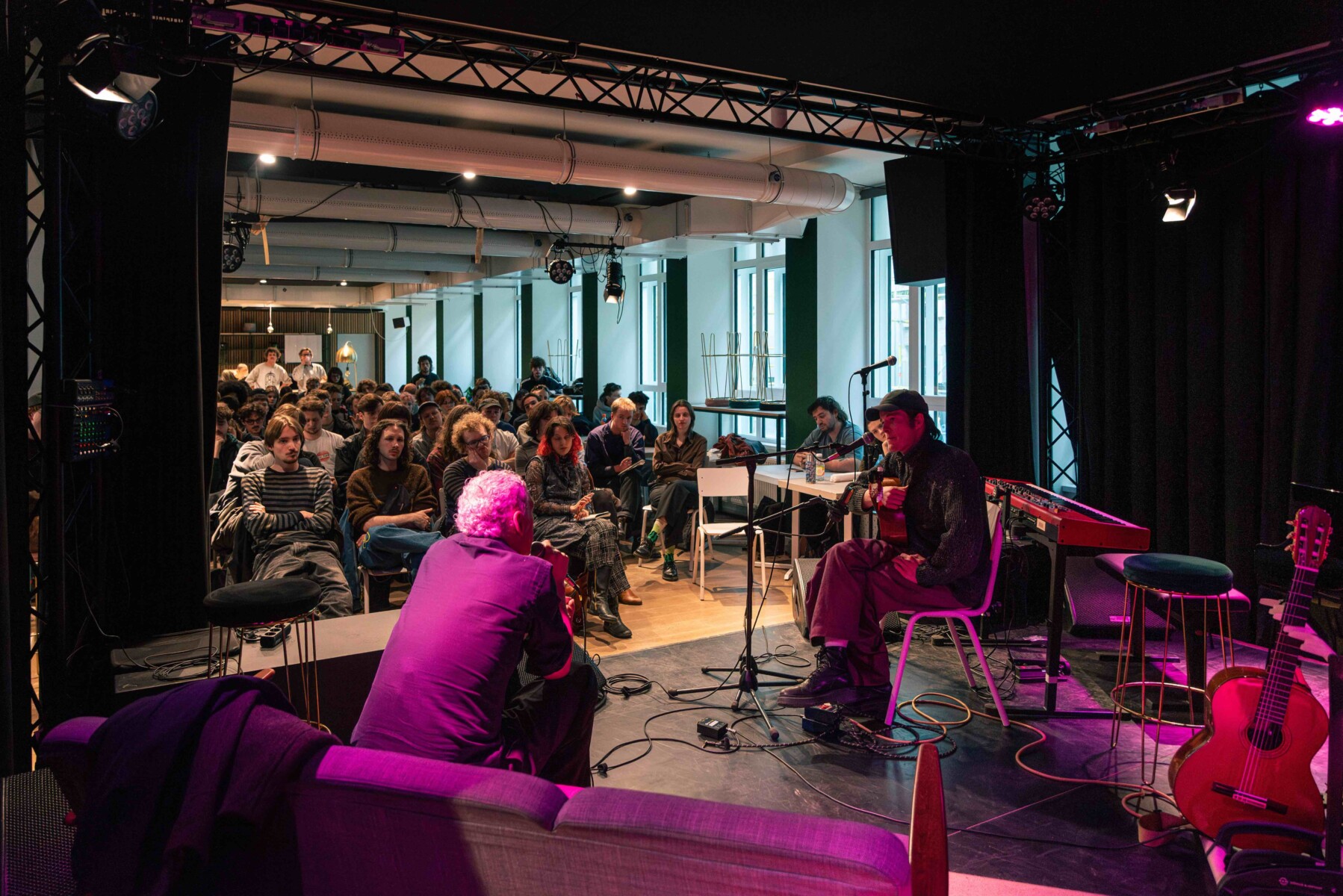
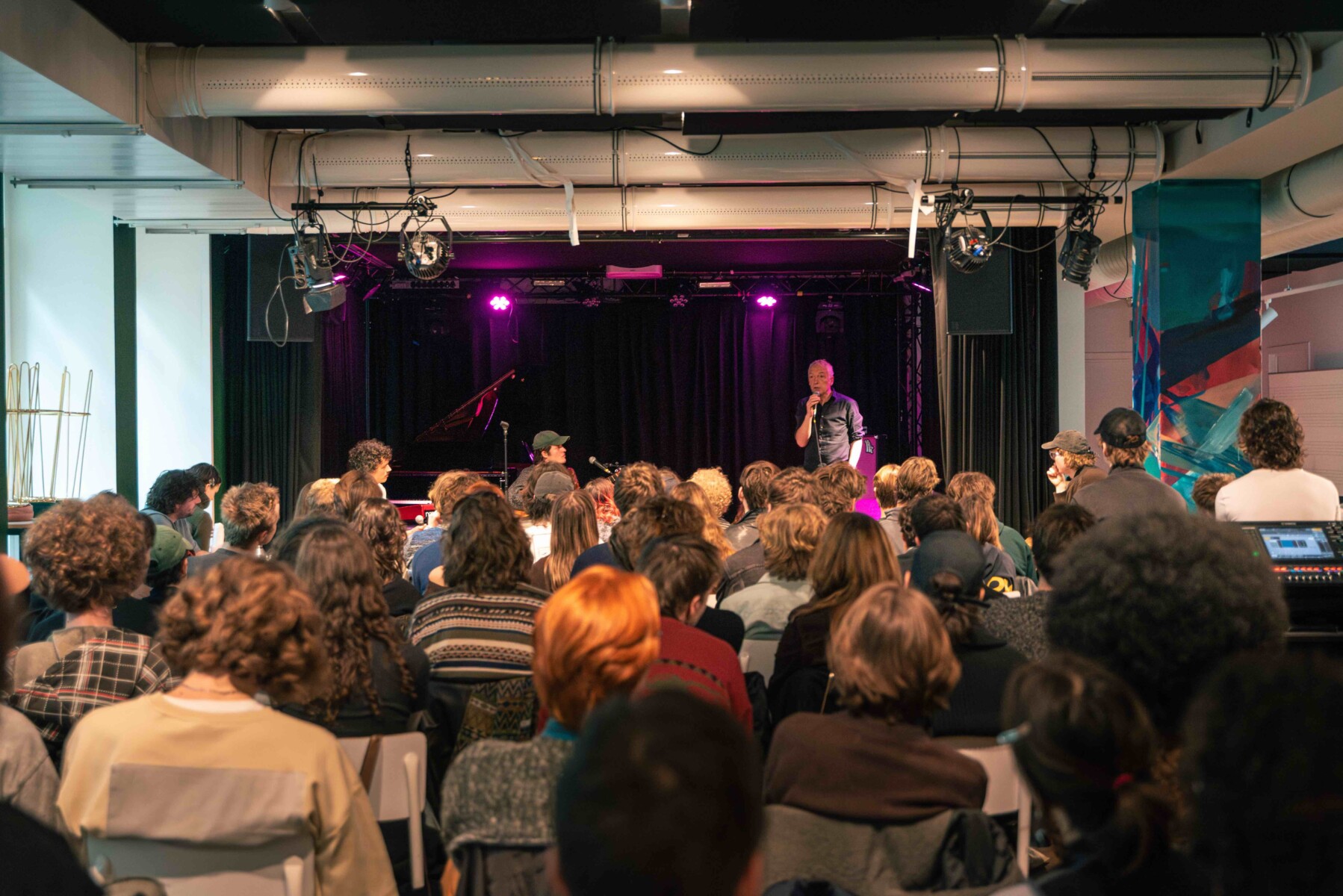
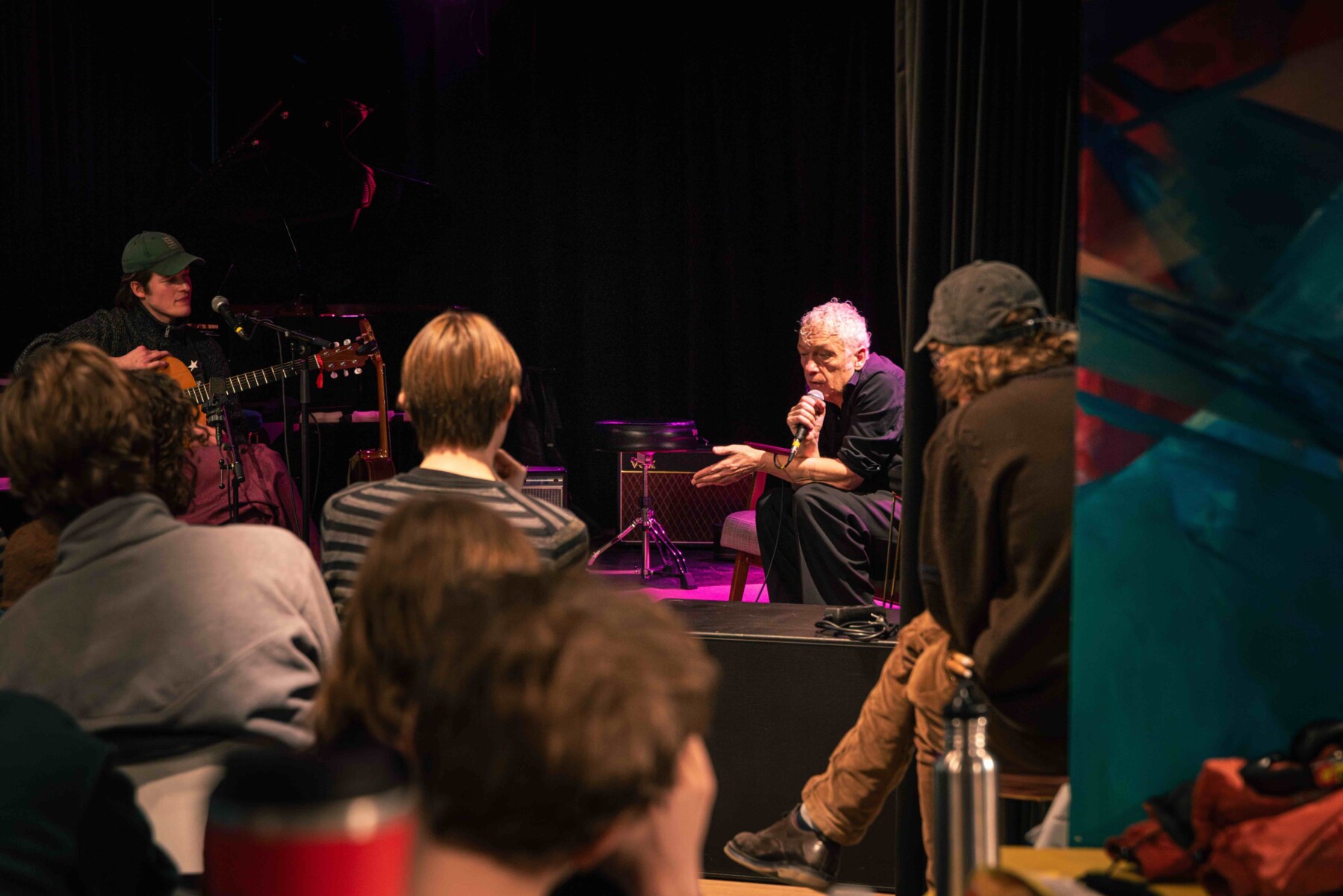
Coffee in hand, lounging on the sofa as if he’s always been there. This is how we find Erik De Jong, better known as Spinvis, one of the most distinctive voices in Dutch-language pop music. At the age of 41, he released his debut album, cobbled together in his attic using toy sounds and saucepan lids. With poetic lyrics about people on the fringes of society, he cuts and shifts until the puzzle fits. Today he’s doing just that at Club Telex, alongside students of jazz, pop and music production. They play their songs, solo and undiluted. He listens and admires, talking to them about what works, what clashes and why you sometimes only realise later that it was actually already perfect. A sample of the conversation.
You sing in Dutch – why did you choose to do that, and have you ever considered writing lyrics in English?
The distance to English is interesting for creating different versions of yourself. In another language, you think differently, you phrase things differently, you behave differently. And in English, the stress is often right at the end of the sentence, which sounds good. In Dutch, that’s not quite the case, so you have to really rack your brains. It’s a challenge, but if you succeed, you spark interest and draw people in, into your music. Even within Dutch, there are differences. In Belgium, there’s a culture of surrealism; it’s more readily accepted, as you see in fashion and comic books, for example. In the Netherlands, you often have to explain what it’s about, what exactly you mean and how it all fits together.
How do you connect with your audience during performances?
As a musician, you contribute one half, and the audience the other. If you radiate a sense of confidence, you put everyone at ease, and only then can you create a new kind of experience together. And if you’re in love with your music yourself, you can pass that passion on to your audience. Pop music is a sort of party game you play with a billion people. That’s why I write my music with the ordinary person on the street in mind. Actually, I’m a folk singer, but the people don’t know that yet (laughs).
How do you come to terms with what you’ve created? When is something finished?
Never (laughs). When you listen to your own music, you hear the difference between what you wanted it to be and what it actually turned out to be. Only you, as the creator, can hear that. People who listen to your songs with ‘fresh ears’ only hear what it ultimately turned out to be. Sometimes I wish I could rediscover my own songs that way. And often you only really understand what it’s about once a track has been recorded and mixed. It’s like taking a Polaroid photo: you only see what’s on it once it slowly develops.
Incidentally, what you feel ashamed of is often what people appreciate most. They admire the fact that you have the courage to embrace it. What you have to offer in return is a sacrifice you make. Perhaps you’re not happy with the sound of your voice or not entirely satisfied with your lyrics. Instinctively, you want to hide it, cut it out or change it, but choosing not to do so is what makes your music unique.
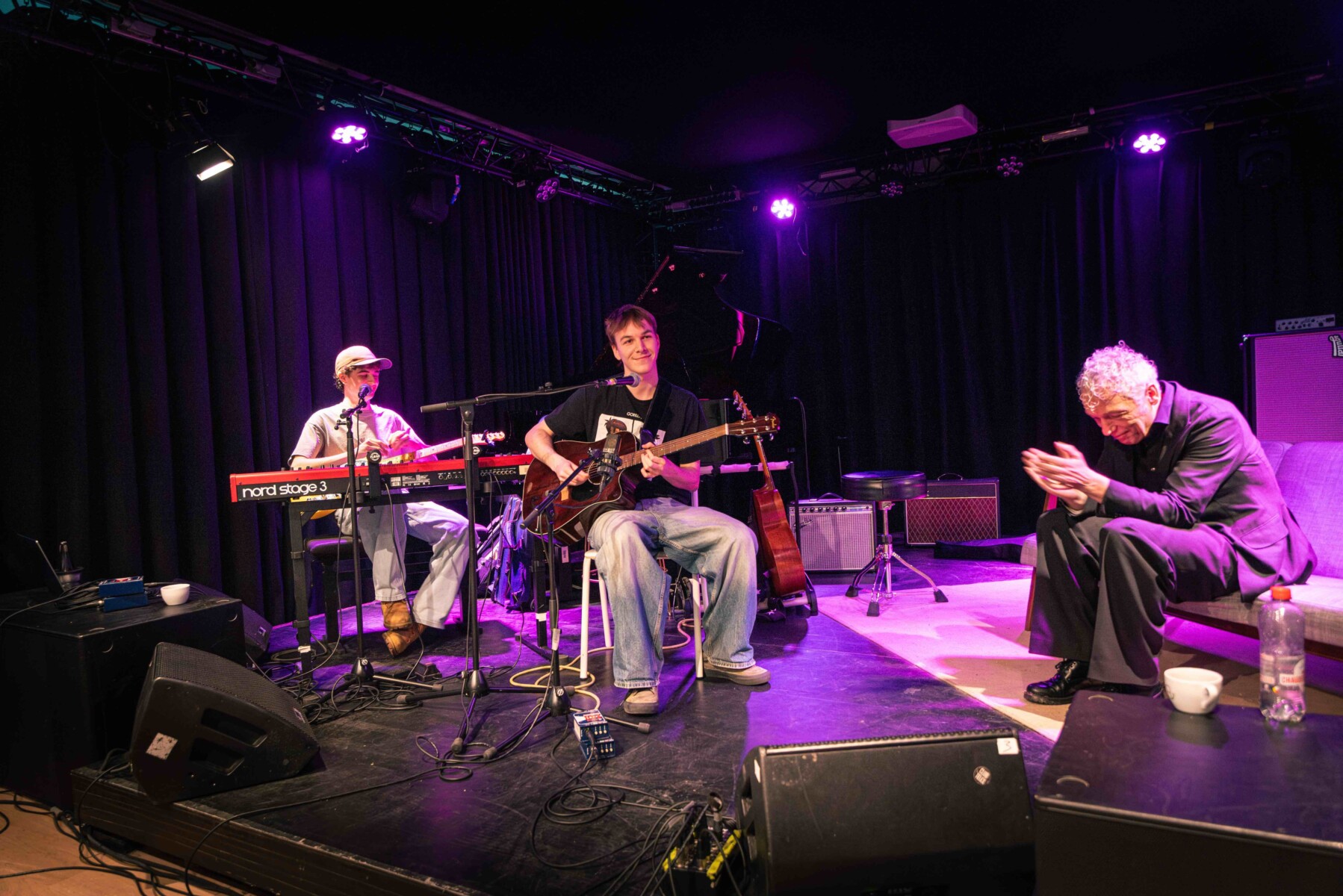
What would you say if you met yourself 24 years ago, on the eve of your debut?
You only break through once. Once you become well-known, you inevitably lose a certain recklessness. Suddenly, there’s a kind of weight attached to everything you do. You do continue to develop, but you’re not sure whether what you’re creating is actually getting any better. And it can sometimes be difficult to experiment with it unnoticed. What’s more, a sort of snobbery creeps in if you’re not careful. Don’t let yourself be held back by ‘good taste’, whatever that may be. Everything is useful. Leave that ‘good taste’ to others and, above all, remain an admirer of beautiful songs yourself. That’s what it’s all about in the end.
 Elis Floreen, mountaintide, Club TelexconcertAgendaArtistic activities
Elis Floreen
Self-proclaimed worst nightmare of hairdressers; hates recording vocals in jeans; dreams of a dog and a dishwasher – and of Cate Blanchett kidnapping her and falling in love with her. Instrumentalist, arranger and producer, inspired by Liszt and Chopin, her lyrics draw from literature, folklore, travel, imagination, symbolism and personal experiences.
mountaintide
mountaintide’s music blends ambient textures with jazz into immersive soundscapes – at times a sharp, captivating wall of sound, at others a swelling wave of evolving emotion that gently flows into a calm, meandering stream. At its core is the expression and sharing of emotion through music. With a focus on lyrical themes, the blurred boundary between composition and improvisation, and the storytelling power of instrumental sounds, mountaintide invites listeners into a deeply moving musical experience.
Paddenhoek 12
9000 Gent
20:00, mountaintide
21:30, Elis Floreen
 Elijah Fox, Club TelexmasterclassAgendaArtistic activities
Only for students / teachers at KASK & Conservatorium and MUDA, student ID required
Multi-instrumentalist, singer, producer, and pianist based in Los Angeles, Elijah Fox grew up in Durham, North Carolina, where he began playing piano at age 11 and was mentored by jazz pianist Yusuf Salim (who had worked with Charlie Parker). Fox studied piano at Oberlin Conservatory of Music under teachers including Sullivan Fortner, Billy Hart, Dan Wall, and Gary Bartz, graduating in 2017 before moving to New York City and later settling in LA.
His distinctive sound blends jazz, impressionism, and psychedelic soul. His piano composition “East Village” was sampled by Drake and 21 Savage on “Major Distribution,” which peaked at No. 3 on the Billboard Hot 100. His track “Wyoming” went viral on TikTok and has amassed tens of millions of streams. Fox has recorded and produced for artists including SZA, Childish Gambino, Masego, ScHoolboy Q, Denzel Curry, Kali Uchis, J. Cole, and others. He serves as the touring keyboardist for UK drummer Yussef Dayes and has performed sold-out shows across the US and Europe. He also releases instrumental music under the alias Søren Søstrom and is signed to Universal Music Publishing Group.
His original piano works (including albums such as City in the Sky, Wyoming, and Hydra) and production credits have established him as a leading voice in contemporary impressionistic and modern jazz-influenced music.
Paddenhoek 12
9000 Gent
 Ilyas & Stan invite, Club TelexconcertAgendaArtistic activities
Ilyas (Bylemans) & Stan (Gonzalez) invite: open mix'd Telex jam. Opened by Stan Gonzalez (guitar), Kasper Snellebrand (Bass), Manuel Laman (drums), Wolf Deruyter (keys) & Simon Cupyers (sax). After that - the stage is yours, don't forget your instrument!
 Douglas Firs, Sæge, Club TelexconcertAgendaArtistic activities
★★★★★ “Five stars. Effortless” – Humo
★★★★ “Douglas Firs parries pain with beauty.” – De Standaard
“I like this… Instantly.” — Noel Gallagher
After a successful full-band tour, Gertjan Van Hellemont (Douglas Firs) is changing course and presenting his body of work the way it was originally written: solo, stripped-down and intimate. Rediscover his songs about the difficult crossroads of life, sorrow and joy, and what binds us — from the highly praised albums Happy Pt. 2 and Heart of a Mother, Shimmer & Glow, How Can You Know and Hannah. “Music with heart and humour,” someone wrote. And that may sum it up best of all: sorrow and joy as two sides of the same coin.
Support: Sæge
Experiences and reflections from singer-songwriter Cedric Haeck (Sæge). The songs form a time capsule, where every new version can be another door. Cedric loves organic, almost tangible sounds and prefers to pluck a sensitive string. Where a person meets themselves and the confrontation sometimes peaks, connection and softness are of the highest importance. Sæge is the process, music is the catalyst, and the human being is the conductor.
For fans of: Beth Gibbons, Annahstasia, Ben Howard, Frazey Ford, Norah Jones, Melody Gardot, Agnes Obel, Trixie Whitley, Lianne La Havas, Thomas Dybdahl…
Sæge, 20:00
Douglas Firs, 21:30
 Eric McPherson, Club TelexmasterclassAgendaArtistic activities
A native of New York, Eric McPherson came to prominence apprenticing with legendary saxophonist and educator, Jackie Mclean, and innovative pianist and composer Andrew Hill. Those foundational experiences cultivated Eric into one of the leading drummers in contemporary creative music. Eric continues the legacy of the musical giants who came before him. As well as performing and teaching internationally with an array of today’s leading contemporary creative musicians, Eric teaches privately and at the University of Hartford’s, Jackie Mclean institute. In addition to his touring and recording with Jackie McLean, Eric has performed with a wide range of major jazz figures, including Pharaoh Sanders, Andrew Hill, Richard Davies, Claudia Acuña, Jason Moran, Greg Osby and Avishai Cohen.
Paddenhoek 12
9000 Gent
 Roni Ben-Hur & Katrien Van Opstal, Club TelexconcertAgendaArtistic activities
Flowing grooves, timeless melodies, and an intimate jazz atmosphere come together in a special performance featuring renowned New York jazz guitarist Roni Ben-Hur and the captivating voice of Katrien Van Opstal. Blending beloved standards with original compositions, they create a warm and expressive musical journey, joined by bassist Joshua Dellaert and drummer Toon Van Dionant.
Let yourself be carried away by their musical dialogue—elegant, soulful, and deeply engaging.
Free entry. Doors open at 19:30, concert starts at 20:00.
Paddenhoek 12
9000 Gent
 Eoghan Ó Ceannabháin, Club Telex, KASKcinemaconcertAgendaArtistic activities
To give the screening of Celtic Utopia at KASKCinema an extra musical touch, we’re bringing Eoghan Ó Ceannabháin to Ghent. Eoghan is a folk artist and political activist whose songs—full of both heartache and joy—have won over plenty of listeners. After playing in bands like Skipper’s Alley, One Tongue, and Jiggy, he released his solo debut The Deepest Breath in 2022.
His music moves effortlessly between warmth and political edge, with songs about things like the grip of capitalism, sung in both English and Irish. He blends modern themes with a rich, tradition-inspired sound, giving it a fresh twist. His voice is something special too—deep and hypnotic, rooted in the old Sean-nós singing style, and capable of pulling you into a kind of trance.
All in all, Eoghan Ó Ceannabháin is a standout voice in Irish folk and definitely worth checking out.
Paddenhoek 12
9000 Gent
 ZNŪN, Zias, Club TelexconcertAgendaArtistic activities
Zias
‘Zias’ is a band centered around singer-guitarist Zias Roeland, with Flor Nackaerts on drums and Kasper Snellebrand on double bass. They create a warm, dusky, and intimate atmosphere. With their acoustic songs, they deliver a listening set that envelops the audience in melancholy and stillness. They aim for authentic and refined sounds that lean toward indie folk.
ZNŪN
Znūn is an energetic blend of electronic dance music and Midwest emo — born out of pure indecision, but grown into a unique sound. With guitarists and synthesizer players Rocco Segers and Zias Roeland, the musical foundation is rock solid. On drums — and occasionally synth as well — Flor Nackaerts adds extra dynamics and drive. Together, Znūn delivers a live set that floats between emotion and danceability, combining raw guitars with electronic synths that get the audience moving.
Paddenhoek 12
9000 Gent
 The Dance Funk Collective, ʁə.no, Club TelexconcertAgendaArtistic activities
- 19:30, Doors open & hot dogs
- 20:00, ʁə.no
The project of Renaud Lauwers – a piano-led performance blending storytelling, stillness and intensity. Expect a mix of opera rock and glam rock, in the spirit of artists like King Crimson, Queen and David Bowie. Featuring Renaud Lauwers (vocals, piano), Diete Verschaeve (bass), Arthur Pas (guitar) and Hannes Denhaerynck (drums). - 21:15, The Dance Funk Collective
A high-energy fourteen-piece band delivering explosive grooves, powerful brass and an irresistible stage presence. The rhythm section features Joppe Vermote (drums), Kasper Snellebrand (bass), Kamiel Bossuyt (guitar) and Staf Decoene (keys), joined by a dynamic horn section: Sebastiaan Cooman (baritone sax), Mjolnir Pauwels (trombone), Simon Cuypers (tenor sax), Ferre Vankeirsbilck (alto sax), Axl De Groote (trumpet) and Thomas De Maertelare (trumpet). Vocals by Natacha Braeckman, Anna Schaeken, Louisa Hautekiet and Marthe De Leeneer, who rotate lead duties and bring a set full of dancefloor-ready grooves, tight hooks and vibrant energy.
 Telex Talks: Pierre Drevet, Club TelexmasterclassAgendaArtistic activities
Trumpeter, arranger and composer Pierre Drevet has 35 years of experience at the CRR of Chambéry teaching trumpet, harmony and arrangement in the Jazz Department. He is currently performing with the Jazz Ensemble of Patrice Caratini (since 1996) and the Brussels Jazz Orchestra (since 2001). Alongside these projects, Drevet has been a part of the Stéphane Guillaume Project and the Karim Maurice Quintet. In 2004, he formed the “Pierre Drevet Quintet”. Since 2012, Drevet has been involved in the “European Jazz Trumpets”, a project that was awarded, in 2006, 1st Prize at the international “Made in New York Jazz Competition”. One of Drevet’s more recent projects is the Bossa 2.0 (2017) of the Lilananda Jazz Quintet, which was formed in 2015, Phares (2021), and 'Espaces Partages' (Duo B. Revel, P. Drevet - 2021).
Pierre Drevet will give a masterclass with the jazz and pop trumpet players between 10h and 12h30 and the jazz and pop composition students between 14h and 17h.
Paddenhoek 12
9000 Gent
 Echoes of Brazil, Club TelexconcertAgendaArtistic activities
Join us for a vibrant evening of music performed by the talented students of KASK & Conservatorium - guided by accordeonist Philippe Thuriot and composer and musician Vitor Gonçalves. They present a colorful program inspired by Brazilian rhythms and styles - a lively mix of Chorinho, Forró, Bossa Nova, Samba, and more - where jazz, pop, and classical influences meet the rich spirit of Brazil.
Paddenhoek 12
9000 Gent
 The House of Modes, Club TelexconcertAgendaArtistic activities
For his new project, ‘The House of Modes’, bassist and composer Martijn Vanbuel invited Brazilian accordionist Vitor Gonçalves to join him: a musical chameleon with jazz in his fingers, Brazilian rhythms in his blood, and a sound palette as colorful as a street party in Rio. To complete the trio, Martijn also brought in Tim Finoulst, a guitarist with whom he has shared a strong musical connection for years. The result is a band with solid roots and fresh shoots.
The House of Modes is not a house with walls, but with musical rooms, each with its own atmosphere. Jazz, classical, folk, Brazilian music: it's all there, interwoven and mixed together. But don't expect a tour down the familiar path. With Martijn's idiosyncratic compositions as their compass, these three musicians take the less traveled roads. Doors open at 7:30 p.m., the concert starts at 20:00. Admission is free.
 IBE, Club TelexconcertAgendaArtistic activities
Winner of The Voice, his debut single “Table of Fools” shot straight
to number one on De Afrekening. He toured major festivals like Rock
Werchter and Pukkelpop, won a MIA award, and went platinum. Then COVID
turned everything upside down. Now IBE reclaims the spotlights with new
music and a new band, making his long-awaited comeback. A unique try-out
show marks the start of his WONDER TOUR. Don't miss out! Doors at
19:30, free entrance.
Guitar: Nils Borremans
Keys & Backing Vocals: Emma Huyghe
Bass: Etienne Gijselinckx
Drums: Sam Enthoven
Paddenhoek 12
9000 Gent
 Masterclass Spinvis, Club TelexmasterclassAgendaArtistic activities
On 13 February, Spinvis will visit KASK & Conservatorium. He will discuss his creative process, listen to live performances by jazz, pop and music production students, and share his thoughts on what works, what doesn't, and why it sometimes takes time to realise that something was actually good all along. The masterclass is open to all jazz, pop and music production students.
Spinvis is the musical alter ego of Erik de Jong, one of the most idiosyncratic voices in Dutch-language pop music. At the age of 41, he released his self-titled debut album (2002), which he put together in his attic room in Nieuwegein. Using samples, toy sounds, pan lids and poetic lyrics, he creates a unique, lo-fi sound world like puzzles: cutting, shifting and searching until everything seems to fall into place. The lyrics often deal with ordinary people on the fringes of society, full of fragile beauty. What started as a one-man project has grown into a living, changing line-up with musicians from different generations. Over the years, Spinvis has gained widespread recognition, including the Zilveren Harp, the Annie M.G. Schmidt Prize and the Popprijs. Wandering, coincidence and imagination are still at the heart of his creative process.
Paddenhoek 12
9000 Gent
Masterclass Spinvis, Club TelexmasterclassAgendaArtistic activitiesOn 13 February, Spinvis will visit KASK & Conservatorium. He will discuss his creative process, listen to live performances by jazz, pop and music production students, and share his thoughts on what works, what doesn't, and why it sometimes takes time to realise that something was actually good all along. The masterclass is open to all jazz, pop and music production students.
Spinvis is the musical alter ego of Erik de Jong, one of the most idiosyncratic voices in Dutch-language pop music. At the age of 41, he released his self-titled debut album (2002), which he put together in his attic room in Nieuwegein. Using samples, toy sounds, pan lids and poetic lyrics, he creates a unique, lo-fi sound world like puzzles: cutting, shifting and searching until everything seems to fall into place. The lyrics often deal with ordinary people on the fringes of society, full of fragile beauty. What started as a one-man project has grown into a living, changing line-up with musicians from different generations. Over the years, Spinvis has gained widespread recognition, including the Zilveren Harp, the Annie M.G. Schmidt Prize and the Popprijs. Wandering, coincidence and imagination are still at the heart of his creative process.
Paddenhoek 12
9000 Gent
 Simon Rigter, Club TelexconcertAgendaArtistic activities
KASK & Conservatorium jazz teachers present a tribute to Jazz’s great composers, accompanying jazz master saxophone player Simon Rigter (collaborations with the Dutch Jazz Orchestra, The Reeds, Curtis Fuller, George Coleman, Joe Cohn, Jim Rotondi, Nancy Marano, Alvin Queen, Ferdinand Povel, Ruud Jacobs, Pim Jacobs, Frans Elsen, Rob van Kreeveld, Peter Beets, and Marco Kegel and many more).
On tenor sax: Bart Defoort, guitar: Hans Van Oost, double bass: Janos Bruneel, drums: Toon Van Dionant and piano: Christian Mendoza.
 Geitenvel + Telex Jam, Club TelexconcertAgendaArtistic activities
Three vicious brigands and a court jester storm Fort Telex!
Stretch your goatskin, don your armour and prepare for spectacle. After Goatskin can jam paint off the walls, bring your instrument.
 Trapped Ants, Club TelexconcertAgendaArtistic activities
Trapped Ants is a pop/rock duo best described as the musical cross between twenty one pilots, Muse and My Chemical Romance. Lead singer/pianist/bassist Niels is currently studying at KASK & Conservatorium where he will graduate this year with Trapped Ants as his graduation project. This is a try-out for his graduation concert.
i.c.w. Week van de Belgische Muziek
Paddenhoek 12
9000 Gent
 Nele Vernaillen, Club TelexconcertAgendaArtistic activities
Flautist Nele Vernaillen performs compositions that hover between warm jazz harmonies and narrative improvisation, as well as more elaborate themes and grooves. As the graduation project of her master jazz the Conservatory of Ghent, she collaborates for this with Willem Heylen (Lara Rosseel Quintet, Aki, Games & Motifs ...) on guitar, Anke Verslype (Aki, Bodem ...) on drums, Cedric Haeck (Milo Meskens, Bani Adam ...) on bass and Oya Bakiroglu (Anemoon, Ikaro ...) on darbuka/percussion.
i.c.w. Week van de Belgische Muziek
Paddenhoek 12
9000 Gent
 Sage, Club TelexconcertAgendaArtistic activities
The sage lurks in every moment of every day, in every sneer, or smile. The challenge is to grasp it and, again and again, find the courage to pull it out of the shadows into the light. This confrontation is the friction that sets me on fire, from which I dedicate myself to creation. Each work is an opportunity to face my fears and expand the space within myself. Welcome to an atmosphere created by Cedric Haeck and like-minded people under the banner: ‘Sage’.
i.c.w. Week van de Belgische Muziek
Paddenhoek 12
9000 Gent
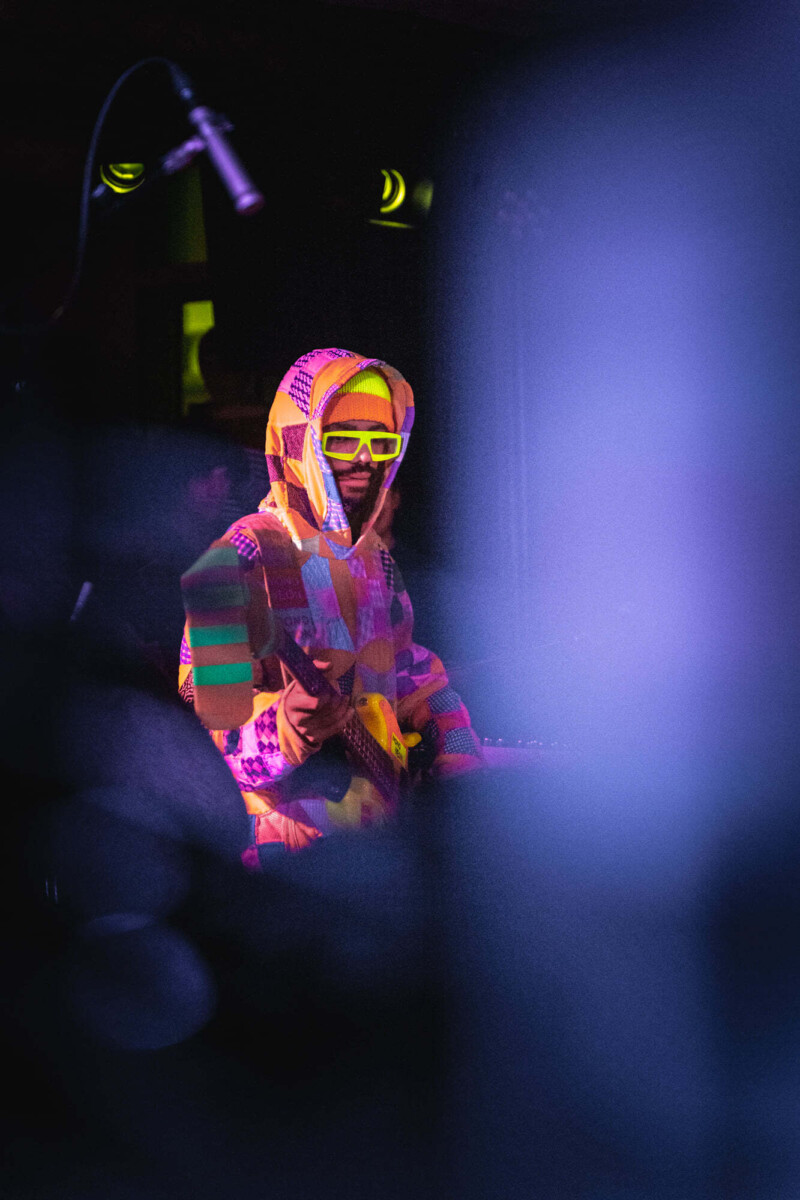
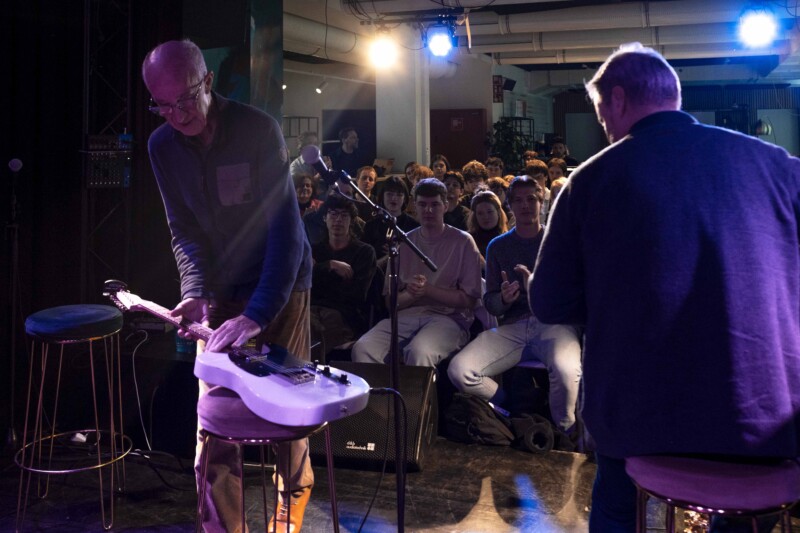 presentationLees, kijk, luistereducation Masterclasses and concert by MonoNeon and bandThrowback to the mind-blowing concert and masterclass by MonoNeon at our Club Telex.
 presentationLees, kijk, luistereducation