
On ‘An Institution is not an Island’
The six of us stepped into the room, entering through a small tucked-away corridor on the second floor of the Pauli building at KASK & Conservatorium. As we entered the ‘Malfait’ meeting room, we first noticed the large meeting table in the center, its bland light wood laminate. Our gaze then lifted to the walls lined with portraits, and to the busts sat placidly before them, their stillness amplifying the room’s formality. A sequence of male faces — key figures in the history of the institution — interrupted only once by a portrait of former dean Chantal De Smet, commissioned recently by Anne-Mie Van Kerckhoven.
Located next to the dean’s office, this space hosts administrative meetings that directly shape the present and future of KASK & Conservatorium. Its centrality is both spatial and organisational, yet it remains largely invisible and inaccessible to those outside institutional structures, especially students. Encountering the room, it felt strangely suspended from the everyday life of the school. The portraits formed a closed circle of authority, their gazes pressing inward, leaving us with the sense of being looked down upon. Their arrangement quietly asserted who is remembered, whose importance is visualised, and which stories are foregrounded in the institution’s history. Chantal De Smet’s portrait, rather than dissolving this pattern, rendered the room’s contours even more visible.
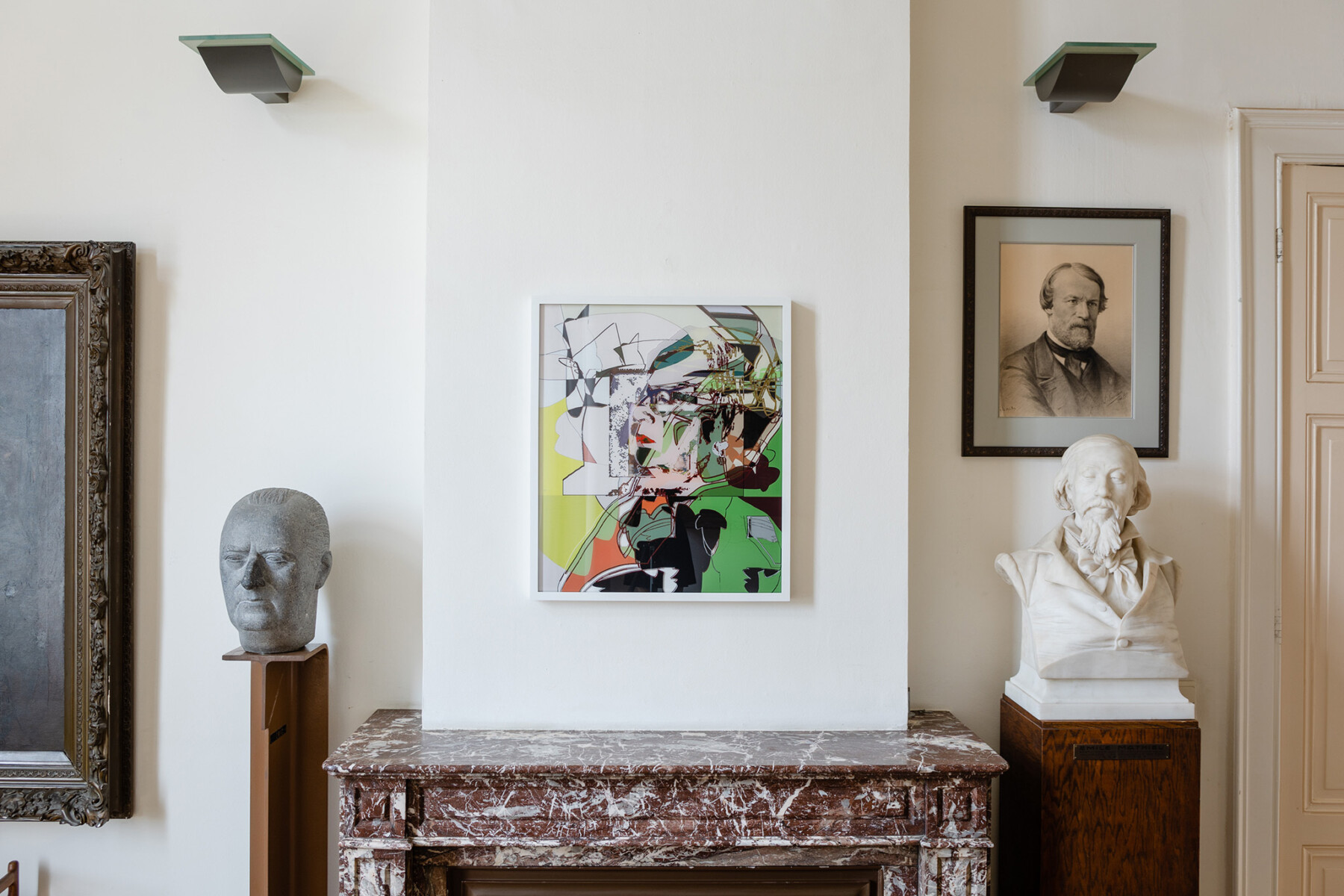
As students of the Curatorial Studies prograduate, we were introduced to the meeting room in November 2024 by Liene Aerts. She had been working at KASK & Conservatorium for a good fifteen years and was convinced this was something we would be interested in seeing. We were in the early stages of conceptualizing a project which would research the layered histories of the institution and the Bijloke site: a meadow turned abbey and hospital, and now home to seventeen different cultural institutions in Ghent. KASK & Conservatorium itself traces its origins back to 1748, founded by artist Philippe-Carel Marissal as a drawing school. Marissal intended for girls to have access to the academy since its inception. But in the end, it would take another 150 years, until 1907, for girls to finally be admitted to drawing classes, and only in 1931 the first mixed-gender painting courses took place. This history of male homogenization extends beyond the meeting room portraits and into the auditoriums, classrooms, and studios on campus, which carry the male names of Gustave Permeke, Frans Masereel, Raoul Servais, Victor Horta, among others.
We were drawn to the portrait of Chantal De Smet, striking both by its singular aesthetic and by it being the only female portrait in the room. Liene informed us that when De Smet became dean of the academy in 1988, she concurrently became the first female dean in the entire higher arts education in Flanders. De Smet was also a major figure of the second feminist wave in Belgium and a founding member of the Dolle Minas, a socialist-feminist movement emerging in 1970. Delving deeper into her work and KASK & Conservatorium as an institution, we came across a written contribution to the tenth anniversary of KIOSK — a contemporary art space located on the Bijloke campus — in which De Smet argued that art and educational institutions never exist in isolation; that “institutions are not islands”, but embedded in social, political, and cultural ecosystems, whose responsibilities extend beyond their walls.
Gathering, researching, situating
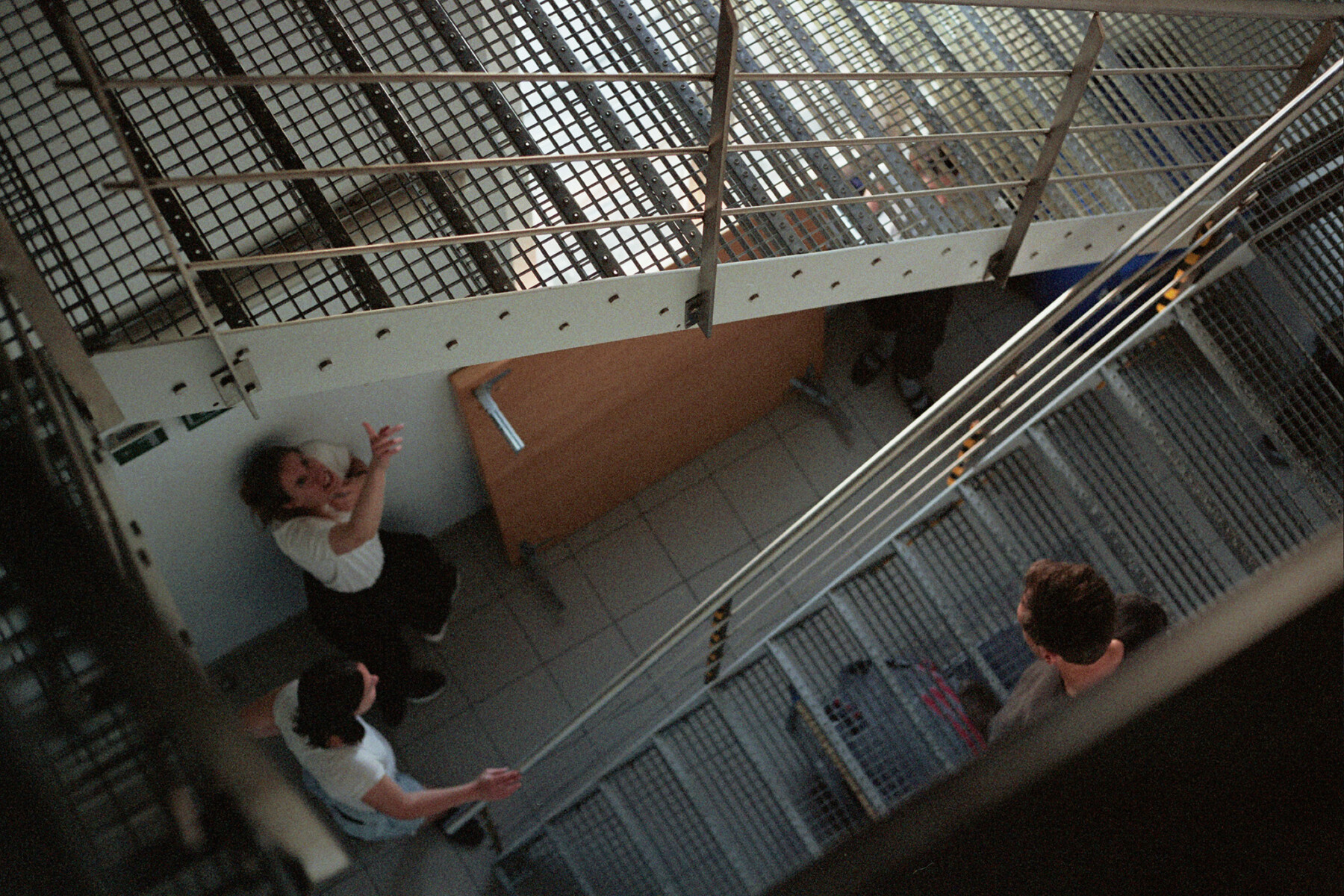
Our research process began with an informal mapping of KASK & Conservatorium. We were drawn to spaces that seemed overlooked: both architecturally (for instance, the attic suspended above day-to-day circulation, the Second World War shelters buried beneath grass mounds, and the residual in-between areas which no longer hold a clear function) and metaphorically (blind spots, such as the the entrances, stairwells, and corridors crossed countless times each day, yet rarely recognized as sites that carry institutional meaning). We visited the institution’s library, art collection and archives — which included artworks by the first female students of the school — meeting teaching and library staff who had developed their own research, perspectives and lived experiences within the institution.
Building on our growing curiosity, we started thinking of 'margins' and 'centers': not only in their spatial manifestations, but in what they expose about history and access. In The Production of Space (1974), Henri Lefebvre argues that space is never neutral; spaces are designed, occupied and controlled, often favoring dominant ideologies. Departing from this perspective, and looking at what we had in front of us, different questions arose amongst our group: Which histories of KASK & Conservatorium are made visible within its current infrastructure, and which narratives are hidden, forgotten, or erased? How does this shape the way the institution understands itself today? If we consider the institution as soft power and space as hard power, how might we reclaim both? For whom is an art institution open, and for whom is it closed?
We all felt rather disoriented at the beginning, overwhelmed by the diverse potential of our initial point of departure. It was as though the more research we did, the more doors opened, seemingly drifting us further from finding the core of the project. Our research process also shifted in unexpected ways: at the start, we approached it with a fairly traditional sense of ‘research’, gathering references, consulting publications and archives, and situating ourselves within this context. As we progressed, we became increasingly aware of the limitations of this approach — particularly in a context where so many voices have not been foregrounded in the meeting room or in the broader narrative of the school: women, people from non‑Western European or migration backgrounds, queer people, and people with different access needs. Along the way, and with intentionality, our project became a space of exchange and knowledge-sharing in more informal and communal ways – offering counternarratives to histories that present themselves as singular and exclusionary.

Artistic interventions
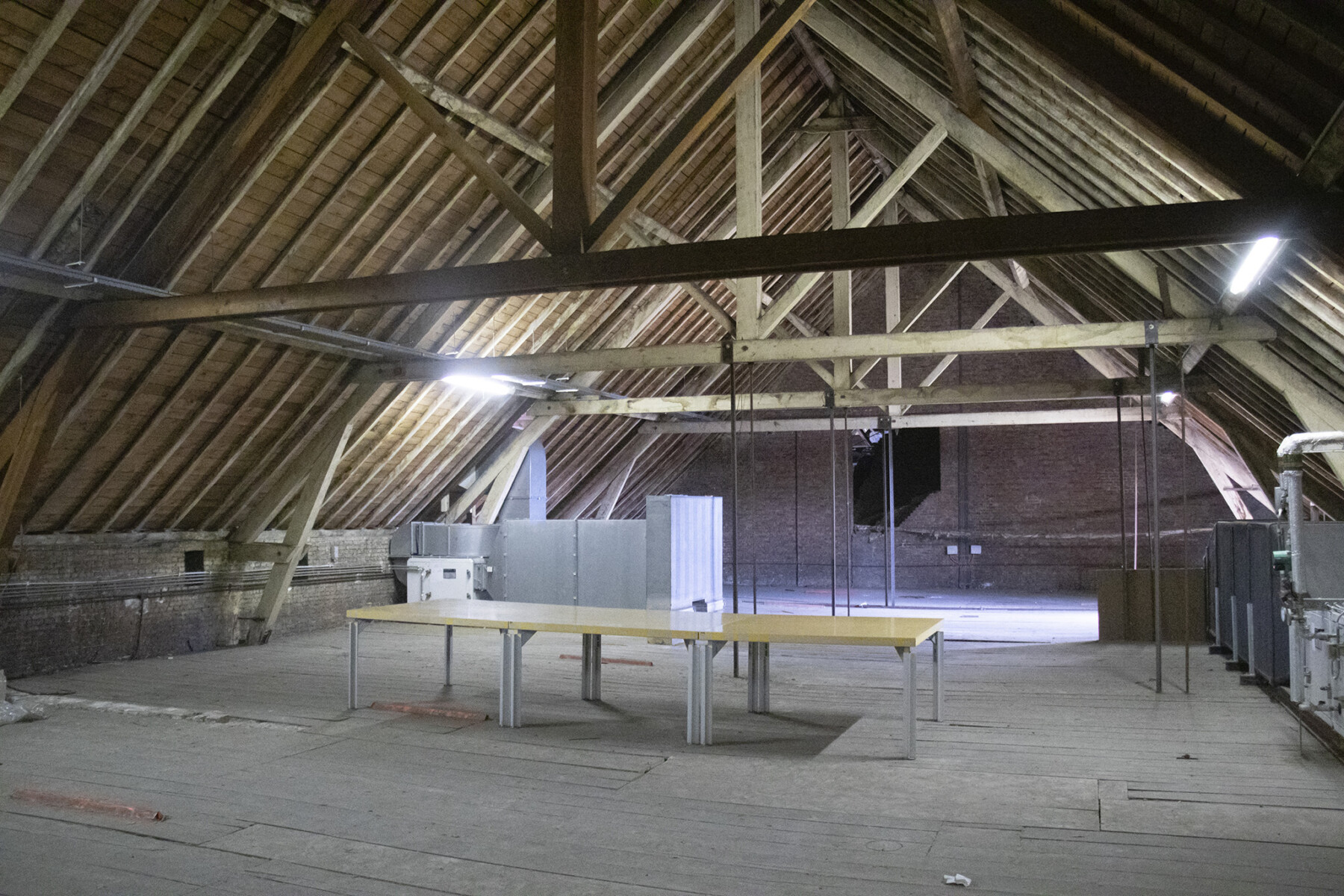
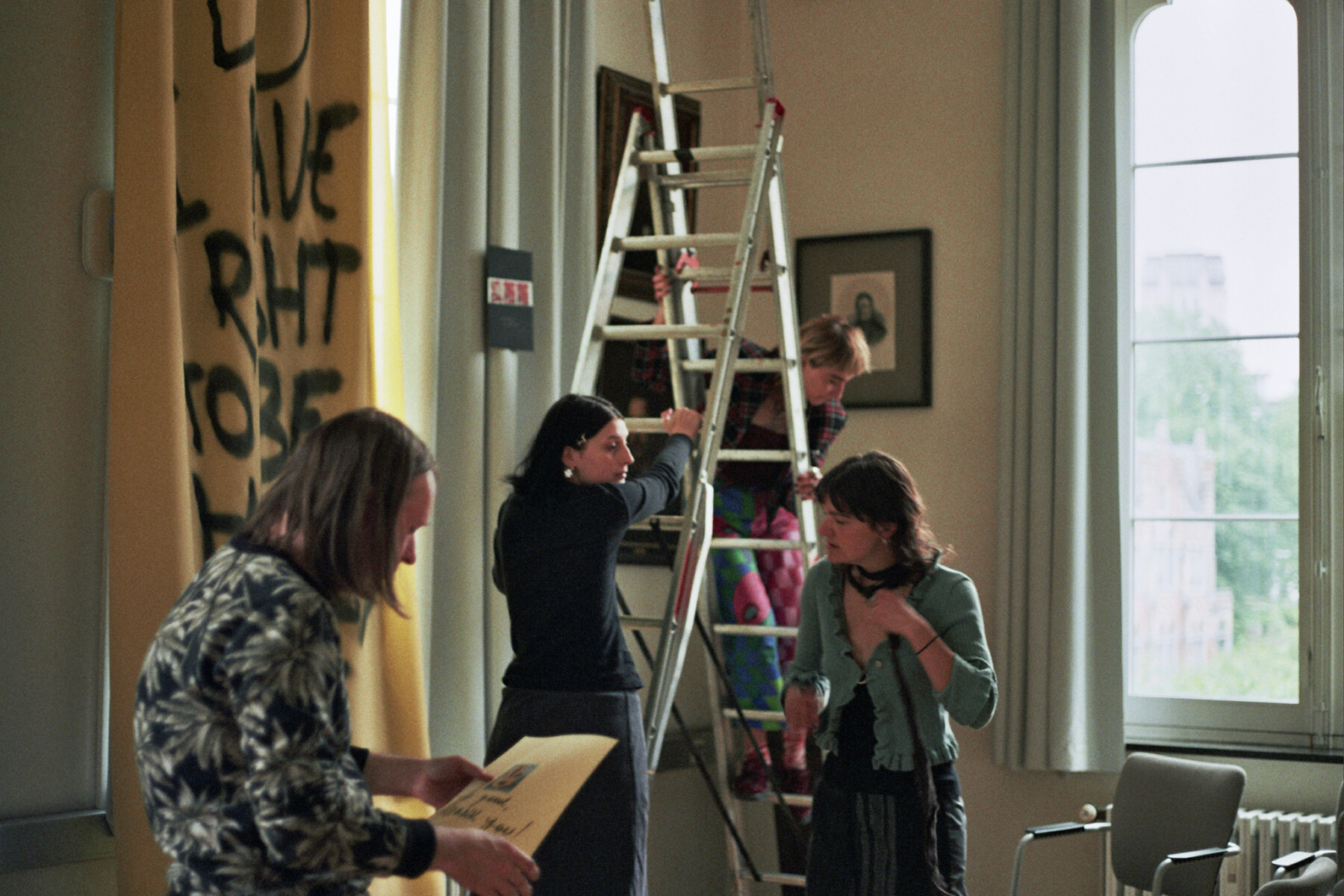
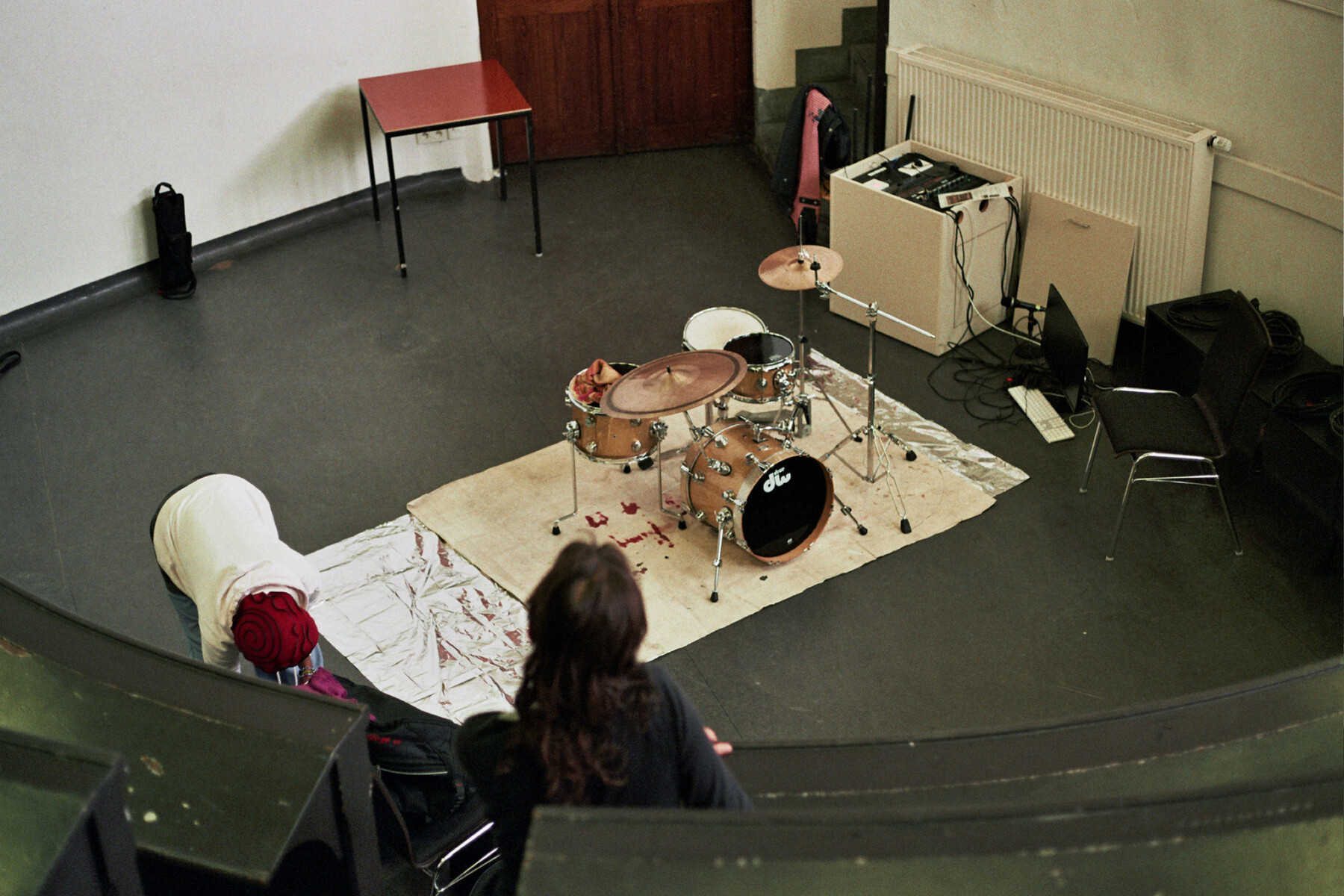
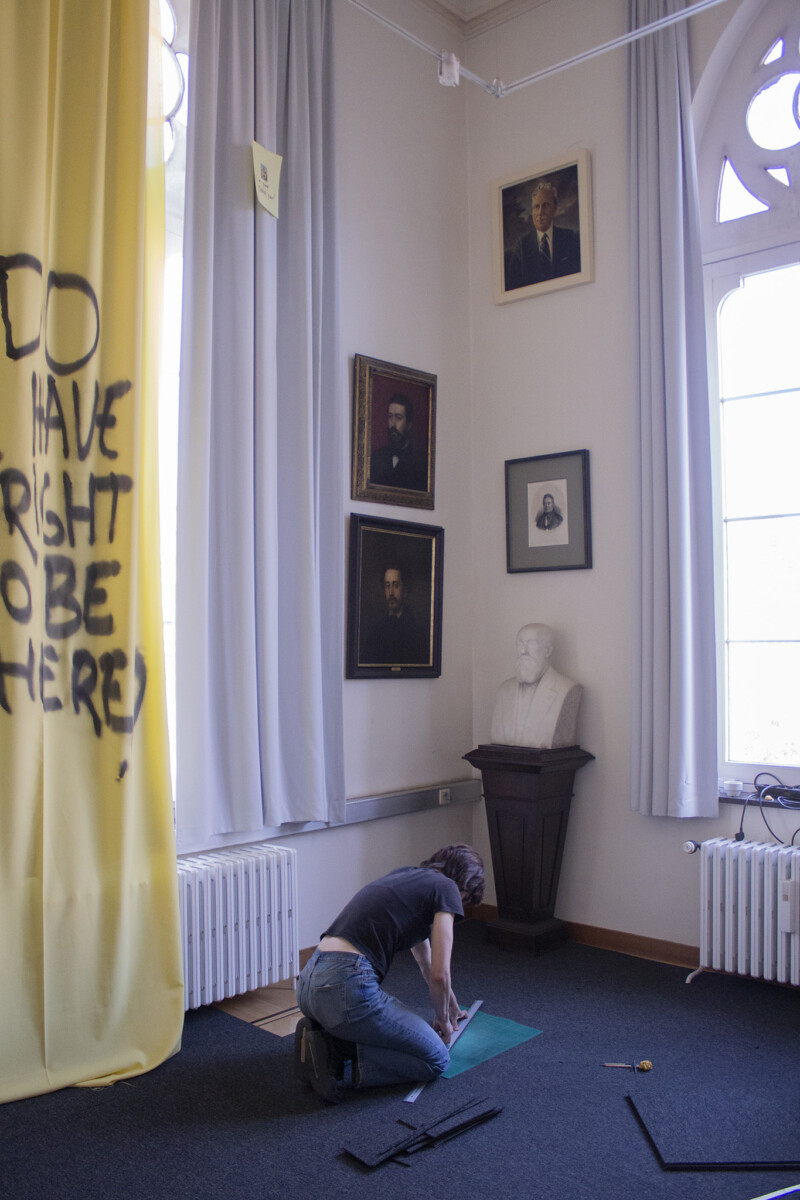
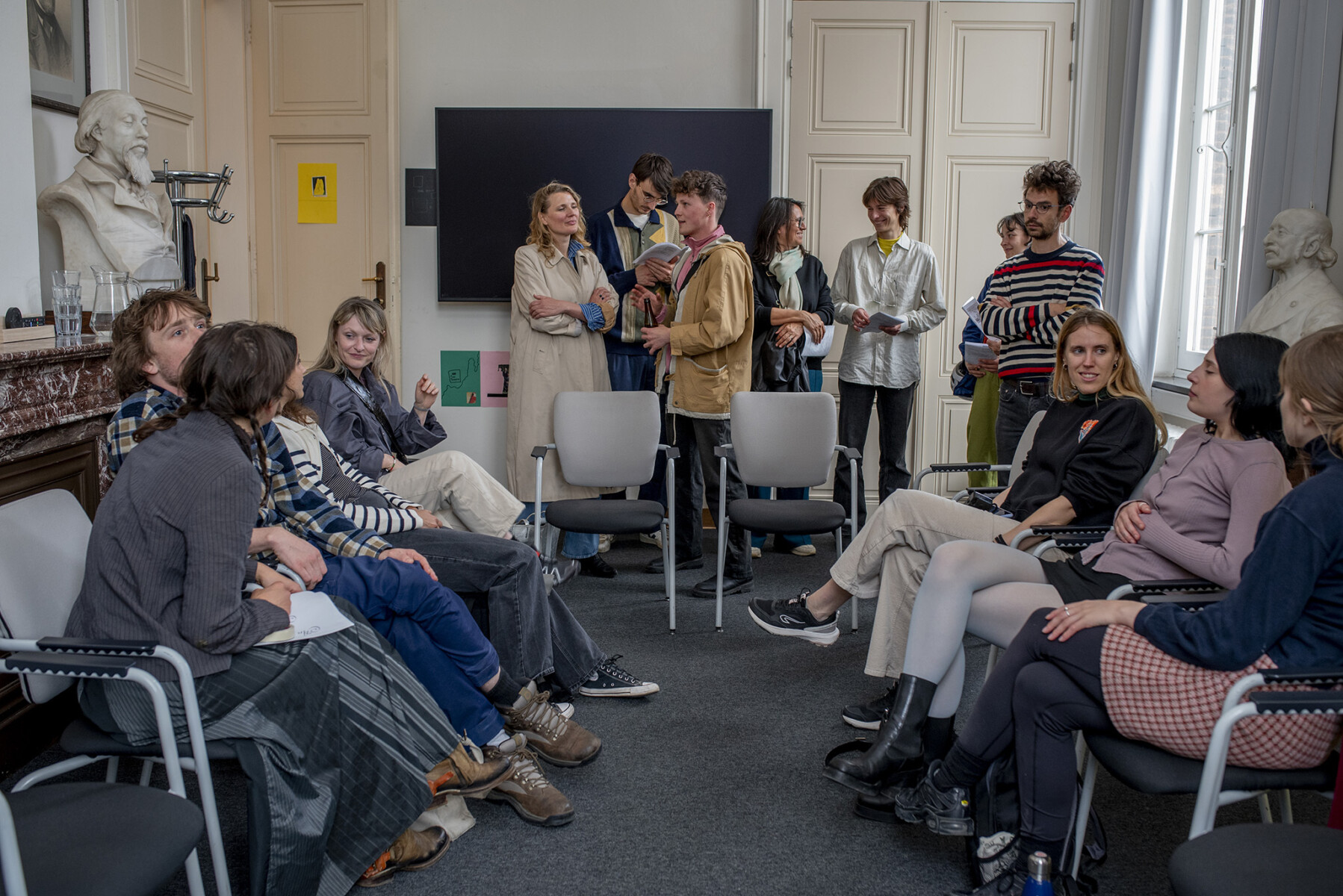
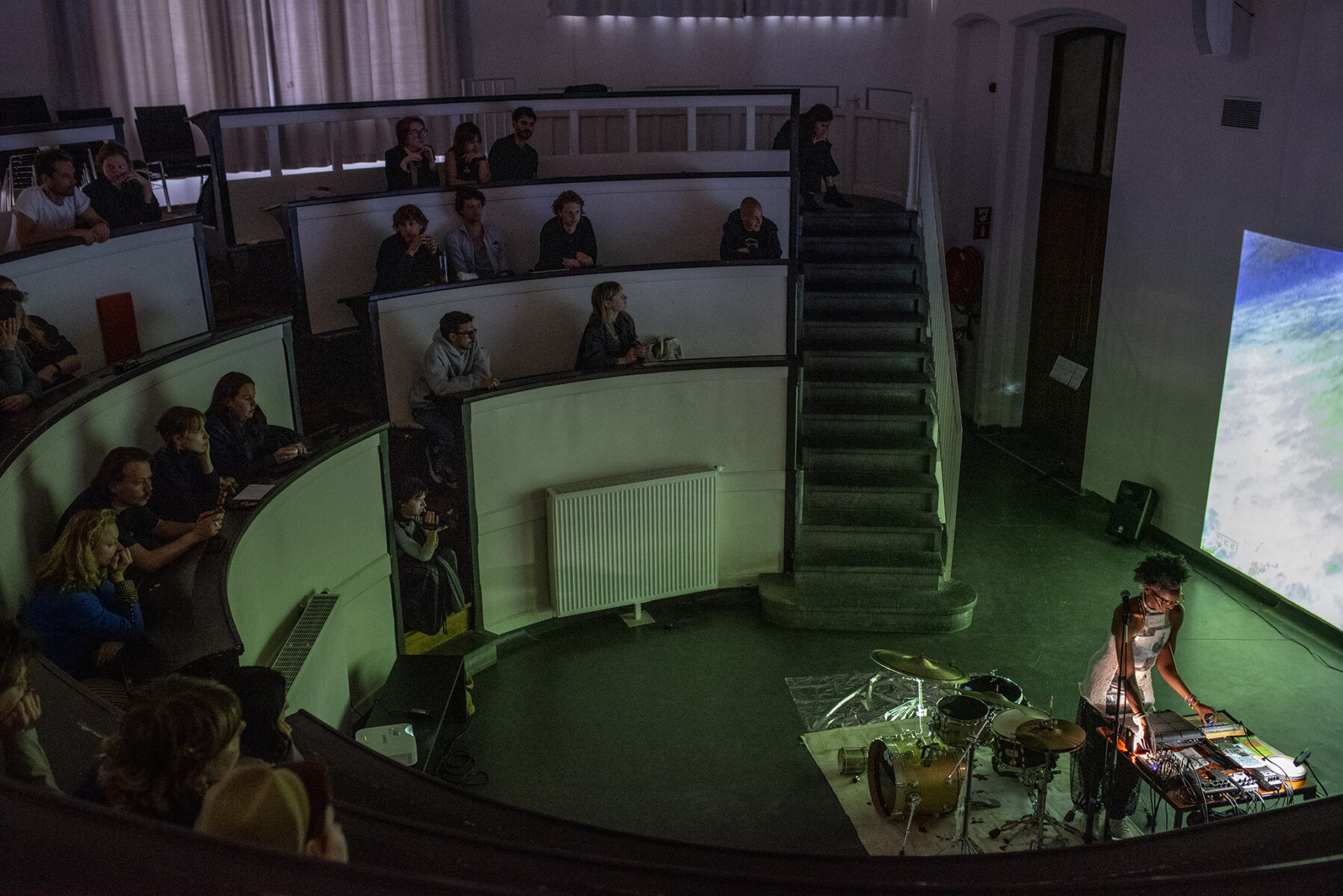
Based on our research on the institution and its spatial politics, we launched an open call inviting four artists to intervene in these different spaces on campus as an opportunity to collectively question institutional, historical, infrastructural and spatial hierarchies. Over the course of May 2025, Sanie Irsay dismantled the meeting table, lifting together its dead weight out of the room and into the attic above; Nikolay Karabinovych introduced a series of collages and a curtain, asking Do I have a right to be here?; and the room was covered with wall-to-wall carpet with a concealed binder by Celine Aernoudt. Eventually, we opened the meeting space to an audience of students and staff, to sit in the emptied circle of chairs, share a drink, and explore and discuss what had taken place. Later that evening, a performance by Lázara Rosell Albear took place in the Cirque auditorium, a former anatomical theatre, as a “dissection” of the school and of her lived experiences within it as a student years ago, offering a reflective culmination to the project.
The attic and the meeting room were particularly compelling as they are usually closed off to students or outsiders, both physically and symbolically. Working in these spaces, we were searching for a way in, experimenting with gestures that had not been attempted before at KASK & Conservatorium. The interventions thus became openings and starting points, creating moments of dialogue and friction, transforming and reimagining spaces that are usually inaccessible and rigid.
The project unfolded as a collaborative and collective process — not only among us as curators, but across everyone who became involved. Conversations with different staff members shaped our early understanding of the school’s architecture and histories, while the structure of the project and the selection of interventions emerged through dialogue among the six of us. When meeting the artists to prepare and later install their works, each encounter became an exchange: their perspectives added forms of knowledge that the institutional record has not captured. This way of working has shaped our emerging curatorial practices and our understanding of participatory trajectories.
On working together
Throughout the project, we questioned our agency as students in a one-year programme, arriving with little personal familiarity to the school or site, or prior empirical knowledge. We wondered to which degree the institution belonged to us and to what extent we could critique it. Yet by acknowledging our transience — rather than treating it as a limitation — a different form of agency emerged, one grounded not in ownership but in attention, reciprocity, and care. Claiming space, even temporarily, became a way of redistributing it, and of giving it back differently. Transience became integral to both the project and the very notion of an ‘intervention’. At the same time, we continue questioning how to balance temporary provocative artistic or curatorial gestures with sustainable institutional dialogue. Once again, the words of Chantal De Smet point us toward this balance: a departure from fixed structures of institutional history and identity, toward a more reflexive, porous way of existing within institutional spaces.
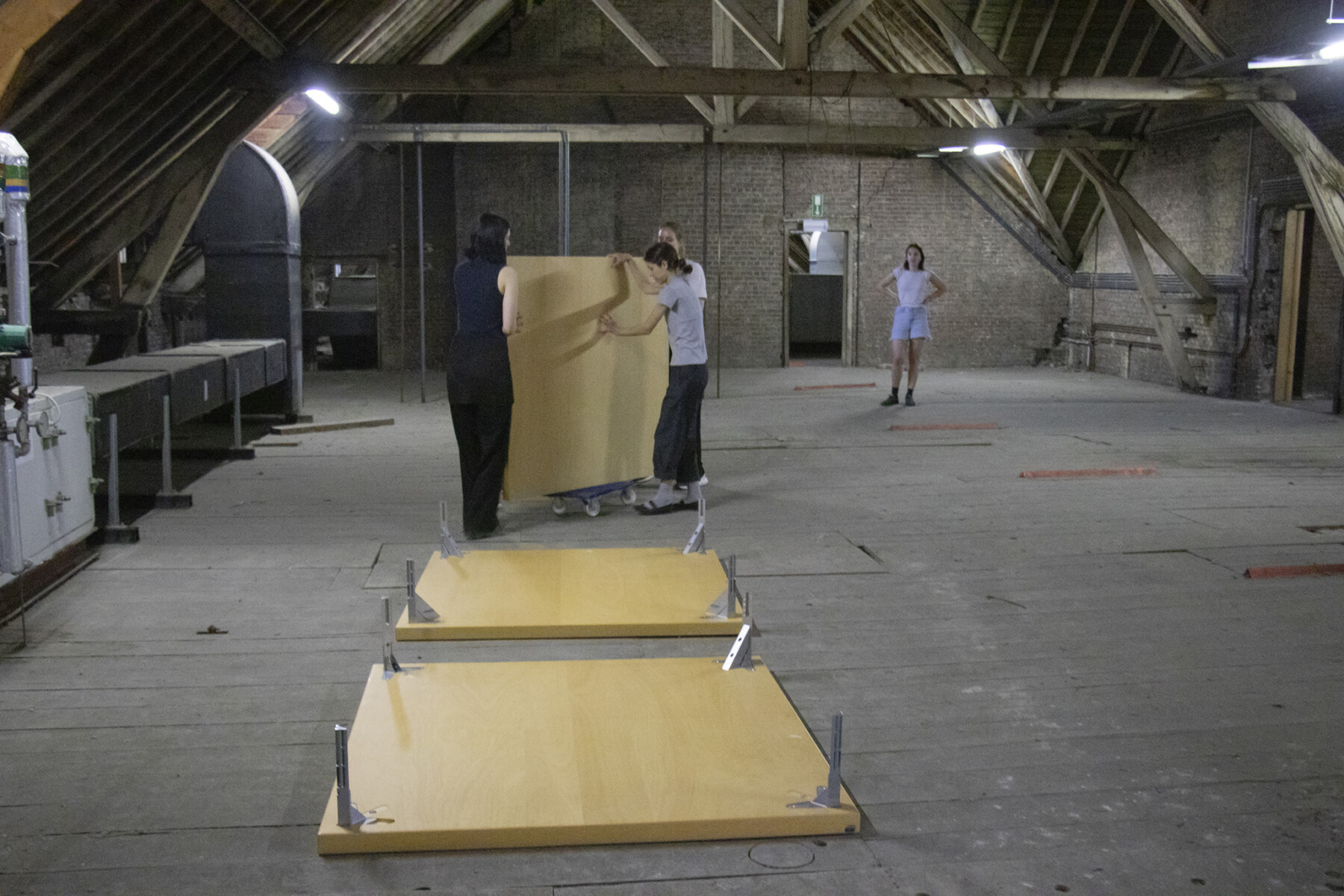
Our collective brought together a range of identities, backgrounds, and lived experiences: some of us had completed art education elsewhere, some were practising artists, others had previous research on access and inclusion — most of us already shared an interest in how art can operate beyond institutional boundaries. We often held differing, sometimes strong opinions: whether to work exclusively with female or marginalised identities; which conceptual or theoretical affinities mattered most; the use of humor within the artistic interventions; and how explicit the political messaging should be. It was valuable to have our assumptions and viewpoints challenged so consistently, and to eventually treat our differences as a generative force rather than an obstacle. It taught us to be better listeners — not only with one another, but also with the school itself, and the deanery and staff. We learned to listen with greater consideration, nuance, and respect.
The project, initially created within the scope of a postgraduate course elective, became the beginning of something we hope will be longer-lasting and more expansive. We are curious how it might grow beyond its starting point at KASK & Conservatorium. It has already left clear impressions on our emerging curatorial practices: we found connections between ourselves through our shared attention to the spaces around us, our questioning of how we move through them, our efforts to ground ourselves within an institution, and our continuous challenging of conditions that otherwise appear fixed. These shared concerns are prompting several of us to want to continue working together in this way. An Institution is not an Island could reshape itself in response to new institutional and spatial contexts, continuing to open overlooked spaces, invite new voices, and challenge the hierarchies embedded in institutional history. Its potential lies in evolving further as a collective reflection — being reclaimed, reimagined, and extended by others.
Reading list:
Louis Cloquet (1849-1920): Architect tussen Monument en Stad, Patrick Goditiabois & Lieselotte Van De Capelle (2022)
Geschiedenis der Zusters van de Bijloke te Gent, Zuster Agnes David & Jozef F.A. Walter’s (1929)
De Wereld Verlaten: Uit het Geheugen van de Bijloke, Barbara Drieksens & Ann Cassiman (2002)
Van Marissal tot Vlerick: 1751-1988, M. Werbrouck-Cools (1988)
Hogeschool Gent 1748-1995, Chantal De Smet (2010)
Choosing the Margin as a Space of Radical Openness, essay by bell hooks (1989)
The Production of Space, Henri Lefebvre (1974)
KASK 260, booklet for exhibition, curated and written by Liene Aerts (2011)
Show Me Your Archive and I Will Tell You Who is in Power, booklet for exhibition curated by Nataša Petrešin-Bachelez and Wim Waelput, booklet written by Liene Aerts (2017)
Ten Years KIOSK: Chantal De Smet, essay by Chantal De Smet (2020)
Garden Happenings, research project and podcast series by Laura Herman, Godart Bakkers, Birgit Cleppe and Bert De Roo (2021)
On Politics of Space
An Institution is not an Island was the first project realized by curatorial studies students in the academic year 2024-2025 as part of the annually recurring elective course Politics of Space under the supervision of Liene Aerts and Laura Herman. Pedagogical environments are shaped by histories of exclusion—of certain narratives, achievements, and forms of knowledge. These exclusions manifest in infrastructure, archive management, collection policy, portraiture, naming practices, etc. How can we critically engage with the spaces where we (un)learn? How might we reframe, rename, and reimagine our learning environments, following Sara Ahmed’s notion of ‘disorientation and reorientation’?
Politics of Space is a thinking exercise: if our infrastructure – and thus the faces and contents we give parts of it – reflect who we are, then who are we?
Politics of Space is a practical exercise: as a long-term project we hope that the results will lead to a growing archive, a series of interventions that can take various forms.
As such, this text is the first in a series of written reflections, retrospective articles, interviews and archival research that focuses on the school as an institution, as infrastructure, as a community of people, as a lived and living body of which we are all part and must therefore take care of.
 articleLees, kijk, luisterartistic activitiesstudent fine arts Alalú
 presentationLees, kijk, luistereducationstudent photography Who Am I Without You Mister Man?
 articleLees, kijk, luistereducationstudent fine arts Film Titel Proposition; Einmalig
 Lees, kijk, luister Inside Conversations
 articleLees, kijk, luistereducationartistic activities Dwars
 articleLees, kijk, luistereducation