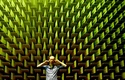
The sublime in its romantic tradition is provoked by bombastic experiences, often related to extreme situations of (outside) phenomena (storms in high mountains, shipwrecks, …). It is an out-of-scale experience and it is always a fiction as it implies a distance between the phenomenon and the beholder. In the body of work that I am creating, this ambivalent dis-orientation happens with forms that involve the spectator in a different way. The situation that is either proposed from the start or that evolves through time is fragile. It can fail at any moment. It is on a verge, at a tipping point. But, unlike in the romantic sublime, it is not a fiction. It is not a representation of a fragile situation. It is really happening in the space. And precisely because it is situated at a fragile threshold the spectators realize that they have agency on what is happening. They are placed in the situation of being responsible for it. My research analyzes the strategy, goals and signification of this transition from aesthetic experience to ethical responsibility.
Exercising Fragilty in Theatres and Beyond
 Doctoral defense David Weber-Krebsresearch presentationAgendaOnderzoek
On December 16, David Weber-Krebs, artistic researcher at KASK & Conservatorium, will defend his doctorate to obtain the title Doctor of Arts. On behalf of the candidate and his promotors, Dr. An Van Dienderen (HOGENT - KASK & Conservatorium), prof. dr. Christel Stalpaert (UGent) and Prof. Dr. Em. Bart Verschaffel (UGent), we would like to invite you to this occasion.
The public defense will start at 16:00 in auditorium Cirque in the Cloquet building on Campus Bijloke. Afterwards, you are welcome to attend the reception. Please confirm your attendance by sending an e-mail to david.weberkrebs@hogent.be.
Exercising Fragility in Theatres and Beyond
The place of this research project is the enclosed space of the theatre in relation to the great outdoors of the world outside of it. Traditionally the theatre provides a space where audiences implicitly agree to a temporary separation from their everyday lives, from what is happening outside. However, in the Anthropocene—the era of ecological interconnectedness and blurred boundaries between nature and culture—this isolation is challenged. The sublime, historically a one-way experience of awe and fear evoked by overwhelming forces, must be rethought in this context. Rather than seeing audiences as passive recipients of grandiose effects, the Anthropocene emphasizes reciprocal relationships, where spectators actively or by their mere co-presence in a space shape the theatrical experience. This shift invites a reconceptualization of the sublime as a 'fragile sublime,' where the artwork becomes vulnerable and co-agency defines the interaction between audience and performance.
This research project was carried out on different levels and using various means: within the theatrical space by creating performances and curating projects; and outside the theatrical space by developing a writing practice and inviting others to write. Meanwhile, the sudden spread of an invisible airborne element made people around the world both dangerous to each other and vulnerable to one another, disrupting not only human relationships but also cultural institutions. Theatre doors were closed indefinitely, and this research project that had taken place within the four walls of the theater suddenly unfolded outside of them.
David Weber-Krebs
David Weber-Krebs is an artist, researcher and curator based in Brussels. He studied at the University of Fribourg (CH) and the Amsterdam School of the Arts (NL). Recent works are the performances The Silencing and The Death of Ivan Ilyich. He is curator of the series performance-conferences On Enclosed Spaces and the Great Outdoors and the editor of the book And Then the Doors Opened Again. David collaborates on a regular basis with different artists and theorists and he teaches at different visual arts and performance academies.
The research project Exercising Fragility in Theatres and Beyond was financed by the HOGENT Arts Research Fund.
 On Enclosed Spaces and the Great Outdoors - 5, Zwarte Zaalresearch presentationAgendaArtistic activitiesOnderzoek
With contributions by Augusto Corrieri, Katja Dreyer, Nikolaus Gansterer, Yannick Guédon, Guy Gypens, Antoine Pickels, Julie Sermon, Christel Stalpaert and May Abnet, Julien Bruneau, Alondra Castellanos Arreola, Zoë Demoustier and Irena Radmanovic as the Guardians of Sleep
On Enclosed Spaces and the Great Outdoors is a series of performance-conferences exploring how the performing arts—their forms, research, and discourses—are being challenged by climate emergency.
This fifth edition marks the conclusion of David Weber-Krebs' PhD in the Arts, Exercising Fragility in Theatres and Beyond, a journey he embarked on six years ago. During this time, the world has experienced significant upheavals, most notably a pandemic that forced theatres to close, only to reopen in a profoundly altered state. This moment revealed new vulnerabilities, as an invisible airborne threat made humans both dangerous to, and fragile toward, one another. This disruption not only reshaped human relationships but also affected cultural institutions at their core.
This edition of On Enclosed Spaces and the Great Outdoors offers a space where artistic propositions respond to theoretical perspectives, centering fragility on stage and reflecting on what it means for our presence in the world and our ecological responsibilities.
Key contributors include Julie Sermon, author of the acclaimed Morts ou vifs, pour une écologie des arts vivants, and Augusto Corrieri, artist, scholar and magician, whose work bridges performance, art, and ecology and author of the sensational In Place of a Show: What Happens Inside Theatres When Nothing is Happening.
Composer and singer Yannick Guédon will present an exploration of voice, unfolding subtle variations of a single note, to explore the mobility and fragility of sound.
In April 2020, at the height of the COVID-19 lockdown, Katja Dreyer, Antoine Pickels, and Christel Stalpaert imagined what their first post-lockdown theatre experience might be. Now, in 2024, they revisit and reflect on those imaginings.
The day will conclude with a special reprise of The Guardians of Sleep (2017). While sleeping, the human body is vulnerable. A feeling of security and peace helps us every night to withdraw from the world. But what if the social protection as we know it, suddenly falls apart?
- Concept & curation: David Weber-Krebs
- production: Emma Verbeek, Emilie Legrand
- co-production: Outline and KASK & Conservatorium (HOGENT – Howest)
- Supported by Flanders State of the Art
David Weber-Krebs is affiliated as an artistic researcher to KASK & Conservatorium, the school of arts of HOGENT and howest. The research project Exercising Fragility in Theatres and Beyond, is financed by the HOGENT Arts Research Fund.
5 euro (students)
lunch and apéro included