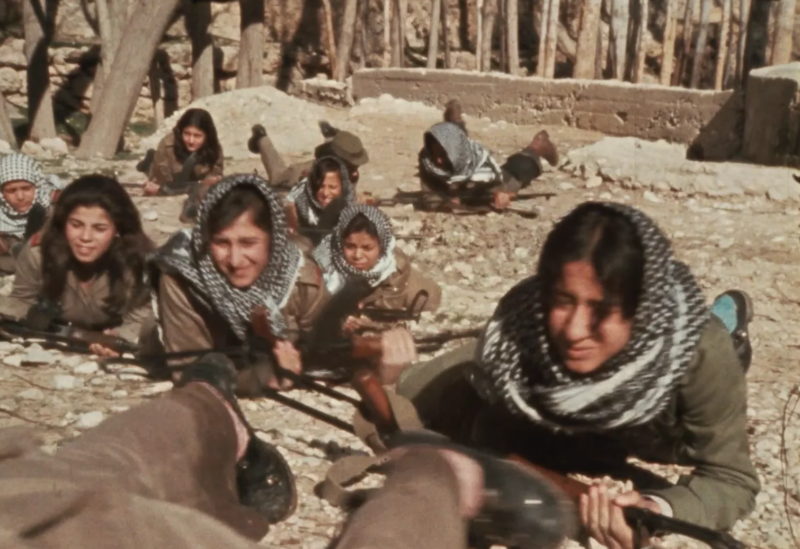
26.02.26, 20:30, Jocelyne Saab Revisited
Lebanese journalist and filmmaker Jocelyne Saab is known for her politically engaged films, which she made during a career spanning from the 1970s until her death in 2019. With more than forty titles to her name, Saab brought the untold stories of the Arab world to the screen and gave a voice to marginalised and oppressed communities. During this evening, we revisit her combative yet nuanced oeuvre with two of her most powerful achievements.
In the short film Palestinian Women (1974), Palestinian women resist the Israeli occupation of their land through education and armed resistance. With Letter From Beirut (1978), Saab returns to Lebanon, where she directs herself in a poetic narrative that questions the creeping continuation of the conflict. She then leaves for South Lebanon, which is occupied by Israel. There, for the first time since the start of the civil war, she documents the Palestinian resistance at the border.
This evening takes place in the context of the book Jocelyne Saab: Inventory 1973–1983 (2024), about the rise of left-wing political movements, armed revolutions and public struggle in the Arab world. The screening will be followed by a Q&A with authors Mohanad Yaqubi, Mathilde Rouxel and Elettra Bisogno.
Cloquet
Godshuizenlaan 4
9000 Gent
 publicationLees, kijk, luisterresearchresearcher Listening session, live recording05.12.24 in Kunstenbibliotheek
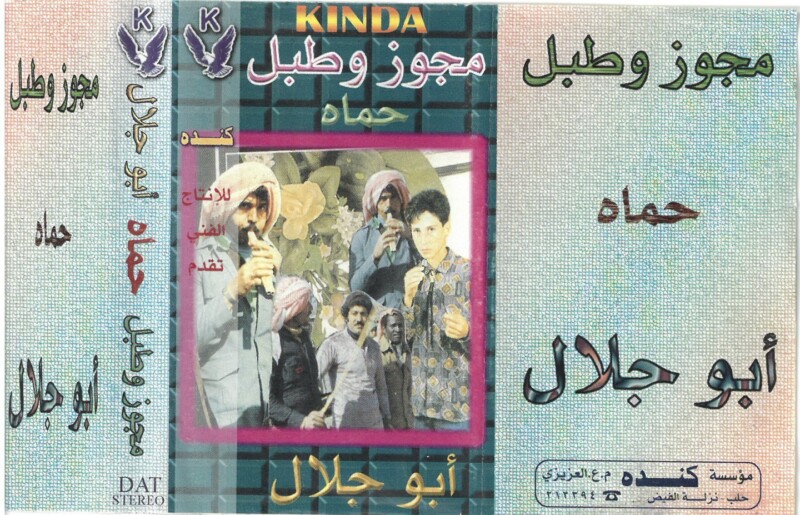 audioLees, kijk, luisterresearch
 Archives in Dialogue (Episode 5)research presentationlectureAgendaOnderzoek
Dialogue with members of the Palestine Film Institute General Assembly (Rasha Salti, Saeed Taji Farouky and Reem Shadid) followed by a screening of R21 AKA Restoring Solidarity (71 min, 2022, DCP)
Archives in Dialogue is a platform dedicated to gathering, sharing, and reflecting on archival practices, solidarity, and memory. Simultaneously recorded as a podcast, this initiative aims to foster an ongoing conversation that delves into the realms of politics, poetry, and cinema. The dialogue specifically focuses on artistic productions connected to the anti-colonial, anti-imperialist, and anti-fascist political struggles of the 20th century. An era that produced a vast and rich body of film work that has been consistently marginalized in film studies, curation, and the industry.
By examining archival practices related to these films and their histories, we can better understand and interrogate the absence or discontinuation of such political engagement in contemporary cinema. Through the practice of "unarchiving" archives, this dialogue seeks to reconstruct collective histories and revive the intersections of transitional solidarities. This horizontal reflection on practices and methodologies ultimately allows a new pedagogy to emerge.
The fifth episode focuses on the critical role of activating film heritage and archives during the genocide in Gaza. It explores how the pursuit of relevant contexts and images became an essential act of resistance. Furthermore, it examines the vital contribution of transnational Palestine solidarity networks in challenging the dehumanization of the Palestinian people within mainstream media.
The guests are not only members of the Palestine Film Institute General Assembly but are also acclaimed film programmers and curators. They regularly collaborate with Palestinian and international artists, filmmakers, and activists, deeply engaging with these themes. Their expertise offers an expansive view of artistic practices utilized for researching Palestinian film and art archives, as well as the institutional strategies developed to interrogate and redefine the meaning of archiving and programming in times of conflict.
The Dialogue will be followed by a screening of Mohanad Yaqubi’s film, “R21 AKA Restoring Solidarity.” A film that uses the medium of cinema and its timeline to inventory a 16mm collection about the Palestinian struggle, which has been safely preserved in Tokyo. This Screening is part of United Screens for Palestine activities in collaboration with N22.
This Episode of “Archives in Dialogue” is hosted by Pianofabriek, in the context of their United Screens for Palestine screening series in collaboration with N22( Brussels community centers Network), and the Archival Sensations research cluster at KASK & Conservatorium.
Mohanad Yaqubi is affiliated as an artistic researcher to KASK & Conservatorium, the school of arts of HOGENT and howest. The research project Aesthetics of Transnational Solidarity Cinema was financed by the HOGENT Arts Research Fund.
 Mohanad Yaqubi, Mathilde Rouxelresearch presentationAgendaOnderzoek
Mohanad Yaqubi and Mathilde Rouxel launch the publication Jocelyne Saab: Inventory 1973–1983 at Sharjah Art Foundation in the UAE.
Delve into the path-breaking filmography of Jocelyne Saab with editor and researcher Mohanad Yaqubi and Mathilde Rouxel, an Arab cinema researcher and film programmer. This talk is being held in conjunction with the launch of Yaqubi’s publication Jocelyne Saab: Inventory 1973–1983, which reflects on the emergence of political film production and the broader context of Saab’s work from 1973 to 1983. The conversation will be preceded by a screening of two of Saab’s films—South Lebanon: The Story of a Village Under Siege (1976) and Les Femmes palestiniennes [Palestinian women] (1974).
Mohanad Yaqubi is one of the founders of Idioms Film, an arthouse production company established in Ramallah in 2004. He is also a member of Subversive Film, a curatorial collective focused on researching and redistributing militant cinema from Palestine and beyond. Since 2017, he has been a lecturer and researcher at KASK School of the Arts, Ghent. His first feature film,Off Frame AKA Revolution Until Victory (2016), premiered at Toronto International Film Festival, Berlinale, Cinéma du réel, Dubai International Film Festival and Carthage Film Festival. His second feature, R21 AKA Restoring Solidarity (2022), debuted at documenta fifteen, IDFA, Marrakesh Film Festival, True/False Film Fest and Melbourne International Film Festival.
Mathilde Rouxel specialises in the history of cinema in Arab countries, particularly resistance cinema since the 1960s. She is the artistic director of the Aflam Festival, Marseille, and the Franco-Arab Film Festival, Noisy-le-Sec. She has written and edited several publications on the work of Jocelyne Saab, with whom she worked during the last years of Saab’s life. She is also co-founder of the Jocelyne Saab Association and the Archive Circulation Initiative, which raise awareness about the challenges of preserving film heritage and share technical knowledge related to film and analogue technology through research and training workshops in Arab countries.
Al Mureijah Square, Sharjah
UAE
 [cancelled] Christina Hazbounresearch presentationAgendaOnderzoek
Due to personal circumstances, the listening session of Christina Hazboun is cancelled.
From November 2024 onward, the research cluster The Art of Resonance – The Resonance of Art is organising a series of informal listening sessions with international artists and researchers, with an eye (and ear) to cultivating a sonic sensibility and relationality.
Christina Hazboun
Christina Hazboun is a Sonic Agent, surfing soundwaves in search of ear-gasms, exploring music and sound in space, time and society. Her multifarious adventuring through music and sound manifest through an intersectional web of activities aimed at amplifying the voices of the underheard from the SWANA and the global majority via poetic and research based texts, audio/sound collages, workshops, and curation with a focus on music industries, gender diversity and digital connectivity. Her main sphere of activity focuses on increasing the appearance and audibility of new sounds and music from West Asia, North Africa and the global south sharing hybrid, diverse and powerful voices with those who come with an open ear.
i.c.w. artistic researcher Mohanad Yaqubi's research project Transnational Solidarity.
Cloquet
Godshuizenlaan 4
9000 Gent
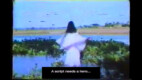 The Myriad of Faces of the Future Challengers (2022), KASKcinemaresearch presentationfilmAgendaArtistic activitiesOnderzoek
For this fourth edition of ‘Archives in Dialogue’, members of Jakarta-based collective Forum Lenteng are invited. They research and produce films on the history of Indonesian cinema and in particular film production during the Suharto New Order regime (1966-1998).
In 1966, General Suharto seized power in Indonesia and remained self-proclaimed ‘father of the Indonesian people’ until 1998. This reign was overshadowed by an anti-socialist attitude with atrocities against his opponents. Suharto called his regime, which vehemently opposed communism, socialism and Islam, the ‘New Order’ (Orde Baru). He underpinned his vision of history with a series of propagandistic films, some of which were compulsorily shown in schools and broadcast annually on TV.
It is high time for a renewed look at New Order cinema, preferably through the slightly ironic glasses of Yuki Aditya and I Gde Mika, who, with The Myriad of Faces of the Future Challengers, still manage to find hints of subversion and dissonance in the craziest places. The film is rigorously constructed with YouTube material, because that is the true memory and cinematic history of a country that has little interest in anything lofty like film history. Every blurry image in this film is an attack on forgetfulness.
Archives in Dialogue, organised by KASKcinema i.c.w. Film-Plateau and KASK & Conservatorium's Archival Sensations cluster, is a space for reflection on archival practices, art and memory. This event is part of Mohanad Yaqubi's research Aesthetics of Transnational Solidarity Cinema at KASK & Conservatorium.
i.s.m. Film-Plateau
Cloquet
Godshuizenlaan 4
9000 Gent
 Cinema as Assemblyresearch presentationAgendaOnderzoek
With Forum Lenteng, Marinho de Pina (Mediateca Abotcha), La Voix des sans papiers de Bruxelles in collaboration with Mieriën Coppens and Elie Maissin, Marwa Arsanios, Massimiliano Mollona, Bojana Cvejić, Elettra Bisogno, Lara Khaldi, Elhum Shakerifar, Subversive Film and Robin Vanbesien.
In a time of genocides and authoritarian crises, how can contemporary cinematic practices align with and support political imaginations striving for social justice and antifascist liberation? How do they help us rehearse these imaginations? Cinema as Assembly is a three-day study circle that invites the public to come together – as an audience, as thinkers and as makers – to explore cinema’s potential as both a method and medium that can help rehearse collective organisation, militant imagination and liberatory transformation.
Grounded in a relational geography of translocal struggles, imaginaries and resources, this study circle brings together film collectives from diverse locations (Jakarta, Malafo, Palestine, Lebanon, Brussels, and beyond) and with different cinematic practices. What insights emerge when they share their tools and methods for creating decolonial, speculative and collaborative narratives and methodologies in cinema?
The Cinema as Assembly study circle is co-conceived by Robin Vanbesien, Subversive Film, and Grégory Castéra as part of the World Histories of the Commons programme at KANAL-Centre Pompidou. It builds on the Ciné Place-Making study circle developed by Vanbesien in 2022 at Kaaistudios.
See the full programme and reserve your tickets
- Robin Vanbesien explores modes of embodied knowledge and collective imagination engaged in social and political struggles. Through the notion of ciné place-making, he acknowledges the capacity of cinema to preserve, reclaim, and redistribute invisibilized memories, histories, and lived cultures, using a cinematic language that probes beyond the prevalent scenes of representation. He collaborates with situated emancipatory grassroots movements, exploring cinema as a space for social gathering and political engagement that rehearses the capacity to hold space collectively. In 2020, Vanbesien co-founded The Post Film Collective, which explores cinema as a form of speculative rehearsal and communal assembly. ‘Under These Words (Solidarity Athens 2016)’ (2017) and ‘the wasp and the weather’ (2019) premiered at transmediale and Cinéma du Réel. His first feature ‘hold on to her’ had its world premiere at Berlinale Forum Expanded (2024).
- Subversive Film is a cinema research and production collective that aims to cast new light upon historical works related to Palestine and the region, to engender support for film preservation, and to investigate archival practices. Their long-term and ongoing projects explore this cine-historic field including digitally reissuing previously overlooked films, curating rare film screening cycles, subtitling rediscovered films, producing publications, and devising other forms of interventions. Formed in 2011, Subversive Film is based between Brussels and Ramallah.
Supported by the Flanders Audiovisual Fund (VAF) of the Government of Flanders x Robin Vanbesien’s doctoral research Ciné Place-Making at Sint Lucas Antwerpen Research Group (SLARG) & Antwerp Research Institute of the Arts (ARIA) x Mohanad Yaqubi’s research Aesthetics of Transnational Solidarity Cinema/ Archival Sensations Cluster at KASK & Conservatorium
O.L.V. Van Vaakstraat 81
1000 Brussel
 The roller, the life, the fight (2024), KASKcinemafilmAgendaArtistic activities
On 5 February, at 16:00 KASKcinema screens the film The roller, the life, the fight (2024) directed by Hazem Alqaddi and Elettra Bisogno. The latter is a former film student; this feature debut builds on the master project she also co-directed with Alqaddi.
The film will be followed by a Q&A with the makers.
The roller, the life, the fight (2024)
Hazem arrives in Belgium after a painful journey from Gaza. At the same time, Elettra also arrived in Brussels to study documentary film. Their first moments together are revealing and trigger the desire to get to know each other through the medium of film. The camera becomes the tool for listening to and transforming each other. Through the images of their lives, we are plunged into the details of the meeting of two worlds. The act of recording is an engagement to justice and their movements reveal their wish to resist to a divided society. Hazem and Elettra are confronted with the rigidity of his asylum procedure and must stay strong and united. Will they be able to face it together? It is an exile, an inner migration to reach a place where gazes are softer and more equal.
Cloquet
Godshuizenlaan 4
9000 Gent
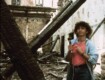 Archives in Dialogue (Episode 3), KASKcinemafilmresearch presentationAgendaArtistic activitiesOnderzoek
Archives in Dialogue is a space to gather, share and reflect on archival practices, art and memory. In being simultaneously recorded as a podcast, this space seeks to encourage an ongoing conversation, reaching into the realms of politics, poetry, and cinema. The dialogue looks specifically to artistic productions made in relation to the anti-colonial, anti- imperialist, anti-fascist political struggles of the 60s and 70s—a period with a rich and sustained filmic body of work that has been widely and systematically marginalized in film studies, in film curation and in the film industry. The absence, or discontinuity, of such political practices in today’s cinema can be understood and interrogated by looking at archival practices relating to these films and their related histories. By inviting practices of “unarchiving” archives, the dialogue aims to reconstruct collective histories and revive intersections of transitional solidarities. As such, a pedagogy begins to emerge from a horizontal reflection on practices and methodologies.
The third iteration of Archives in Dialogue invites 3 practitioners whose practice engages with aesthetically and politically subversive cinematic heritages. Anoushka De Andrade, Mathilde Rouxel and Ali Essafi, together with Mohanad Yaqubi, will be in dialogue to discuss the realities and challenges of dealing with a cinematic heritage that is politically in essence, both at the time of production and today. Each practitioner will be invited to reflect on their own practice and experiences, and to think towards a collective understanding of engaged political archiving practices, including on questions of restoration, re-distribution, and solidarity.
The “Archives in Dialogue” series is hosted by KASKcinema in collaboration with the Archival Sensations cluster at KASK & Conservatorium in Ghent. This event is part of Mohanad Yaqubi’s research Aesthetics of Transnational Solidarity Cinema at KASK & Conservatorium.
Archives of Archives: transnational solidarity film legacies (film programme), 20:30
Films are an archive of the future, and archives are the future of films. This program reflects on the intertwined relationship between images of the present and images of the past by looking into the archival collections of three exceptional filmmakers from the Global South alongside the archival practices that bring these collections into motion in the present.
Ahmed Bouanani, Sarah Maldoror and Jocelyne Saab allproduced films and narratives from within the anti-colonial struggles. In bringing their work into dialogue, this program aims to reflect on questions of methodology and cinematic propositions around images, sound, words, spaces, as well as on archive curation. the program bridges Ahmed Bounani’s eclectic cinematic language, the diasporic decolonial cinematic practices of Sarah Maldoror and Jocelyne Saab’s subjective gaze on revolutionary aesthetics and audience sensibilities.
- Mémoire 14, Ahmed Bouanani (1971 ‧ 30 min)
The film is an adaptation of a poem written by the director in 1967. Made from the film archives of the Moroccan Cinematographic Center, the film is intended to be a story of the French Protectorate in Morocco, seen through the myth-filled memories of Moroccans.
- And the Dogs Kept Silent, Sarah Maldoror (1978 ‧ 13 min)
Recording of excerpts from Aimé Césaire's play. The rebel recites, in front of his mother, a long, heartbreaking poem in which he protests slavery. Actors Gabriel Glissant and Sarah Maldoror perform in the Musée de l'Homme's reserves dedicated to black Africa. Statues and masks from the institution's collections punctuate the film, accompanied by Martinican landscapes.
- Beirut My City, Jocelyne Saab (1982 ‧ 37 min)
In July 1982 the Israeli army laid siege to Beirut. Just before the beginning of the siege, Jocelyne Saab sees her 150-year old childhood home situated in West Beirut go up in flames. Staying in spite of it in the besieged city, she films and asks herself: when did all this begin? While Jocelyne Saab’s images scroll to the rhythm of Roger Assaf's words and voice, every place becomes a historical site and every name a memory.
Guests Biographies
- Annouchka de Andrade has been the Artistic Director of International Film Festival of Amiens. A film festival focused on authors cinema and African and South American films. With over 30 years of experience, Annouchka has worked in international cultural cooperation with a strong focus on audio-visuals, cultural heritage and production in France, Spain, Columbia, Bolivia, Venezuela, Peru and Equator. She has provided technical assistance to Sarah Maldoror in the last 20 years.
With her sister Henda Ducados they have developed a project to preserve and share Sarah Maldoror and Mario de Andrade’ work. The path of two individuals who fought for African independence and cultural emancipation. Crucial to their work are films restoration of films, archiving of documents, correspondences, manuscripts and unknown screenplays etc.
- Ali Essafi was born and raised in Morocco, Ali Essafi studied psychology in France, then entered the world of filmmaking. His works as a director include "General, here we are", "The Silence of the beet fields", "Ouarzazate Movie" and "Shikhat’s Blues" which have been widely screened on the international circuit. Returning to Morocco he embarked on lengthy research on the north-african film & visual archives. These have been transformed into films, installations and publications. His film « Crossing the Seventh Gate » was premiered at the Berlinale (Forum) in 2017 and his last one Before the Dying of the Light will be premiered at IDFA (Amsterdam) in 2020. Ali Essafi is a member of several art & cinema organisations including the Oscars Academy.
- Mathilde Rouxel is a researcher and programmer. She holds a PhD in film studies and continues her research on the history of cinema in Arab countries at the IREMAM-CNRS of the University of Aix-Marseille as an associate researcher. She is artistic director of the AFLAM festival in Marseille and of the Franco-Arab film festival in Noisy-le-Sec (France). In 2019, she co-founded the Association Jocelyne Saab for the restoration and dissemination of the work of the Franco-Lebanese filmmaker. The association's work over the past six years has been to produce and publish artistic and scientific content around the work of Jocelyne Saab, and to train digital restoration professionals in Lebanon and Egypt to put the filmmaker's work back into circulation.
Cloquet
Godshuizenlaan 4
9000 Gent
 Mo'min Swaitat (Palestine Sound Archive), Kunstenbibliotheekresearch presentationAgendaArtistic activitiesOnderzoek
From November 2024 onward, the research cluster The Art of Resonance – The Resonance of Art is organising a series of informal listening sessions with international artists and researchers, with an eye (and ear) to cultivating a sonic sensibility and relationality.
Mo'min Swaitat
Mo’min Swaitat is a London-based Palestinian artist, theatre and filmmaker who trained at the Freedom Theatre (Jenin) and arthaus (formerly LISPA) in London/Berlin, specializing in the Jacques Lecoq method of physical theatre, mask work and mime. He is the founder of Majazz Project, an archival platform and record label focused on reissuing Palestinian cassette and vinyl albums and field recordings, with a particular focus on sounds from the 1960s through to the 1990s. As part of the Majazz Project, Swaitat has initiated the Palestinian Sound Archive, which has been shared through NTS radio and was recently subject of an exhibition held at the Southbank Centre. Swaitat comes from a long line of Bedouin musicians and storytellers, and the archive references his rootedness in music as a means of celebrating one’s culture and sense of belonging.
i.c.w. research project Transnational Solidarity by artistic researcher Mohanad Yaqubi.
Godshuizenlaan 2A
9000 Gent
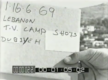 Mohanad Yaqubi, KASKcinemalectureAgendaArtistic activitiesOnderzoek
In 2021, an Israeli filmmaker donated scanned material from Israeli army archives to the Palestine Film Institute as a form of recovery. The collection includes 35 digital clips, presumably from looted archives during the 1982 Israeli invasion of Beirut, including those from the Palestine Cinema Institute from the 1970s. The lecture-performance examines archiving as concern versus oblivion, translating relatedness into inventories, transcripts and captions. Mohanad Yaqubi, Palestinian filmmaker and co-founder of Idioms Film, researches militant cinema and has taught at KASK & Conservatorium since 2017.
Mohanad Yaqubi is affiliated as an artistic researcher to KASK & Conservatorium, the school of arts of HOGENT and howest. The research project Transnational Solidarity was financed by the HOGENT Arts Research Fund.
 I laugh because I know they can't kill melectureAgendaOnderzoek
Mohanad Yaqubi demonstrates using archival footage that it was predominately makers from other cultures who determined what was filmed and what left out of shot. This meant that Palestinians themselves were not really seen. And invisible people can easily be dehumanised and disappear.
The visualisation of Palestine has been formed around the holy landscape of the scriptures, mixed with the mystic orient of fantasies. Yaqubi makes us aware of the images imprinted in our minds. In the past Palestinians have all too often appeared as interchangeable, silent extras. Yaqubi regains the right to speak about their divided past and the picture of them that has been painted.
This lecture investigates the history of image production around Palestine, to understand and position Palestinian cinema in the context of struggle against disappearance, at the same time, championing Palestinian filmmakers who have been experimenting resistance through forms, structures and aesthetics, breaking the barrier, brick by brick, through their films for the past 70 years, as a way of struggle, a cinematic one.
Mohanad Yaqubi
Born in Kuwait 1981 for a Palestinian father and Syrian mother, he grows up hearing the stories of the destruction of his hometown Al-Majdal from his grandparents, who were ethnically cleanse from there after the establishment of the state of Israel in 1948 and resided at an UNRWA Refugee camp in Gaza. Yaqubi is a filmmaker, producer and one of the founders of Idioms Film, an Arthouse production based in Ramallah since 2004, he is also a member of Subversive Film, a curatorial collective that seeks to research and redistribute militant cinema from Palestine and beyond. He is a resident researcher at KASK & Conservatorium since 2017.
The title of the lecture comes from Martin Carter, Poems of resistance, University of Guiana, 1964
IJpromenade 1,
1031 KT Amsterdam,
Netherlands