
 Jocelyne Saab Revisited, KASKcinemafilmAgendaArtistic activitiesOnderzoek
Lebanese journalist and filmmaker Jocelyne Saab is known for her politically engaged films, which she made during a career spanning from the 1970s until her death in 2019. With more than forty titles to her name, Saab brought the untold stories of the Arab world to the screen and gave a voice to marginalised and oppressed communities. During this evening, we revisit her combative yet nuanced oeuvre with two of her most powerful achievements.
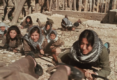
In the short film Palestinian Women (1974), Palestinian women resist the Israeli occupation of their land through education and armed resistance. With Letter From Beirut (1978), Saab returns to Lebanon, where she directs herself in a poetic narrative that questions the creeping continuation of the conflict. She then leaves for South Lebanon, which is occupied by Israel. There, for the first time since the start of the civil war, she documents the Palestinian resistance at the border.
This evening takes place in the context of the book Jocelyne Saab: Inventory 1973–1983 (2024), about the rise of left-wing political movements, armed revolutions and public struggle in the Arab world. The screening will be followed by a Q&A with authors Mohanad Yaqubi, Mathilde Rouxel and Elettra Bisogno.
Cloquet
Godshuizenlaan 4
9000 Gent
 Cinema as Assemblyresearch presentationAgendaOnderzoek
With Forum Lenteng, Marinho de Pina (Mediateca Abotcha), La Voix des sans papiers de Bruxelles in collaboration with Mieriën Coppens and Elie Maissin, Marwa Arsanios, Massimiliano Mollona, Bojana Cvejić, Elettra Bisogno, Lara Khaldi, Elhum Shakerifar, Subversive Film and Robin Vanbesien.
In a time of genocides and authoritarian crises, how can contemporary cinematic practices align with and support political imaginations striving for social justice and antifascist liberation? How do they help us rehearse these imaginations? Cinema as Assembly is a three-day study circle that invites the public to come together – as an audience, as thinkers and as makers – to explore cinema’s potential as both a method and medium that can help rehearse collective organisation, militant imagination and liberatory transformation.
Grounded in a relational geography of translocal struggles, imaginaries and resources, this study circle brings together film collectives from diverse locations (Jakarta, Malafo, Palestine, Lebanon, Brussels, and beyond) and with different cinematic practices. What insights emerge when they share their tools and methods for creating decolonial, speculative and collaborative narratives and methodologies in cinema?
The Cinema as Assembly study circle is co-conceived by Robin Vanbesien, Subversive Film, and Grégory Castéra as part of the World Histories of the Commons programme at KANAL-Centre Pompidou. It builds on the Ciné Place-Making study circle developed by Vanbesien in 2022 at Kaaistudios.
See the full programme and reserve your tickets
- Robin Vanbesien explores modes of embodied knowledge and collective imagination engaged in social and political struggles. Through the notion of ciné place-making, he acknowledges the capacity of cinema to preserve, reclaim, and redistribute invisibilized memories, histories, and lived cultures, using a cinematic language that probes beyond the prevalent scenes of representation. He collaborates with situated emancipatory grassroots movements, exploring cinema as a space for social gathering and political engagement that rehearses the capacity to hold space collectively. In 2020, Vanbesien co-founded The Post Film Collective, which explores cinema as a form of speculative rehearsal and communal assembly. ‘Under These Words (Solidarity Athens 2016)’ (2017) and ‘the wasp and the weather’ (2019) premiered at transmediale and Cinéma du Réel. His first feature ‘hold on to her’ had its world premiere at Berlinale Forum Expanded (2024).
- Subversive Film is a cinema research and production collective that aims to cast new light upon historical works related to Palestine and the region, to engender support for film preservation, and to investigate archival practices. Their long-term and ongoing projects explore this cine-historic field including digitally reissuing previously overlooked films, curating rare film screening cycles, subtitling rediscovered films, producing publications, and devising other forms of interventions. Formed in 2011, Subversive Film is based between Brussels and Ramallah.
Supported by the Flanders Audiovisual Fund (VAF) of the Government of Flanders x Robin Vanbesien’s doctoral research Ciné Place-Making at Sint Lucas Antwerpen Research Group (SLARG) & Antwerp Research Institute of the Arts (ARIA) x Mohanad Yaqubi’s research Aesthetics of Transnational Solidarity Cinema/ Archival Sensations Cluster at KASK & Conservatorium
O.L.V. Van Vaakstraat 81
1000 Brussel
 The roller, the life, the fight (2024), KASKcinemafilmAgendaArtistic activities
On 5 February, at 16:00 KASKcinema screens the film The roller, the life, the fight (2024) directed by Hazem Alqaddi and Elettra Bisogno. The latter is a former film student; this feature debut builds on the master project she also co-directed with Alqaddi.
The film will be followed by a Q&A with the makers.
The roller, the life, the fight (2024)
Hazem arrives in Belgium after a painful journey from Gaza. At the same time, Elettra also arrived in Brussels to study documentary film. Their first moments together are revealing and trigger the desire to get to know each other through the medium of film. The camera becomes the tool for listening to and transforming each other. Through the images of their lives, we are plunged into the details of the meeting of two worlds. The act of recording is an engagement to justice and their movements reveal their wish to resist to a divided society. Hazem and Elettra are confronted with the rigidity of his asylum procedure and must stay strong and united. Will they be able to face it together? It is an exile, an inner migration to reach a place where gazes are softer and more equal.
Cloquet
Godshuizenlaan 4
9000 Gent
Born in Italy in 1993, Elettra Bisogno grew up in various european cities. After studying graphic design in Italy, where she specializes in experimental printmaking, she moves to Brussels and instinctively turns to the moving image. She draws inspiration and forges herself from watching and listening to the world, in its beauty and its injustice. Graduating in 2021 from KASK & Conservatorium in the film programme, she emerges as a documentary filmmaker with two short films: Ultima Cassa (2018) and Old Child (2020). She is now working with Mohanad Yaqubi in the research Aesthetics of Transnational Solidarity at KASK & Conservatorium.