18.03.26 – 20.03.26, Research Days 2026, Play
What if play were set at the heart of reseach, to become its driving force?
With Play as its central theme, KASK & Conservatorium announces the first edition of the Research Days: a three-day festival for researchers, artists, students and visitors to explore playfulness in thought and action — through performances, lectures, panel discussions, exhibitions, workshops and interventions.
Playfulness as a radical gesture
Playing is a fundamental way to engage with the world. How we play both reflects and shapes our ways of being and knowing. Playing also introduces instability and imagination, placing us in a fluid, indeterminate field of experience.
In artistic research, playfulness can function as a mindset and as a research method. Here, playing becomes a critical tool for exploring ideas, testing assumptions, and generating knowledge. When researchers and artists fully embrace play, they tap into its disruptive potential, using uncertainty and improvisation to challenge norms.
Yet play is never neutral. It is situated, embodied, and negotiated: shaped by movement, territory, materials, social structures, media, and the technologies through which it unfolds.
When does art or research in the arts become a playful proposition? Who is allowed to play, and who is excluded? And how might playfulness be understood as an attitude that opens up possibilities and moves beyond normative constraints?
9000 Gent
 Mohanad Yaqubi, members of Oema foe Sranan Project Group, Archives in dialogue (Episode 6)research presentationAgendaOnderzoek
Solidarity and Diasporic Archives: Women of Suriname
Archives in Dialogue is a platform and podcast that fosters conversation on archival practices, solidarity, and memory, focusing on political, poetic, and cinematic works from major 20th-century political struggles (anti-colonial, anti-imperialist, anti-fascist) often overlooked in film studies.
The sixth episode will explore solidarity networks through the Dutch film collective Cineclub Vrijheidsfilm (founded 1966), which screened, distributed, and produced films on global liberation, including their 1978 film, Oema foe Sranan (Women of Suriname), a collaboration with LOSON (National Consultation of Organizations from Suriname in the Netherlands) that embodied a horizontal solidarity approach. Members of the project group will join the dialogue to discuss the historical context of Cineclub Vrijheidsfilm and LOSON, the importance of restoring films created under diasporic conditions, and the session will conclude with a screening of Women of Suriname.
 Benny Nemer, Nitsan Margaliot, drama students KASK & Conservatorium, Poste RestanteAgendaOnderzoek
Poste Restante takes as its material starting point 800 homoerotic postcards donated to researcher Benny Nemer by the Fonds Suzan Daniel, Belgium’s LGBTQ+ archive. The postcards are at once diverse in their depictions of gay erotic aesthetics while also being limited to their specific era and the tastes and collecting habits of their original owner, the anonymous “Herman D”, an allegedly closeted gay man from West Flanders who died in 2023. During the Research Days, Nemer will animate and activate these postcards through movement research with Berlin-based dance artist Nitsan Margaliot and master students from the drama programme. The research will be guided by acts of touching, sorting, arranging, re-arranging, and circulating the cards, seeking novel ways of tracing and fostering queer bonds of kinship across time and space. The research will end with a sharing moment that invites the public to join in the activation and circulation of the materials.
movement research
After the screening of KOPIRAET, there is a conversation with An van. Dienderen and Mohanad Yaqubi about their current research and the need to confront the imperative to “unlearn imperialism” in documentary practice.
(Moderator) Stoffel Debuysere
(Guests) An van. dienderen, noah berhitu, Mohanad Yaqubi
 An van. Dienderen, Hugo DeBlock, KOPIRAETresearch presentationAgendaOnderzoek
How do images made by Western filmmakers cycle back to the source communities?
This presentation focuses on the 2026 documentary KOPIRAET. In Bislama, ‘kopiraet’ means ‘native copyright’ or ‘collective authorship’, and the film explores the boundaries of ownership in Vanuatu. It exposes the complexities of deconstructing a colonial gaze when working from a Western filmmaking perspective. A key focus is how images created by Western filmmakers can be returned to the communities they depict. The documentary sheds light on the vision, policies and procedures of the Vanuatu Kaljoral Senta, an institution that has become a model in the Pacific region thanks to its efforts to decolonise cultural heritage by archiving regional images and regulating all filming through a permit system. Kate Fletcher, The dressed body moving in the living worldresearch presentationAgendaOnderzoek
A participatory workshop that examines how sensory, embodied experience can transform dominant narratives around fashion, sustainability and ecological crisis.
The capacity is limited for this activity and you must make an additional reservation.
Register here (volzet)
Kate Fletcher, Lambros Malafouris, Joost Rekveld, Playing With Objects: Making, Thinking & Material Agencyresearch presentationAgendaOnderzoekPlay as epistemic strategy. This roundtable reflects on what it means to make objects when thinking, acting, and material things are considered inseparable. Play is approached as a way of thinking with things, challenging the boundary between humans and material culture.
 Pedram Kargar, Politics of Touch – Massage with Happy Endresearch presentationAgendaOnderzoek
This tactile performance explores care, embodied knowledge and slow attention through the act of giving and receiving massage. By using touch as a method, the work explores how bodies communicate, let go and relate to each other. Visitors experience the performance individually or in small groups and enter a sensory encounter in which touch becomes both the means and the carrier of meaning.
Kate Fletcher, Sofie Verclyte, Catherine Willems, Playing Together: Collaborative Making & Non-Verbal Knowledgeresearch presentationAgendaOnderzoekPlay as relational method. This roundtable explores collaborative making as a playful research practice where knowledge emerges through the interaction between bodies, gestures, and environments, rather than language alone. Play is approached as a way of working together towards transforming design practices in the contemporary context.
 Bert De Roo, Giliam Ganzevles, Reading-with Soilresearch presentationAgendaOnderzoek
In Reading-with Soil, we read the soil samples we collectively gathered the day before: unstable and imaginative, where the aesthetic dimension becomes as meaningful as the analytical insights they afford. The samples can be approached as technical data, while simultaneously inviting more speculative ways of reading.
The capacity is limited for this activity and you must make an additional reservation. You are welcome to attend this debriefing even if you did not participate in the workshop.
Collectivity, participation & social play
 Resonance in Difference - Ensemble, Resonance in Difference 2research presentationAgendaOnderzoek
This polyphonic ensemble seeks resonance in their differences. They explore the potential of the presence of different voices, without a distinct leader, guided by the nature of their interaction.
(saxophone) Sam Comerford
(vocals) Lynn Cassiers
(percussion) Eric Thielemans
(double bass) Nils Vermeulen
(quarter-tone pianos) Seppe Gebruers
Sam Comerford, Myra Melford, Resonance in Difference 2research presentationAgendaOnderzoekAs part of his doctoral research Radical variations, Primitive forms, Sam Comerford is working on methods to abstract elements from within the structures of Irish traditional music, in particular the playing of fiddler Tommie Potts (1912-1988), and use them in the context of improvised music.
For this concert, he will write a suite of music where he will reduce the elements of Irish dance music to the essential, the set accented tones and motor rhythm (as defined by Mícheál Ó Súilleabháin) and through intervallic transformation (based upon the system of Henry Threadgill) abstract them to find a format that allows for sympathetic resonance between the Irish dance music tradition and improvised music.
(saxophone) Sam Comerford
(piano) Myra Melford
 Maria Chávez, Listening sessionresearch presentationAgendaOnderzoek
Since November 2024, the research cluster The Art of Resonance is regularly organising a series of informal listening sessions with international artists and researchers, with an eye (and ear) to cultivating a sonic sensibility and relationality.
On the occasion of the research days, we are very happy to have Maria Chávez as our guest. Born in Lima, Peru and based in NYC, Maria is best known as an abstract turntablist, sound artist and DJ. Coincidence, chance and failures are themes that unite her work across mediums, including improvised performance, sound sculpture, visual art, book objects and multi-channel installation.
During this session, she will introduce her groundbreaking improvisational turntabling practice, centered on connections between material and temporal failure, and experimentation, through the use of broken vinyl records. The session will draw directly from Chávez’s long engagement with Deep Listening, a practice developed by Pauline Oliveros, emphasizing embodied attention, improvisation, and responsiveness to environment and materials. Here, play operates as a method of research, where experimentation and risk-taking generate knowledge through action rather than instruction.
 Joost Rekveld, The Salt Transistorresearch presentationAgendaOnderzoek
This lecture-performance explores how our technology could have looked different by reproducing a scientific experiment from 1930s Germany. At its heart is the transistor, an invisible component that makes the digital world possible.
In 1938, ten years before the transistor was officially invented, the German scientist Robert Wichard Pohl demonstrated a slow precursor made from ordinary salt. As electrical currents were literally visible, this technology made its operation legible and transparent.
Drawing on this historical re-enactment, the performance prompts us to consider alternative technological trajectories: could we conceive of technologies that are extremely slow, non-toxic, or even anti-fascist? What does it mean to think of technology as playful by nature?
Collectivity, participation & social play
 Laura Palau, Dieter Dewitte, On graftingresearch presentationAgendaOnderzoek
It is often said that those in glass houses should refrain from throwing stones. A reminder that spaces of privilege, frequently quick to critique, must instead cultivate self-awareness and transform wounds into moments of reflection and change. As Donna Haraway wisely notes, “It matters what ideas we use to think other ideas (with).” The ongoing research project, Glass-House & Soft Stones, proposes not merely to think about nature but to think with it. In this context, Laura Palau proposes a series of experiential learning activities focused on apple tree care at the Bijloke site. Here, participants will be invited to practice grafting and pruning.
Our collective practice draws from the traditional Catalan practice of parany, where trees were pruned into conic shapes to trap birds. In this reinterpretation, we will become ensnared, forced to slow down and attune withthe Bijlokesite’s heritage trees, which, through grafting, are carried into new trees and projected toward the future, prompting the question of what kind of orchard we wish to cultivate ahead.
The capacity is limited for this activity and you must make an additional reservation.
workshop
Collectivity, participation & social play
 Seppe Gebruers, Eric Thielemans, Lynn Cassiers en Nils Vermeulen, Resonance in Difference 1research presentationAgendaOnderzoek
3x20 minutes panel discussions interspersed with 15-minute duo improvisations
Resonance in Difference is a musical and improvisational dialogue between different tunings. Each tuning forms its own world, its own voice. In practice, musicians often adapt to the most dominant tonal world – usually that of the piano, which has dominated Western music history for centuries. However, pianist and researcher Seppe Gebruers works with two pianos that differ by a quarter tone. In this session, he enters into conversation with three musicians, without them having to adapt completely to his tuning. We will search for resonance in difference, rather than unity or consensus. Tuning here functions not as an effect, but as a motor for movement, friction and new forms of harmonic and melodic improvisation. The interaction of different tonal systems gives rise to polytunings: sound fields in which multiple tunings are active simultaneously and influence each other. Three duos are participating in this experiment; between sessions, they discuss, reflect and make adjustments together. The participating musicians are Seppe Gebruers, Eric Thielemans, Lynn Cassiers and Nils Vermeulen, each interacting with the quarter-tone pianos.
Part 2 of Resonance in Difference starts at 20:00.
 Helena De Preester, Exploration session Do you remember tamagotchis?research presentationAgendaOnderzoek
Join us to discuss Do you remember tamagotchis? and get more insight in the research behind intimate relationships between people and technological “others”.
New forms of intimacy are emerging between humans and machines. This visual essay explores our emotional connections with social robots and digital companions. What happens when human openness to technology merges with a sense of artificial consciousness? How does it affect us when we feel heard and understood by AI-powered digital companions? How do we behave in interactions with social robots? Humans possess the ability to attribute intentions, thoughts, and feelings to non-living beings. As contemporary users of socially and emotionally intelligent technology, we engage in creative acts of connection and empathy with machines. At the same time, we live in the ambivalence between feeling and knowing: I can experience the machine as an other, but I know it is non-living technology. The rise of technological others affects our view of intimacy and romantic relationships. Through the experience of love, suffering, and death of technological others, this essay explores how technology does not free us from the vicissitudes of love and death, but rather affirms them in a new form.
exploration session
 Soft Connection Lab, Walk your shoelaceresearch presentationAgendaOnderzoek
Have you ever considered the materiality of your shoelaces? Soft Connection Lab invites you to join a workshop where we will braid and walk together. This workshop unfolds as a playful exploration of ropes, tracks, space, and human interaction.
The capacity is limited for this activity and you must make an additional reservation.
 Soft Connection Lab, Walk your shoelaceresearch presentationAgendaOnderzoek
Have you ever considered the materiality of your shoelaces? Soft Connection Lab invites you to join a workshop where we will braid and walk together. This workshop unfolds as a playful exploration of ropes, tracks, space, and human interaction.
The capacity is limited for this activity and you must make an additional reservation.
Register for this activity (fully booked)
 Bert De Roo, Giliam Ganzevles, Being-with Soilresearch presentationAgendaOnderzoek
In the Being-with Soil workshop, a tension emerges between scientific and subjective modes of reading, between knowing and not-knowing the soil beneath our feet on a day-by-day basis. Navigating the campus grounds in a wandering, attentive manner – guided as much by permeability as emotional resonance, we collect a variety of soil samples. Using the Pfeiffer Chroma Test, the samples are transformed into circularchromatograms that make aspects of the collected material visually perceptible.
This workshop has been cancelled. On Friday you can still attend Reading-with-Soil.
Collectivity, participation & social play
How can playfulness be a form of resistance?
In the general outline of these research days we state that 'when researchers and artists fully embrace play, they tap into its disruptive potential, using uncertainty and improvisation to challenge norms'. In this roundtable discussion we want to delve deeper into this assumption. Three artists and researcher at KASK & Conservatorium are invited around the table to explore where and when in their practices and in practices they've witnessed they have really experienced this subversive and disruptive potential of playfulness? What is needed for playing to really challenge norms and even to become an act of resistance against the powers at play.
Guests: Bauke Lievens, Benny Nemer, Laura Palau
Moderator: Geert Belpaeme
Bauke Lievens works as a dramaturg, maker, teacher and artistic researcher in various performing arts disciplines. Her teaching practice has a strong focus on intersectional feminism, affect theory, gender, disability and critical black studies.
Benny Nemer is a multidisciplinary artist, diarist and researcher with twenty-five years of professional practice working with sound, performance, video, participatory gestures, photography, epistolary writing, and flowers. His work has explored and addressed diverse themes over the years, with enduring concern for the language of love and relation, queer archives, flowers as artistic material, the voice as conductor of affect and identity, and artistic interventions into museum mediation practice.
Laura Palau is a multidisciplinary artist. Her image-based and time-based practice reacts to climatic and social emergencies, it is often collaborative and participatory. She collaborates with the public and communities by turning them into participatory laboratories. Based on feminist and indigenous thinking and the rural knowledge in which she grew up, her work weaves together rituals of care, trying to reconcile dichotomies such as human vs. nature, rural vs. urban and local vs. global, intending to deconstruct such distinctions, established primarily by Western academia.
 Geert Belpaeme, Meditation Session on Playfulnessresearch presentationAgendaOnderzoek
What can we learn from the theatre actor? What is playfulness and how can it enrich our daily lives? How do we deal with our reality and environment through play? And what potential lies behind the radical embrace of playfulness?
Geert Belpaeme invites you to a playful meditation session, a philosophical exploration of playfulness in our existence. The actor has an important lesson in store. Through play, we gain an appreciation for the complexity of the world. Play is connected to the distance you can take from the world, and from yourself. Play has to do with disrupting and exploring boundaries.
During these meditation sessions, Geert Belpaeme invites you to let go of the daily performance of an immovable identity. Our identity is a positively charged “nothingness”. In that field of tension, we are undefined and at the same time full of possibilities. The beginners’ session on Thursday lays the foundation for a deeper understanding of playfulness in our existence. The session on Friday builds on those insights to explore the radical potential of playfulness in a disrupted world.
Embodiment, sensation & physical play
 Edwin Carels, Fontain(e)research presentationAgendaOnderzoek
What if Aby Warburg had lived to see the television era? The Fontain(e) installation brings together two images that engage in dialogue through their shared status as reproductions. It consists of a small monitor showing a short video loop and a plaster water nymph incorporated into a metal table structure.
The nymph is a cast of a well-known Renaissance panel that was originally intended for a fountain in Paris. This object from the KASK collection arrived in Ghent in the first half of the nineteenth century as compensation for works of art confiscated by Napoleon, and it was given its current reclining position in the 1970s.
On the monitor, we see an unintentionally broadcast television image of a presenter applying make-up. Video effects and random music give the recording the character of an amateur video clip. Almost two centuries of reproduction techniques lie between these two idealised female figures. Paying homage to Duchamp’s Fountain, this combination forms the basis of the research project History Deletes Itself: Anamnesis of a Video Archive.
Access, power & exclusion
 Opening night receptionresearch presentationAgendaOnderzoek
With Research Days, KASK & Conservatorium is launching a new annual festival dedicated to artistic research. The opening night marks the start of this initiative with a programme of installations, performances and discussions. The evening will conclude with a festive reception.
We see Research Days as an open moment of exchange between researchers, students and staff within our school and in dialogue with research communities from other institutions.
The reception is open to anyone involved in or interested in artistic research, including researchers, students, staff and festival visitors.
We only ask that you register in advance using the reservation form.
 Pedram Kargar, 1001 Eggs: 1001 Inquiriesresearch presentationAgendaOnderzoek
This performative exploration examines food, ritual and collective care. Through the preparation, transformation and handling of food – with eggs as the central motif – the work explores themes such as vulnerability, nutrition, precariousness and shared presence. The result is a sensory experience in which eating, watching and participating all form part of the performance.
We invite researchers Luanda Casella and Laura Huertas Millán to shed light on the theme Playfulness as a radical gesture based on their own practice, followed by a conversation about how playfulness can function as a critical, disruptive and imaginative force within artistic research. The conversation will be moderated by Jana J. Haeckel.
After this conversation, we invite everybody to a reception.
Luanda Casella is a writer, performing artist, and theatre director, currently a house artist at NTGent and artist in residency at de Singel International Arts Centre. Her work focuses on the use of 'manipulative discourse' in communication processes and 'unreliable narrators' in classic and contemporary works of fiction. Luanda Casella is currently a teacher at the drama department at KASK & Conservatorium, Ghent. She has also been a guest lecturer at the following programs: DAS Graduate School, Amsterdam; KABK, The Hague; P.A.R.T.S, School for Contemporary Dance, Brussels; Toneelacademie Maastricht Institute of Performative Arts; Universität der Künste Berlin, Berlin, a.o.
Laura Huertas Millan is a Colombian and French artist and filmmaker based in Brussels, Belgium. Selected in major cinema festivals, more than twenty retrospectives and focuses on her work have been organized internationally. Her films have been featured in solo exhibitions at the MASP Sao Paulo, Maison des Arts de Malakoff and Medellin ́s Modern Art Museum; in biennials and screenings in museums. Since 2019, she is part of the curatorial and research collective Counter Encounters, which has developed projects at the Centre Pompidou and Tate Modern.
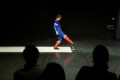 Salomé Mooij, Geert Belpaeme, Anatomy of a stumbleresearch presentationAgendaOnderzoek
Anatomy of a stumble aims to reveal the potential of stumbling. Together with fellow performer Geert Belpaeme, Salomé Mooij questions what makes failed physical actions so fundamental. Based on the rules of slapstick, they explore how staged failure can surprise, move and touch us. A journey of discovery unfolds to a tight, musical cadence. With Anatomy of a stumble, they offer a counterweight to a world that often revolves around efficiency and performance. The performance reminds us of the value of imperfection, failure, vulnerability, resilience, falling and getting back up again.
The capacity is limited for this activity and you must make an additional reservation.
 Laura Palau, Anna Luyten, Reimagining the Bijloke: A Footnote, An Apple Treeresearch presentationAgendaOnderzoek
What happens when we use a stranger’s hand as a map? When walking strategies, ecologies and possible narratives merge into one shared practice? This performative walk begins with an intimate gesture: participants draw lines into each other’s hands, using them as guides through the Bijloke site. Walking in pairs, we arrive at a more-than-100-yearold apple tree, where fruits seem to linger beyond their season, suspended from its branches. We pause for a shared, meditative moment of storytelling, honouring traditional fruit varieties as living archives and regional heritage.
The capacity is limited for this activity and you must make an additional reservation.
 Jerry Galle, Giliam Ganzevles, Bert De Roo, [Intermediate Zones C2-E7]research presentationAgendaOnderzoek
[Intermediate Zones C2-E7] is an attempt to engage with the Bijloke as a more-thanhuman community that unfolds over time. Gathered images, recordings, mappings and observations are fragments that continue to reorganize themselves. This accumulated material becomes the basis for ongoing activation. Apple juice droplets, drawn from the Bijloke’s historic apple trees, create temporary conductive bridges that modulate the collected data. These ephemeral connections introduce contingency into the signal, shaping emergent visual compositions that form and grow denser over time. They are interpreted by machine analysis, informed by the formal documents that shape the site, and subsequently generate a propositional response in the shape of an action, ritual, or form. It is a relay that both carries and catalyses collective material becoming.
 Hannes Verhoustraete, Kumail Syed, Montage as methodresearch presentationAgendaOnderzoek
Montage is often regarded as a stage in the making of a film. But what if montage were not a separate step, rather a continuous practice, and not only in cinema but in any medium? The simple proposition of this project is to consider as montage even the most preliminary acts of bringing together images, colors, fragments of music, sounds, texts, or people. It is there and then that a composition, a rhythm, a palette, a form is already proposed. The exercise is to give form to ideas from the get-go, to approach even the urgencies of our world from a formal level. Montage as Method is concerned with artistic practice as well as pedagogy, developing both feedback and work methods that open space for the unknown throughout the creative process.
 Bauke Lievens / Crip Earth (Re)Generation, Moss Roomresearch presentationAgendaOnderzoek
Moss Room is an immersive audio experience for at least two bodies laying down.
Moss Room is a speculative meditation.
Moss Room is a somatic fiction.
Moss Room is an annexation.
Moss Room is an imaginary landscape.
You cannot listen to Moss Room alone.
Are you looking for co-listeners? You can write down your name on a timetable in De Kabinetruimte and find other bodies to listen with. Please note that Moss Room is in Dutch.
Moss Room is the second installment of Crip Earth (Re)Generation, an artistic research project that seeks to nurture and explore relations of repair at the intersection of artistic practice, disability and our connection to the land. Underlying questions of the research project are: Is the embodied experience of disability/sickness an epistemological position? If so, what can it tell us about societal repair? How can this embodied knowledge be articulated and shared through different artistic forms?
Amongst other actions, Crip Earth (Re)Generation has organized Crip Affinity Group, a monthly gathering with artists living with disability, chronic illness/pain at weder, a local community flower farm. The Crip Affinity Group experimented with seasonal agricultural activities (sowing, grafting, pruning). They embroidered a large collective cloth outdoors, ate together, and read crip theory in the flower field. They devised rituals and small practices of repair, shaped by our lived experiences of illness, disability, and/or chronic pain. Over time, Crip Affinity Group became a shared and shareable space of embodied knowledge about the reciprocity and brokenness of (eco)systems, the mutual dependence of humans and landscape, about toxic productivity, and about the shared vulnerability that connects us to one another and to the more-than-human.
Crip Earth (Re)Generation is an initiative of The Circus Dialogues (continued), an artistic research project at KASK & Conservatorium funded by the HOGENT Arts Research Fund. The project is led by dramaturg, performance maker and lecturer Bauke Lievens in collaboration with a team of co-researchers: Khadija El Kharraz Alami, Kopano Maroga, Louis Vanhaverbeke, Peter Aers, Tineke De Meyer en Tumba Kiambi.
(Concept & text) Bauke Lievens
(Partner in development & text) Tineke De Meyer
(Voice) Dolores Bouckaert
(Sound design) Linde Carrijn
(Recording & mix) Linde Carrijn, Gert Malfliet
(Outside ears) Khadija El Kharraz Alami, Louis Vanhaverbeke
(Thanks to) Robert Monchen & Meer Meer Residency, Stijn Vermeire, Eva Samyn
 Jerry Galle, Life as matter that choosesresearch presentationAgendaOnderzoek
This film conjures up futuristic beings and landscapes that blur the line between the real and the unreal. Sound, image and text offer a meditation on plastic and electronic waste and its possible anticipative role in evolution. Adopting a pseudo-documentary style, the work draws connections between the growth of intelligence and that of new forms of life.
Helena De Preester, Do you remember tamagotchis?research presentationAgendaOnderzoekNew forms of intimacy are emerging between humans and machines. This visual essay explores our emotional connections with social robots and digital companions. What happens when human openness to technology merges with a sense of artificial consciousness? How does it affect us when we feel heard and understood by AI-powered digital companions? How do we behave in interactions with social robots? Humans possess the ability to attribute intentions, thoughts, and feelings to non-living beings. As contemporary users of socially and emotionally intelligent technology, we engage in creative acts of connection and empathy with machines. At the same time, we live in the ambivalence between feeling and knowing: I can experience the machine as an other, but I know it is non-living technology. The rise of technological others affects our view of intimacy and romantic relationships. Through the experience of love, suffering, and death of technological others, this essay explores how technology does not free us from the vicissitudes of love and death, but rather affirms them in a new form.
 Sofie Verclyte, Catherine Willems, Anca Ușurelu, A Sensorial Trackresearch presentationAgendaOnderzoek
A Sensorial Track is an exhibition exploring methodologies of collaborative making, emphasizing knowing by doing (and walking). It invites visitors to engage physically and sensorially with research processes, highlighting how making together shapes knowledge and relationships.
Collectivity, participation & social play