
In literature the figure of the Unreliable Narrator appears as a character who uses persuasive arguments to mislead the reader. The term is used to explain the behaviour of characters who misreport, misinterpret or misevaluate events and who blur the realms of ethics, knowledge and perception usually in highly entertaining ways. In real life, unreliable narration can be a driving force behind violent projects that hide behind ordinary or official language, framed as religious salvation, technological progress or border security.
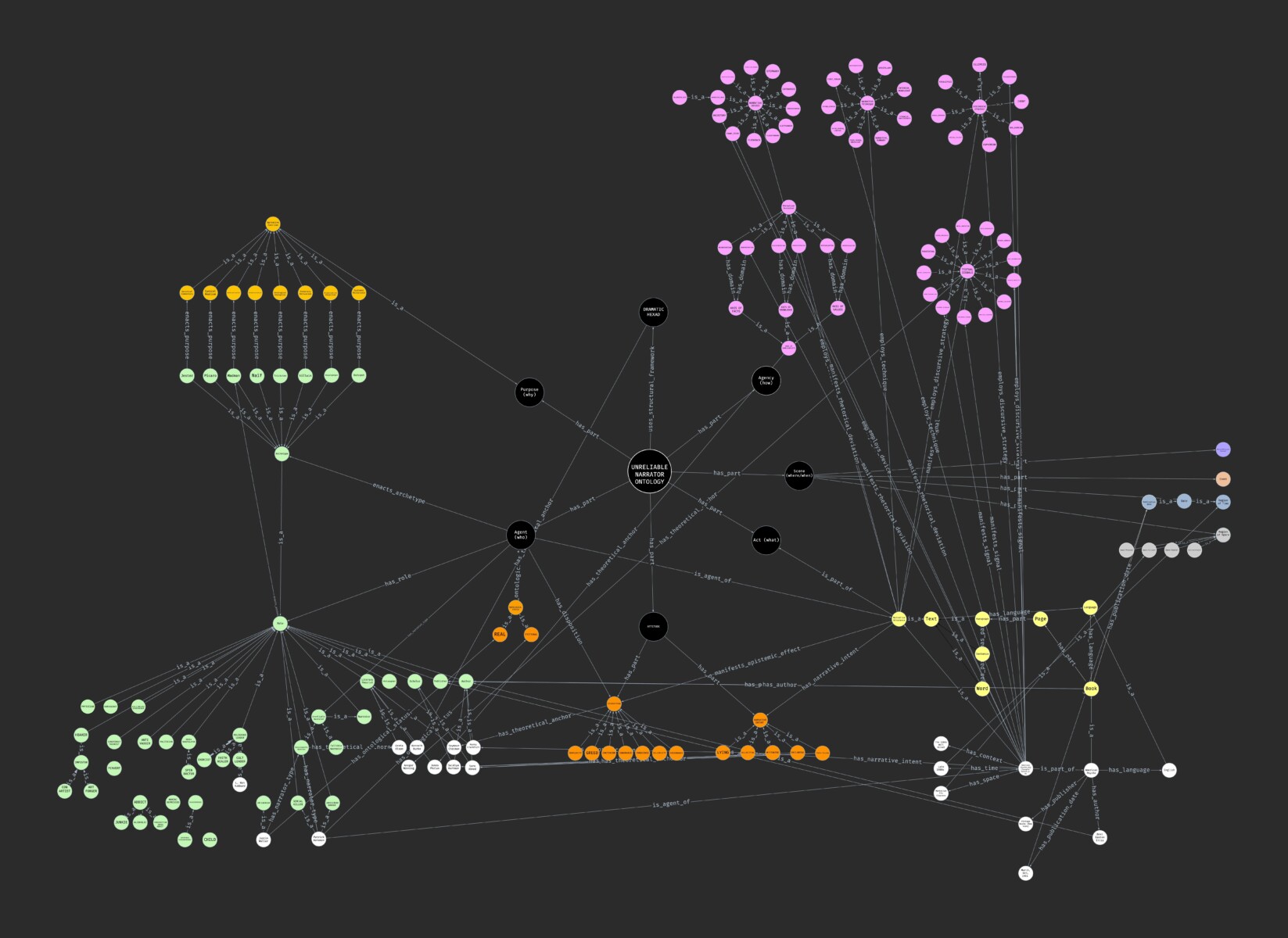
This research project investigates how the study of literary unreliable narrators can illuminate the mechanics of deceptive discourse in the real world. Rather than offering an exhaustive taxonomy of all human deception, this project develops a domain ontology — the Unreliable Narrator Ontology (UNO) — to structure and analyze a qualitative, curated archive of narrative fragments (narrative utterances) drawn from fiction and non-fiction to reveal shared patterns of rhetorical deception. The archive also builds a data bank of characters, grouped into archetypes such as The Villain, The Trickster and The Madman, and set against The Outcast, whose unreliability is imposed by systemic oppression and whose narration becomes a form of resistance.
Using Kenneth Burke’s Dramatic Pentad as its modelling framework, UNO analyzes each narrative utterance across five dimensions: who speaks (AGENT), where and when (SCENE), what is said (ACT), how (AGENCY), why (PURPOSE), and, extended with Burke’s later sixth term, with what disposition and intent (ATTITUDE). Whether a deceptive script is uttered by a fictional character in a novel or by a powerful figure in public life, UNO explores the structural code they share. Its aim is the development of critical thinking: a literature-based lens to help readers detect, decode and navigate performative deception in our precarious world.