
11.02.26, 20:00, Hana Hassanzadeh Kiani, Karin De Vos, Lotte Baelen, Kopiekar
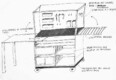
The Kopiekar is a mobile meeting place and workshop where exchange is stimulated through alternative printing techniques. The cart is a small printing studio: a portable collection of tools and materials. Its mobile nature creates an unpredictable dialogue with the immediate environment.
The focus is on collective creation and learning around so-called anti-tools: unpredictable, playful and unconventional tools that invite experimentation rather than efficiency. These tools influence not only the creative process, but also the content and form of the resulting printed matter.
The concept of the Kopiekar is rooted in the idea of commonism, where joint management and shared use of resources are central. This principle is reflected in the way the collection is structured. Tools and materials from personal collections are loaned out and thus made temporarily available to a wider audience. These sustainable resources form the core of the ever-changing collection. Non-sustainable materials, such as paper and ink, are replenished through a system of free contributions.
The collection is activated during gatherings: meetings in which makers are invited to bring an anti-tool, introduce it and share their working methods. Participants then explore this tool collectively by experimenting with it and making prints together. The outcome of each gathering is influenced by three factors: the tool, the chosen theme and the location of the KopieKar. Each gathering results in a series of jointly (re)produced prints.
In addition to the gatherings, the Kopiekar organises open studio days. During these walk-in moments, the workshop is accessible to anyone who wants to use the printing techniques available. In this way, the Kopiekar becomes a mobile hub that opens up resources and knowledge to people who do not have access to them themselves. Outside these fixed times, the Kopiekar can also be used on request for collaborations and projects. Each (anti-)tool will be included in an inventory so that people know which materials are available at any given time. For accessible use, all tools will be accompanied by a logbook in which previous applications and material composition are noted.
In this way, the Kopiekar aims to be a place of exchange between makers, tools and knowledge. Through encounters, shared ownership and collective experimentation, the Kopiekar contributes to the democratisation of printing techniques and the revaluation of making as a collaborative process.
Louis Pasteurlaan 2
9000 Gent
 articleLees, kijk, luistereducationartistic activitiescurated by curatorial studies 24 Hour Swan Lake
 articleLees, kijk, luistereducationartistic activitiesresidenten Jumping Fences
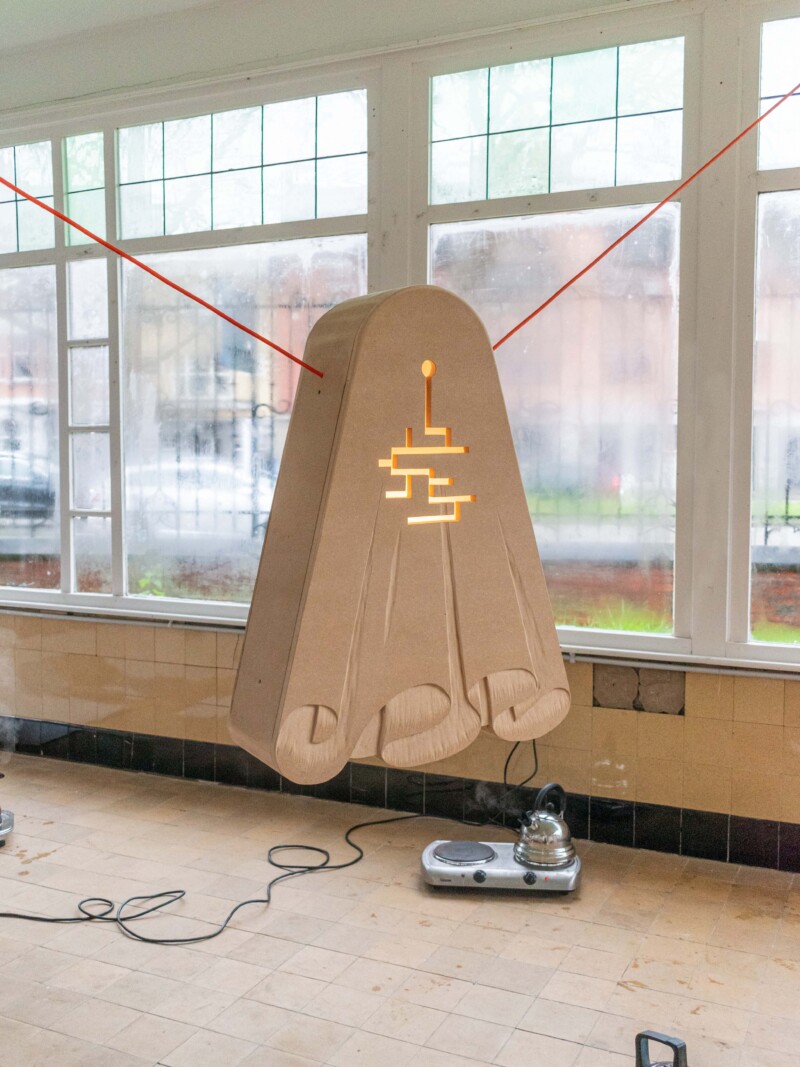 presentationLees, kijk, luisterartistic activitiesresident Jumping Fences
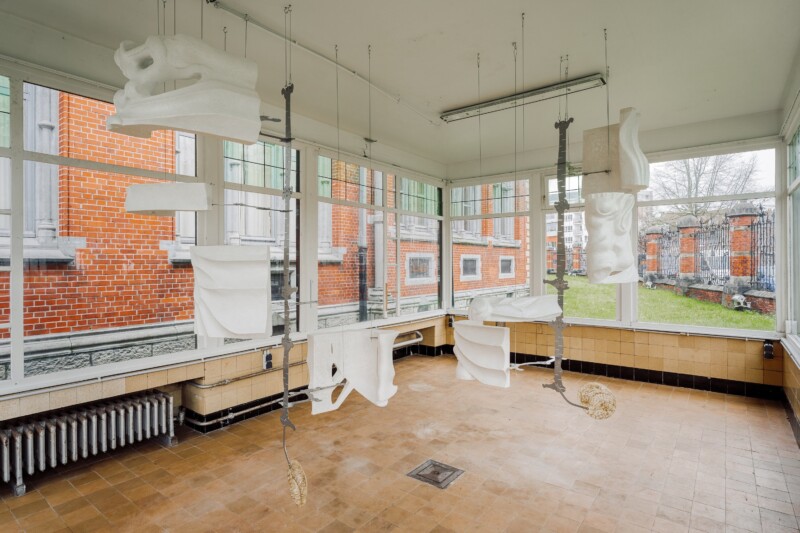 presentationLees, kijk, luisterartistic activities
 THE CELLAR (and our faces, my heart, brief as photos), Het PaviljoenexpoAgendaArtistic activities
In The Cellar (and our faces, my heart, brief as photos), Duccio Viani transforms Het Paviljoen into a domestic cellar brought to the surface: a space of accumulation filled with photographs, letters, postcards and other traces of individual and family histories.
Starting from his own family archive, Viani expanded his research into family cellars and their contents, exploring what he describes as an ecology of the self. As the apparent order of the archive begins to collapse, photographs and documents are exposed to humidity, decay and transformation. What was preserved as evidence of individual lives gradually loses its structure and becomes matter.
The installation is extended by Compost, a collaborative sound piece by Alex Celis and Duccio Viani. Moving between descent and ascent, water and vegetation, decomposition and renewal, the work imagines the cellar as part of a larger cycle in which memories, images, bodies and environments continually change form.
Through The Cellar and Compost, Viani and Celis immerse us in this cycle of accumulation, decay and transformation, asking what remains of the things we preserve—and what might emerge when we allow them to decay.
Duccio Viani
Duccio Viani is a visual artist based between Brussels and Florence. With a background in academia, linguistics and literature, his practice spans painting, mixed media and photography. Working primarily with photographs and paper, he explores the passage of time, material decay and the impermanence of images and objects. Rather than treating photography as a means of preservation, Viani approaches photographic prints as material to be manipulated, degraded, transformed and recycled.
Alex Celis
Alex Celis is a Chilean researcher, curator and interdisciplinary creator with a background in philosophy. Working across writing, documentary film, sound and visual media, he combines theoretical inquiry with artistic experimentation. His current research centres on curating violence and curating decay, exploring how encounters with images and materials can disrupt perception and provoke critical reflection.
Curated by Houda Ben Azzouz
Houda Ben Azzouz is a Brussels-based artist and researcher working across visual and curatorial practices. With a background in journalism, information design, cultural and curatorial studies, her work examines how visual, symbolic, and spatial forms shape narratives and meaning. Working across visual, spatial, and written forms, she explores the often-unspoken frameworks that influence how we see, understand, and relate to the world around us, with particular attention to what becomes visible, accessible, and valued within cultural contexts.
Louis Pasteurlaan 2
9000 Gent
finissage 31.10.26, 16:00–19:00
 Cuntish Magazine, Het PaviljoenexpoAgendaArtistic activities
Launch of the first official issue of the post porn magazine, CUNTISH MAGAZINE
Cuntish Magazine is a sexual and political publication, edited and designed by master student Inès De Laender.
Cuntish Magazine is part of a research into the wide movement of post-pornography. Instead of censoring sexual imagery, it could be reclaimed and reimagined — forming a political stance on the body, sex(uality), gender and image, resisting normative representations. It aims for another way of producing pleasure through looking, creating a counteraction to mainstream internet-porn culture.
In collaboration with experimental publisher copyshop— and bookstore Out of Stock
 #189 Lâle Lootens, Masterprojecten (MAP), Het PaviljoenexpoAgendaArtistic activities
In een ademende, veranderlijke ruimte raakt Washing The Soul aan een innerlijke verschuiving, een beweging van loslaten en terugkeren. In die omwenteling wordt het zelf zachter, ontvankelijk voor wat het overstijgt. Wat hier resoneert, is een stille toenadering tot het onnoembare.
Louis Pasteurlaan 2
9000 Gent
Mon-Thu: 08:00 – 22:00
Fri: 08:00 – 18:00
Sat-Sun: 12:00 – 18:00
 KopieKar printing workshop, Het PaviljoenAgendaArtistic activities
On February 11, starting at 20:00, we will celebrate the construction and launch of the KopieKar in Het Paviljoen!
That same day, we cordially invite everyone to our first print workshop, from 15:00 to 18:00. Everyone is welcome: to print, to try out the tools, or just to come and watch.
Participants are encouraged to bring their own anti-tools: unconventional tools (nothing is too strange!) that we can use to print and experiment together.
The results of this first meeting will be exhibited and celebrated in the evening (with free drinks!).
 Matt Antoniak & Phil Frankland, Het PaviljoenexpoAgendaArtistic activities
Swimming an Itch is an exhibition featuring new work by British artists Matt Antoniak (b. 1991, Nottingham) and former student Phil Frankland (b. 1991, Isle of Man). The exhibition is the result of an ongoing dialogue between the two artists – about painting traditions, material encounters and everyday ephemera – and brings together paintings, drawings and textile works created over the past year. The works are presented in an installation at Convent and at various locations in the city of Ghent.
i.c.w. 019, Het Paviljoen, Kioskiosk
open Fri & Sun, 13:00-17:00
or by appointment
 Sacha Rey, Het PaviljoenexpoAgendaArtistic activities
From Friday 16th May to Friday 6th June, Het Paviljoen presents But I’m a Cheerleader, a solo exhibition by Sacha Rey.
But I'm a Cheerleader explores the challenges for equitable conditions in the creative arts. The documentary, presented at Het Paviljoen as a video installation speaks to different statuses and modes of remuneration, and collectively reflects on the state of working conditions in the sector.
Each protagonist-artworker embodies the character of a cheerleader while practising a physical activity: trampoline, dance, climbing, rollerblading, or running, ice-skating, simultaneously sharing their professional experiences of discrimination. The installation brings to discourse the exploitative nature of the creative industry and the post-scholarship/study experiences that young art practitioners face. Through the reflective nature of this installation, this exhibition prompts a conversation within the context of an art school that addresses contemporary concerns and invites a critical examination of the arts.
The project takes its name from Jamie Babbit's 1999 lesbian comedy of the same name, “But I'm a Cheerleader”.
Sacha Rey (b. 1991, FR) is a visual artist and filmmaker living in Marseille. He is a graduate of the Beaux-Arts de Paris and the École des hautes études en sciences sociales (Paris, France). Sacha practices what he calls “documentary dance” to question physical memories. In his video work, he uses the performing arts as a support for the narrative, intending not to reactualise the traumatic memories of the people who tell their stories.
 Zeynep Kayan, Amel Omar, Reinier Vrancken, Het PaviljoenexpoAgendaArtistic activities
From Thursday 24th April to Sunday 11th May, Het Paviljoen presents that slab of outlaw time, a group exhibition with works by Zeynep Kayan, Amel Omar and Reinier Vrancken.
When endured, waiting is akin to a lethargic state, a prolonged watch where everything seems to stand still. Inwardly, thoughts are racing, reality is being revised. After the hospital was evacuated from the Bijloke site in 1983, Het Paviljoen was used as a storage area. For many years, it lay dormant, out of sight and out of mind before being transformed in 2006 into an exhibition space, a vitrine for all to see, a glass stage. The works of Zeynep Kayan, Amel Omar, and Reinier Vrancken speak to the tension and boundaries between exterior and interior, the outer shell and inner fullness. They disrupt the gestures of vision and the rhythm of one’s perception, drawing attention to blind spots, to the periphery.
Zeynep Kayan’s (b. 1986, TR) practice focuses on exploring the repetitive structural setup of the variations she creates by using video, photography, sound and performance. Through experimentation and chance, the artist articulates a personal vocabulary of the “self”, or of the “human condition”, but rather seems to escape categorization.
Amel Omar (b. 1995, NL) is a multi-disciplinary artist focusing on (site-specific) installation and video. Her practice is grounded in an object-oriented approach, exploring the displacement of objects and spaces and the intrigue of their transitional, liminal states. Through spatial and material interventions, she reimagines conventional functions, inviting new readings of the familiar.
Reinier Vrancken (b. 1992, NL) moves in and out of material and immaterial worlds through oblique connections and poetic leaps. His installations, interventions, objects, and books lyrically test the shifting contours of physical and conceptual bodies—their diffusion and plurality being central to his artistic practice—and become entry points to articulate their underlying relationships.
 Shervin/e Sheikh Rezaei, Soraya Abdelhouaret, Het PaviljoenexpoAgendaArtistic activities
On Thursday 6th March at 18:00, the duo exhibition of Soraya Abdelhouaret and Shervin/e Sheikh Rezaei titled Crying could be a solvent, opens at Het Paviljoen.
As the second part of the Eye becomes water programme, the exhibition seeks to explore waiting in relation to the practice of alchemy. Both artists, with their distinct visual languages, draw connections between material transformation and ideas of devotion and love. The exhibition space thus becomes a vessel where the objects are caught up in moments of transmutation, symbolic of the experience of longing.
Soraya Abdelhouaret (b.1998) lives and works between Paris and Brussels. She is a graduate of the Beaux-arts du Nord and the Beaux-arts de Paris. Her work is directly linked to the question of temporality, and her pieces almost always have a self-destructive or even corrosive dimension. Using low-cost scientific experiments, the artist sets up a bi-reality between mineral materials and disparate materials.
Shervin/e Sheikh Rezaei (b.1994, Belgium/Iran) lives and works in Brussels. In her multimedia practice she explores the contrast between the fluidity and invasiveness of nature/humanity and the controlled and impersonal language of technology. An attraction to the irrational and emotional, took her from architecture to the autonomous visual arts.
Eye becomes water
Drawing from the history of Het Paviljoen, which served as the waiting room of the historic Bijloke hospital for pregnant patients, Eye becomes water is an exhibition and public programme that explores waiting not as a passive or neutral act, but as one that engages multiple temporalities, bodily experiences, and power dynamics.
Curated by Daphné Charitos, Natalija Gucheva, Abel Hartooni, Yasemin Köker, Temitayo Olalekan and Jean Watt.
 Sanie Irsay, Radio Svitlo, Het PaviljoenexpoAgendaArtistic activities
On Thursday, February 27, Radio Svitlo will activate 24 Hour Swan Lake by Sanie Irsay as part of Eye becomes water at Het Paviljoen. The video will be activated with readings by Radio Svitlo, music, zine sales, drinks and more.
The video work is a 24-hour long delayed version of Bolshoy Theatre's 1984 rendition of Swan Lake ballet. Irsay marks three years since the start of the war in Ukraine and uses the instrument used by the USSR in times of turmoil to point out the slow emergencies we live in.
Sanie Irsay (b. 1996) lives and works between New York, US and Amsterdam, NL. Irsay’s practice draws from her heritage as an Uzbekistan-born Crimean Tatar, the indigenous people of Russian-occupied Crimea.
Eye becomes water
Drawing from the history of Het Paviljoen, which served as the waiting room of the historic Bijloke hospital for pregnant patients, Eye becomes water is an exhibition and public programme that explores waiting not as a passive or neutral act, but as one that engages multiple temporalities, bodily experiences, and power dynamics.
Curated by Daphné Charitos, Natalija Gucheva, Abel Hartooni, Yasemin Köker, Temitayo Olalekan and Jean Watt.
Sanie Irsay, Het PaviljoenexpoAgendaArtistic activitiesOn Monday February 24th Het Paviljoen’s Eye becomes water opens with Sanie Irsay’s 24 Hour Swan Lake.
Sanie Irsay’s video work will begin playing at 17:00 and continue for the duration of 24 hours, showing a slowed-down version of Bolshoy Theater’s 1984 rendition of the Swan Lake ballet. Marking three years since the war in Ukraine began and using the tool employed by the USSR in times of turmoil, Irsay signals to the slow emergencies through which we are living.
Sanie Irsay (b. 1996) lives and works between New York, US and Amsterdam, NL. Irsay’s practice draws from her heritage as an Uzbekistan-born Crimean Tatar, the indigenous people of Russian-occupied Crimea.
Join us on Monday 24th February 18:00 for the start of the intervention and on Thursday 27th February when the video will be activated with readings by Radio Svitlo, music, zine sale, drinks and more.
Eye becomes water
Drawing from the history of Het Paviljoen, which served as the waiting room of the historic Bijloke hospital for pregnant patients, Eye becomes water is an exhibition and public programme that explores waiting not as a passive or neutral act, but as one that engages multiple temporalities, bodily experiences, and power dynamics.
Curated by Daphné Charitos, Natalija Gucheva, Abel Hartooni, Yasemin Köker, Temitayo Olalekan and Jean Watt.
Louis Pasteurlaan 2
9000 Gent
 Book launch Jumping Fences, Het PaviljoenlectureAgendaArtistic activities
The Jumping Fences team is delighted to announce the launch of a publication exploring the questions, processes and experiences that emerged from the event and exhibition project held at Het Paviljoen. The publication serves as an interpretive logbook, offering readers a window into the different dialogues that defined this six-month residency in the first half of 2024.
While the residency offered a physical and collaborative environment for creative exploration, the publication translates these experiences into a medium for retrospection. Through interconnected chapters, it probes the questions raised in this shared setting, documenting how each participant navigated the fluidity of their practice and, in turn, contributed to shaping Het Paviljoen.
To celebrate the launch, we invite you to join us for a talk event. This gathering will offer a space to revisit the dynamics of the residency, explore key moments, and discuss the interplay between individual agency and collective influence. Together, we will delve into topics such as the elasticity of artistic roles, the impact of Het Paviljoen’s space on boundary-pushing practices, and how cross-disciplinary collaboration can foster new, hybrid forms of expression.
Jumping Fences, which ran from February till June 2024 at Het Paviljoen, was presented as an exploration of artistic identity in a historically rich space marked by transitory periods. Het Paviljoen has long hosted a diverse spectrum of artistic practices, and during the residency it became a lively site for artists and designers to examine the boundaries separating art from design. Structured as an open dialogue, this residency allowed participants to engage with one another’s work, question their practices in relation to each other, and reimagine their creative approaches beyond conventional limits.
Credits
- Curators: Ismini Kyritsis, Manon Laverdure, Justine Mckenna, Karel Op ’t Eynde, Hugo Roger, Paula Swinnen,Camille Van Meenen and Lisa Verhaeghe
- Artists: Haron Barashed & Lore Janssens, Sjoerd Beijers, Céleste Buyle & Quinten Vermeulen, Yawen Fu, Seppe-Hazel Laeremans, Paola Siri Renard and Jan Vandeplancke
- The project andpublication was kindlysupportedbyCuratorial Studies: Curatorial Studies, KIOSK, KASK & Conservatorium, Stad Gent, Vleeshal, Stad Middelburg, Nederlands Ministerie van Onderwijs, Cultuur en Wetenschap, Alles Kan and Duvel.