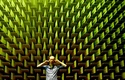
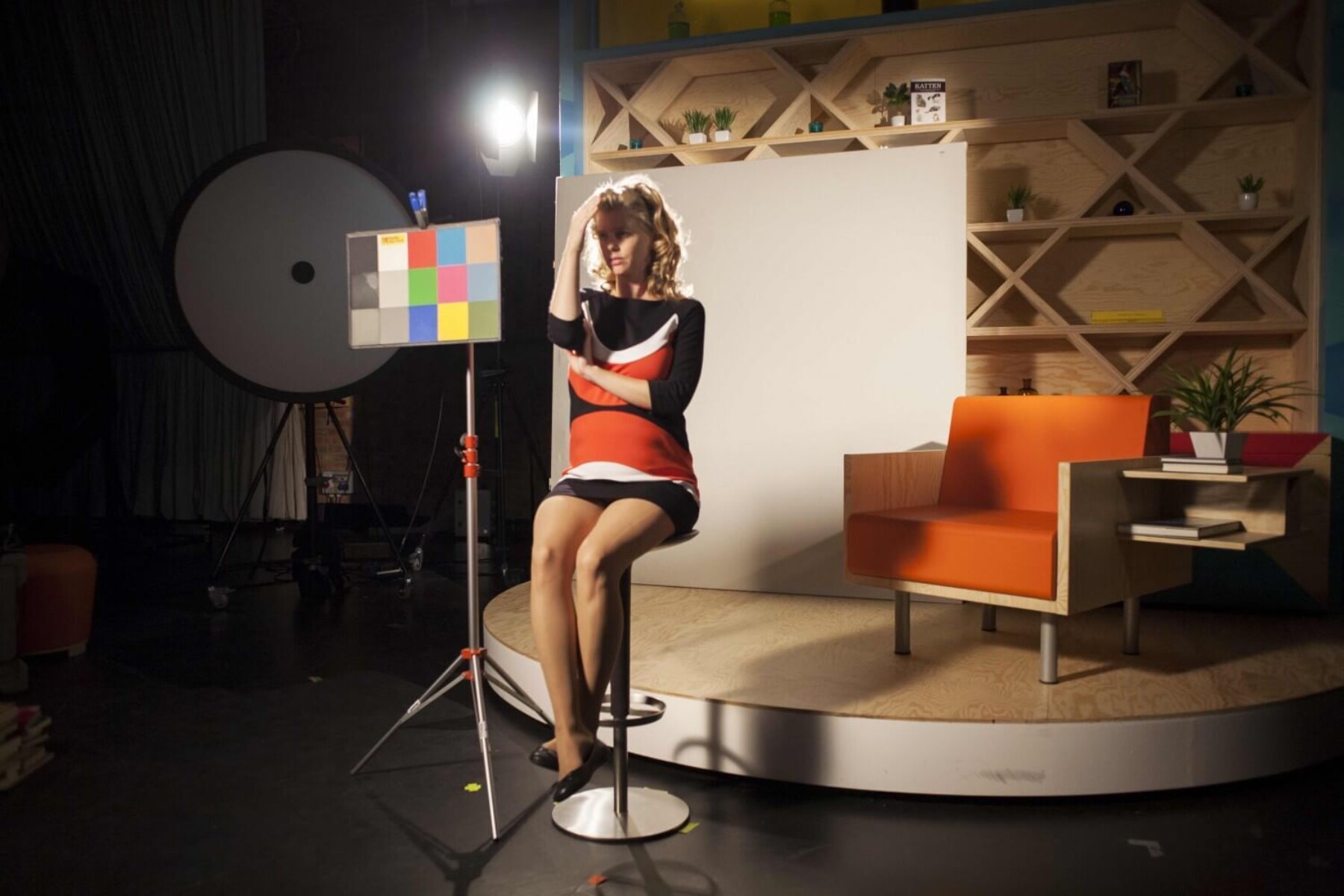


Tom Callemin, Zwarte Zaalexporesearch presentationAgendaArtistic activitiesTom Callemin's artistic research starts from the question of how identity and meaning arise within our perception of images. These processes are constantly changing now that digital and artificial techniques effortlessly generate convincing realities. The photographic images we are confronted with every day increasingly show us a fictional illusion. A fundamental tension is particularly evident in portraiture: behind the skin of the synthetic body lie not psychology or emotions, but merely mathematical calculations of data.
Based on this theme, Callemin set to work with analogue materials such as plaster, wood, clay, shadow and light to create new images that challenge our perception. Like a mirror, each image is a reflection of our gaze and of the act of depicting itself. What do we see? Can we believe the image as it presents itself to us? To what extent do we ourselves give meaning to what we see, apart from what is happening before our eyes?
In the exhibition, Callemin's photographic work is combined with an extensive archive of visual material that addresses these issues throughout history and in different contexts. The developments we are confronted with today in the field of visual culture are not new. With the advent of each medium, such as painting, film and sculpture, which once constituted a technological innovation, similar questions arose about image, meaning and illusion.
A third section of the exhibition stems from the collaboration with filmmaker Griet Teck, who translated the visual research in Callemin's studio into a short film. We get a glimpse of how details from the studio form an illusion in front of the camera. Entire landscapes are constructed in the privacy of the studio as a second reality, where reality unfolds slightly differently. This reveals the underlying constructions of the images that Callemin meticulously builds up. It becomes clear that his images carry an illusion not only in their subject matter, but also in their creation.
Tom Callemin is an artistic researcher affiliated with KASK & Conservatorium, the school of arts of HOGENT and Howest. The research project “Hidden in Plain Sight” was funded by the HOGENT Arts Research Fund.
Arnout De Cleene, Michiel De Cleeneexporesearch presentationAgendaArtistic activitiesIn 1897 the young engineer Theodor Scheimpflug sets out for the Soča River valley in Northern Slovenia.
A stay in the Baumbach Hütte in the remote alpine village of Trenta.
The mountainous area must be mapped. The slopes are steep; the equipment is heavy. The Soča River – its hue azure and almost artificial – winds down through the shepherds’ settlement, with the Vršič Pass looming over it.
The needles and cones of the larches tremble gently when a soft breeze makes its way southwards.
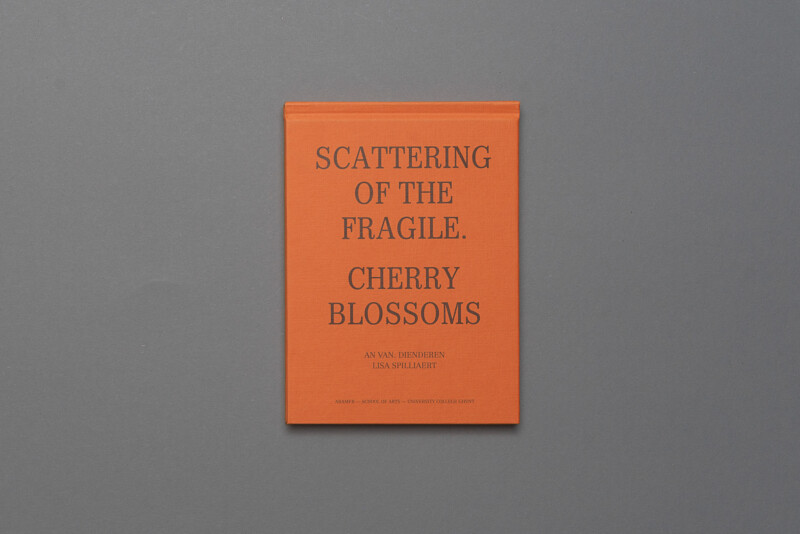
Flying a Kite Through an Oblique Plane of Focus draws on the phototechnical principle named after Theodor Scheimpflug and his interest in kites. At the heart of the project lies an attempt to photograph a nineteenth-century kite flying through an oblique plane of focus in a clearing in the Julian Alps, near Trenta. The title doubles as a protocol through which the work delves into the political, poetic and historical ties between photography, landscape and cartography.
The exhibition opens on Saturday 31 January, from 14:00 to 18:00, with a presentation of the book of the same name (Roma Publications) by Arnout De Cleene & Michiel De Cleene at 15:00.
Flying a Kite Through an Oblique Plane of Focus was made possible with the support of KASK & Conservatorium, the school of arts of HOGENT and Howest. It is part of Arnout and Michiel De Cleene’s research project On Instructing Photography, financed by the HOGENT Arts Research Fund.
Archives in Dialogue (Episode 5)research presentationlectureAgendaArtistic activitiesDialogue with members of the Palestine Film Institute General Assembly (Rasha Salti, Saeed Taji Farouky and Reem Shadid) followed by a screening of R21 AKA Restoring Solidarity (71 min, 2022, DCP)
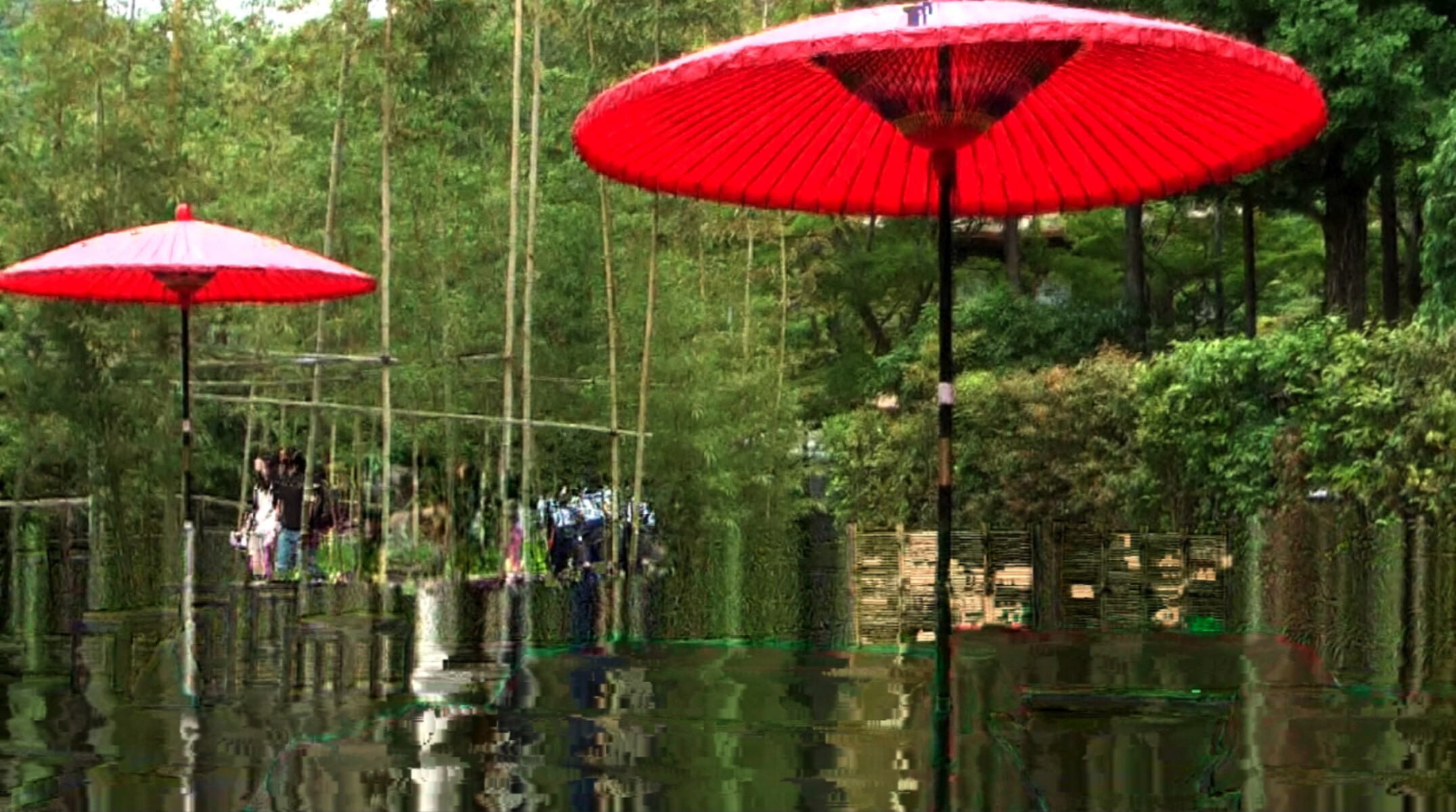
Archives in Dialogue is a platform dedicated to gathering, sharing, and reflecting on archival practices, solidarity, and memory. Simultaneously recorded as a podcast, this initiative aims to foster an ongoing conversation that delves into the realms of politics, poetry, and cinema. The dialogue specifically focuses on artistic productions connected to the anti-colonial, anti-imperialist, and anti-fascist political struggles of the 20th century. An era that produced a vast and rich body of film work that has been consistently marginalized in film studies, curation, and the industry.
By examining archival practices related to these films and their histories, we can better understand and interrogate the absence or discontinuation of such political engagement in contemporary cinema. Through the practice of "unarchiving" archives, this dialogue seeks to reconstruct collective histories and revive the intersections of transitional solidarities. This horizontal reflection on practices and methodologies ultimately allows a new pedagogy to emerge.
The fifth episode focuses on the critical role of activating film heritage and archives during the genocide in Gaza. It explores how the pursuit of relevant contexts and images became an essential act of resistance. Furthermore, it examines the vital contribution of transnational Palestine solidarity networks in challenging the dehumanization of the Palestinian people within mainstream media.
The guests are not only members of the Palestine Film Institute General Assembly but are also acclaimed film programmers and curators. They regularly collaborate with Palestinian and international artists, filmmakers, and activists, deeply engaging with these themes. Their expertise offers an expansive view of artistic practices utilized for researching Palestinian film and art archives, as well as the institutional strategies developed to interrogate and redefine the meaning of archiving and programming in times of conflict.
The Dialogue will be followed by a screening of Mohanad Yaqubi’s film, “R21 AKA Restoring Solidarity.” A film that uses the medium of cinema and its timeline to inventory a 16mm collection about the Palestinian struggle, which has been safely preserved in Tokyo. This Screening is part of United Screens for Palestine activities in collaboration with N22.
This Episode of “Archives in Dialogue” is hosted by Pianofabriek, in the context of their United Screens for Palestine screening series in collaboration with N22( Brussels community centers Network), and the Archival Sensations research cluster at KASK & Conservatorium.
Mohanad Yaqubi is affiliated as an artistic researcher to KASK & Conservatorium, the school of arts of HOGENT and howest. The research project Aesthetics of Transnational Solidarity Cinema was financed by the HOGENT Arts Research Fund.
Edward Georgeresearch presentationconcertAgendaArtistic activitiesEdward George is a writer, broadcaster and photographer. A founding member of Black Audio Film Collective, he wrote and presented, among others, the seminal essay film Last Angel of History (1996), which helped pave the way for contemporary thinking around Afro-futurism. George was part of the multimedia duo Flow Motion and the electronic music project Hallucinator. His ongoing radio series The Strangeness of Dub and The Strangeness of Jazz intertwine a broad musical selection with different geographical musical histories, African/Afro-diasporic knowledge and critical theory from queer and black studies. His recent work includes Dub Housing, a project exploring how dub music articulates a different consciousness of people and place, time and geography, history and architecture, race and metropolis, and Black Atlas, a moving-image essay exploring the Image of the Black archive which was recently exhibited at the Warburg Institute.
Research Days 2026research presentationAgendaArtistic activitiesWhat if play were set at the heart of reseach, to become its driving force?
With Play as its central theme, KASK & Conservatorium announces the first edition of the Research Days: a three-day festival for researchers, artists, students and visitors to explore playfulness in thought and action — through performances, lectures, panel discussions, exhibitions, workshops and interventions.
Playfulness as a radical gesture
Playing is a fundamental way to engage with the world. How we play both reflects and shapes our ways of being and knowing. Playing also introduces instability and imagination, placing us in a fluid, indeterminate field of experience.
In artistic research, playfulness can function as a mindset and as a research method. Here, playing becomes a critical tool for exploring ideas, testing assumptions, and generating knowledge. When researchers and artists fully embrace play, they tap into its disruptive potential, using uncertainty and improvisation to challenge norms.
Yet play is never neutral. It is situated, embodied, and negotiated: shaped by movement, territory, materials, social structures, media, and the technologies through which it unfolds.
When does art or research in the arts become a playful proposition? Who is allowed to play, and who is excluded? And how might playfulness be understood as an attitude that opens up possibilities and moves beyond normative constraints?