15.02.18, 20:00, Nida Sinnokrot
Palestijns filmmaker en installatiekunstenaar Nida Sinnokrot (1971, VS) geeft een lezing over zijn praktijk en solotentoonstelling die daags nadien, vrijdag 16 februari, in KIOSK opent. Sinnokrot tracht de politiek en mechaniek van cinema als massamedium open te breken en zet daar een diversiteit aan nieuwe, zelfkritische vertelvormen tegenover. Zijn camera functioneert als een tool waarmee hij over zijn thuisland, ontheemding en de relatie tussen technologie en kolonialisme vertelt. Met zijn verlangen om de cinematische machine zoals wij deze kennen te bevrijden, drukt hij tevens zijn eigen hybride identiteit uit. Sinnokrot zal enkele sculpturale en filmische installaties in de ruimtes van KIOSK. Ze projecteren een andere manier van kijken waarbij de lineaire tijd en het vaste perspectief dat wij associëren met het traditionele filmapparaat ontregeld worden.
 articleLees, kijk, luisterartistic activitiesstudent curatorial studies WAX (review)
 articleLees, kijk, luisterartistic activities Unfixing the Atlas
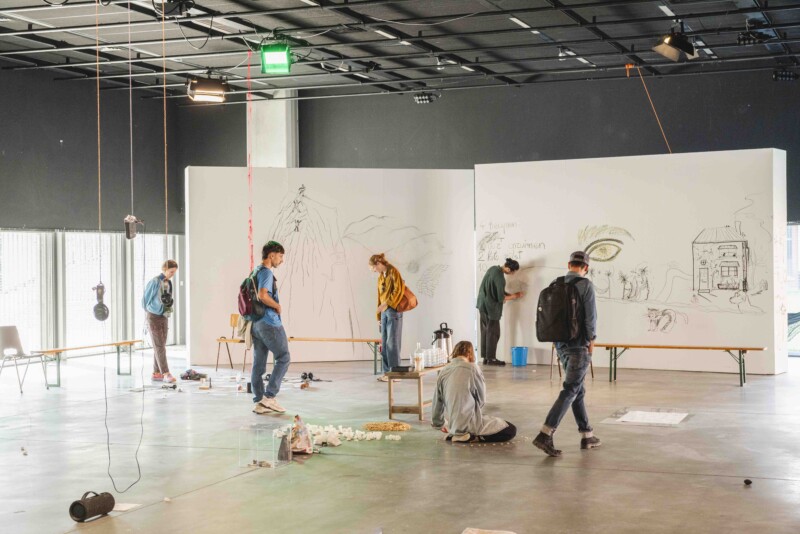 presentationLees, kijk, luisterartistic activities Luc Tuymans, KASKlezing, 29.02.24Opname van de lezing van Luc Tuymans
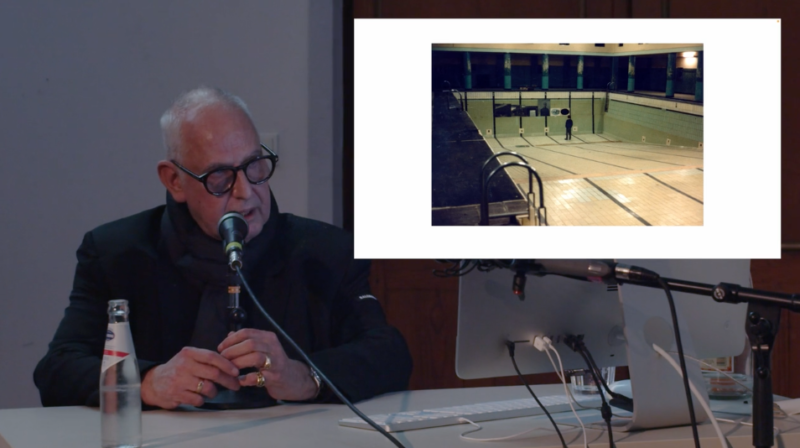 videoLees, kijk, luisterartistic activities Marijke De Roover, KASKlezing, 08.02.24Recording of Marijke De Roover's lecture
 videoLees, kijk, luistereducation KASKlezing, 09.03.23, Linda van Deursenrecording of the lecture
 videoLees, kijk, luisterartistic activitiesresearcher Yavreeges Hokeet Seerem (My beloved / My little one, let me love your soul)
 publicationLees, kijk, luisterresearch Furniture
 publicationLees, kijk, luisterartistic activities KASKLezing, 20.04.2023, The Black ArchivesOpname van de lezing van Mitchell Esajas van The Black Archives.
 videoLees, kijk, luisterartistic activities Het Brievenproject
 articleLees, kijk, luisterresearchartistic activities Het einde van het kunstonderwijs
 articleLees, kijk, luistereducation Jonas Staal
 articleLees, kijk, luisterartistic activities
 Veva Leye, Jelle Martens, KIOSKexpoAgendaArtistic activities
Drawing from seemingly endlessly proliferating word sequences—which arise from a single word through a simple rule and through association—Veva Leye creates montages that present the same words in completely different ways. Uncannily coagulating, these word images expand and contract in an accordion-like movement. A similar rhythm characterizes Jelle Martens’ (photo)graphic registrations that combine fragments, reproductions and trivial observations into layered prints and drawings. Every print layer, every drawing operates as a temporary frame bringing together images that only temporarily solidify, overlap, and fall apart again. Image and language tumble along, stumble upon. Letters form words form images reading looking.
 Lichen Hamraie, Staci Bu Shea, Carly Everaert, Studium Generale, KASKlezingenlectureAgendaArtistic activities
The evening starts with an online lecture by Lichen Hamraie, followed by a conversation together with Leni Van Goidsenhoven. Afterwards there will be interventions by Staci Bu Shea and Carly Everaert, ending with an aftertalk.
Accessibility is often understood as a way to correct built environments not designed with disability in mind. In this talk, Dr. Lichen Hamraie, Canada Research Chair in Technology, Society, and Disability, will will instead explore the broader meanings and practices of access in the twentieth and twenty-first century architecture, design, and disability arts. The talk will focus on four themes: assimilation and anti-assimilation, productivity and anti-productivity, normalization and critique, and the new vocabularies of critical access.
Considering how we can be transformed through giving and receiving care, curator, writer and careworker Staci Bu Shea will reflect on vulnerability and its implications for connection and dignity across interpersonal and institutional domains.
Award-winning costume designer and dramaturgical scenographer Carly Everaert’s presentation will trace how creating spaces for other(ed) bodies — and radically rethinking what a learning space can be — opened the way for their long-term collaboration with Mira Thompson: “Interdependence: On Disability Justice and the (Performing) Arts”. Together, they developed a practice in which co-creation is lived interdependence, crip time is a generative force, and artistic freedom can flourish. This led Carly to altarscenography: theorising how care, attention and solidarity create sacred spaces, where aesthetics and ethics meet as the spiritual foundation for solidarity itself.
About the speakers
- Lichen Hamraie is the Canada Research Chair in Technology, Society, and Disability, and Associate Professor of Social Science at York University. Hamraie’s research on disability and design has helped form the fields of critical access studies and crip technoscience. They are the director of the Critical Design Lab. Hamraie is author of ‘Building Access: Universal Design and the Politics of Disability’ (2017) and host of the Contra* podcast on disability and design. They are a 2022 United States Artists Fellow and Member of the U.S. Access Board.
- Staci Bu Shea is a curator, writer, educator and careworker based in Utrecht, the Netherlands. Broadly, Bu Shea convenes with others over aesthetic, critical, and poetic practices of social reproduction and care work, as well as its manifestations in interpersonal relationships, daily life, community organizing, and institutional practices. Bu Shea is the author of Dying Livingly (Solution series, Sternberg Press, 2025). Bu Shea was curator at Casco Art Institute of Working for the Commons (Utrecht, 2017–2022) and co-curator of Barbara Hammer: Evidentiary Bodies at Leslie-Lohman Museum of Art (New York, 2017). Bu Shea holds an MA from the Center for Curatorial Studies, Bard College (Annandale-on-Hudson, 2016).
- – Carly Everaert is an award-winning costume designer and dramaturgical scenographer. As a lecturer and researcher at the Academy of Theater and Dance in Amsterdam, Carly explores costume, bodies, and sustainability from an intersectional perspective. Their practice is becoming increasingly rooted in the principles of Disability Justice, making diverse abilities, knowledge, and ways of moving more visible. Carly collaborates with artists, curators, educators, and scholars who prioritize embodied knowledge. Carly’s methodology combines critical reflection with material experiments—where making is viewed as a form of thinking. Carly is chair of the jury for the Dutch Theater Festival’s Design Award. Their essay ‘Altarscenography, disability justice and staging coincidence, a secular-spiritual practice of solidarity, on solidarity, coincidence, and shared vulnerability as scenographic practice’ will be published in August 2026.
- Leni Van Goidsenhoven is Assistant Professor of Critical Disability Studies at the Department of Literary and Cultural Analysis at the University of Amsterdam (The Netherlands). Her research focuses on disability, illness, neurodiversity, and non-normative bodyminds in the arts and literature. She is the author of Autisme in veelvoud (Garant, 2020) and OnGehoord (EPO, 2021). Her recent work includes the special issue Cripping Choreography and the forthcoming volume Disability Heritage: Participatory and Transformative Engagement (co-edited with Manon Parry, Routledge). Alongside her academic work, she regularly curates projects for theatres and museums.
This programme is a collaboration between Curatorial Studies, KASKlectures and Studium Generale Gent. The event will be in English and will take place in the Zwarte Zaal of KASK & Conservatorium. The Zwarte Zaal is located on the ground floor and is accessible to wheelchair users, there’s also an accessible toilet in the hallway of KASKcafé. In case you use a wheelchair, go via the entrance of KASKcinema instead of the Louis Pasteurlaan entrance. There are works in the street of KASKcinema, but it’s possible to pass by the entrance at Godshuizenlaan 4. A translation into Flemish sign language will be provided. If you have any further questions about accessibility facilities, please contact the organisation: helena.verheye@hogent.be
Marissal
Louis Pasteurlaan 2
9000 Gent
What happens to an artistic practice when you become a parent? And what happens to an arts institution when an artist’s life disrupts its plans?
Stress Test reflects on how the birth of a child can affect both an artist and an institution. When an artist asked KIOSK to consider postponing his exhibition so he could care for his child, his request also became a stress test for KIOSK: how flexible can an institution be? What responsibility does it bear towards the people it works with?
KIOSK made room for his circumstances and chose to create something new in place of his exhibition. With the help of artists close to KIOSK and its network, a group exhibition took shape around fathers, fatherhood, fathering, and artistic practice. Works based on personal experiences and intimate stories explore care, the love and tension between father and child, and the desire to have or not to have children.
An open call for birth announcement cards designed by artist-fathers extended the invitation to contribute beyond KIOSK’s network. These cards bring together intimate and public moments: the arrival of a child, the announcement of a new life… and an artist becoming a father.
With works by
Ava Pudelek-Hoffman + Nicholas Hoffman, Chloë Delanghe, Danilo Zocatelli, Edouard Peeters-Wintein, Eva Maria Bouillon, Fabrice Schneider, Henry Andersen, Herman Van Ingelgem, Jacques Lizène, Julia Schouten, Laurens Mariën, Leen Voet, Marthe Merckx, Odette & Jasper Rigole, Paul Casaer, Sambasiva Rao Patchineelam & Vijai Maia Patchineelam, Trudo Engels, Vaast Colson, Vanya, Johan & Willem Vermeersch, Veronika Eberhart, Willy Van Ingelgem, and all the artists who contributed birth announcement cards
 Peter Van Hecke, KIOSKexpoAgendaArtistic activities
As part of Connecting the Dots, KIOSK presents A Study on Impact, an interactive installation by Peter Van Hecke in the kiosk pavilion in Citadelpark.
Inside the pavilion, a sculptural space emerges, constructed from eight willow longbows. Visitors are invited to activate the installation through play. Using a blowpipe, they fire acorns collected in the park at a target that forms the space’s final element.
Each impact produces a sound and a vibration that travel back through the installation to their point of origin. Each impact creates an echo and leaves a dent in the target.
A Study on Impact makes the consequences of a seemingly small gesture visible, audible and tangible all at once. The installation invites experimentation, play and wonder, while capturing the traces left behind by every action.
A Study on Impact is the second chapter of Connecting the Dots, a four-part project by Peter Van Hecke for KIOSK.
Louis Hanssensdreef
9000 Gent
 Double Minutes Marathon, KIOSKexpoAgendaArtistic activities
Double Minutes Marathon brings together 8 recently graduated students from KASK & Conservatorium and LUCA School of Arts.
For this edition, Double Minutes has invited the participants for an intensive workshop where they’ll explore the format of an artist talk, in line with their interests and practices. The duos and presentations in this marathon thus result from this period of exchange.
Participating artists
- Angelus Schnabl
- Carlotta Cormegna
- Eva De Vilder
- Freya Coppens
- Gwen Korevaar
- Joppe Carael
- Yara dos Santos
- Zjef Woestenborghs
About Double Minutes
Double Minutes is a program of experimental artist lectures that has been active in Brussels since 2022. For each edition, Double Minutes invite two artists from different backgrounds to rethink the format, taking into account their pairing, the location, and the conventions of this type of presentation.
 De Spijtige Herder 3, KIOSKlectureconcertAgendaArtistic activities
On Thursday, October 1, we celebrate the launch of De Spijtige Herder3, a magazine devoted to art and poetry, edited by Gerard Herman, Nel Aerts, Jan Op de Beeck, Arne Bastien and Vincent Geyskens.
This third issue features:
- An exclusive interview with Hans Werner Poschauko—Maria Lassnig’s personal assistant and confidant—about working and living with the artist.
- A series of drawings by Jolijn Baeckelandt.
- A number of texts exploring the place of painting in the contemporary art world. These texts emerged from HAND & HORIZON, a “seminar on painting” that we organised at KASK in March of this year. Students and lecturers from Leipzig, Malmö, Helsinki and KASK Ghent came together to give lectures and discuss painting (see the table of contents attached).
- A recent self-portrait by Vincent Geyskens, reproduced as an unnumbered screen print on the back cover.
During the launch evening, poetry will be read by:
Brunhilde Von Braun
Veva Leye
Vincent Geyskens
…
There will also be live music.
 Booklaunch Frank Vande Veire, KIOSKlectureAgendaArtistic activities
het balanseer presents Het kwaad by Frank Vande Veire:
We live in strange times. We accuse one another of racism, sexism, fascism, self-enrichment, indifference... On the internet and in the press, insinuations and condemnations rain down, as if we were taking part in a contest in which we try to outdo one another in moral outrage. At the same time, there is rarely any talk of evil, and even less of ‘sin’. These concepts are dismissed as outdated, overly religious or metaphysically charged, remnants of a pernicious Judeo-Christian legacy. In his werpsels, Frank Vande Veire breathes new life into these concepts. He turns his attention to the evil that rages in the world and within ourselves, prompted by a philosophical or literary text, a news report, a documentary, or a personal experience. He delves into the depths of our envy, (self-)hatred, resentment... Human beings torment others because they are tormentors of themselves.
About Frank Vande Veire
Frank Vande Veire has previously published the novels Bloeiende Agatha (2013) and Het einde van alle straten (2022) with de balanseer. He has also written philosophical essays on art, literature, and social phenomena: Als in een donkere spiegel. De kunst in de moderne filosofie(2003), Neem en eet, dit is je lichaam (2005), and Tussen blinde fascinatie en vrijheid. Het mensbeeld van Slavoj Zizek (2015).
 Ommery De Zutter, KIOSKexpoAgendaArtistic activities
Throughout July and August, Ommery De Zutter inhabited KIOSK as artist in residence. While KIOSK remained closed to the public during the summer, Ommery De Zutter, used the anatomical theater as a map for creating an immersive VR experience.
Ommery De Zutter’s exhibition de Wereldgeest, resulting from this residency, opens on 12 September and will be on view until 4 October.
What happens when creationbecomes materially endless?
When skills as a means of creation begin to play a secondary role?
How would expression unfold then?
In what way would it be different?
Is it valid?
Does it remain valid when it continues to be about itself?
Or does creation then become too entangled in itself?
And if that is the case, why shouldn’t it simply be allowed to
When does creation become useful to the Other?
Isn’t creation emerging from creation itself precisely creation?
Does it make sense to investigate the same idea from emptiness when someone has already taken it up from an established position?
Can we accept it when creation is no longer intended for us?
Where does the balance with the Other lie during creation?
Is the imbalance of time and energy with the Other not precisely what is necessary for creation?
Are we also the Other? Are we without the Other?
Does thinking about creation and the Other disrupt the existing balance?
Isn’t it simply obvious that the next forms of creation will move beyond our own abstraction, emerging from semantic-geometric constructions that surpass our own understanding and give rise to new realities?
 Céline Vahsen, KIOSKeventAgendaArtistic activities
For the finissage of Hisae Ikenaga’s solo exhibition Anatomies of Use, Céline Vahsen presents a sound performance in which gestures visibly and physically cause the acoustic landscape.
Through repetitive and manufacturing gestures, industrial materials resonate and bring manual labour into rhythm. Vahsen will also use pottery made by her aunt: utilitarian objects that reconnect her with the past.
Her aunt worked in a ceramic and glass manufacturing company that later became her own, until the late 1990s, when open trade and capitalism contributed to the decline of smaller industries. Playing with vessels, plates and bowls — first functional, then obsessive, then ceremonial — Vahsen transforms everyday objects into resonant instruments carrying personal, social and industrial histories.
Some elements of the choreography are part of a collaborative practice she started in 2025 with percussionist Aya Suzuki.
 Coincidental FLINTA* Choir, KIOSKeventAgendaArtistic activities
An unconventional choir performance by a group of FLINTA*-people investigating the relationship they have to their voice. Together they welcome vulnerability through whispers, stutters and echoes, while also showcasing the power of a collective voice in resisting patriarchal norms. This performance grew out of the master project Exploring a Feminist Voice by Anne Rosa Lut.
The performance is organized on the occasion of the last day of Hisae Ikenaga's solo exhibition Anatomies of Use.
Performers
Anne Rosa Lut, Imme van Zuilekom, Kika Vens, Elvira Mahieu, Kim Heerkens, Sofie Vanderbauwhede, Vera Goldhoorn, Elfine Radwanski, Hriedt Van Biervliet.
 [cancelled] Julian Abraham "Togar", KASKlezingenlectureAgendaArtistic activities
Due to visa issues, this KASK lecture has been cancelled.
Julian Abraham "Togar" is a drummer and visual artist whose practice flows with visual art, sonic practice and experimental filmmaking. Togar's practice often focuses on the demystification and dissemination of specialist scientific knowledge to broader communities through sound, installations and collaborative practices.
Togar's works have been presented at the 17th Istanbul Biennial; 15th Gwangju Biennale; 13th Taipei Biennale; 58th Carnegie International (Pittsburgh); and in public institutions and museums such as De Appel (Amsterdam), KHOJ (New Delhi), SculptureCenter (New York), Nottingham Contemporary and Cemeti (Yogyakarta), among others.
 Maryia Kamarova, Mosquito Farm, KIOSKconcertAgendaArtistic activities
Trinkets, strings, handmade kits and stones that sing: the songs of activated non-instruments will fill the reverberant expanse of Ghent's Kiosk for a double bill that straddles the fringe between concert and installation. Maryia Kamarova's propelling sculptures meet Mosquito Farm's mishmash of structured chaos, all against the backdrop of Hisae Ikenaga's uncanny archeologies in KIOSK's ongoing exhibition, Anatomies of Use, to counter the cross-disciplinary dissonances.
Maryia Kamarova
A sound universe constructed from fragments of nature and treasures of the everyday ~ Belarusian artist Marya Komarova creates spatial settings somewhere along the border of sound installation and meditative performance. Her electro-acoustic gizmos and environmental compositions come alive under her actions and inertias, taking their own destinies into uncharted aural territories and inhabiting spaces as intently as the spectators who fall under their spell.
Mosquito Farm
Two years after their appearance at KRAAK Fest, Maddie Banwell and Grace Black return with Mosquito Farm to show the evolution of their musical contraptions. Bowed metal wobbles, tin cans rumble, fans whir and swirl, and improvised percussion setups drill a beat into action as radio transmissions feed the drone. Perhaps something resembling a guitar or a wind-up hamster might make an appearance ~ anything's a possible player in this hypnotic orchestra of happenstance.
 Hisae Ikenaga, KIOSKexpoAgendaArtistic activities
For her first solo exhibition in Belgium, Hisae Ikenaga presents a selection of existing and new works. The title Anatomies of Use refers to the subtle displacements that structure her practice: shifts of function, status, and meaning. Industrial and domestic objects are appropriated and reconfigured, their use suspended, their familiarity unsettled. Forms appear stabilized, as if halted after transformation, revealing tensions between use, form, and memory.
Ceramic works extend this reflection through the figure of the cylinder, borrowed from industrial lamination tools and transposed into pottery. The motif becomes form, matrix, and trace of gesture. In a new video in collaboration with film director Paula Onet, Soft Dissection, artisanal and medical gestures intersect, opening an ambiguous space between workshop and laboratory. Through these displacements — from tool to object, from gesture to image — Ikenaga constructs an archaeology of the present, where each form becomes trace, sculpture, and question.
About Hisae Ikenaga
Born in Mexico City in 1977 to a family of Japanese origin, based in Europe for more than twenty years and currently living in Luxembourg, Hisae Ikenaga has developed an artistic language that unfolds at the intersection of design, archaeology, and surrealism. She studied art theory and visual arts in Mexico, Kyoto, Barcelona, and Madrid. Her work reveals a fascination with the afterlife of manufactured objects: their programmed obsolescence, their capacity for transformation, and their potential to host new forms of life. Each sculpture embodies a tension between the industrial and the handmade, between the cold logic of production and the fragile warmth of the human hand.
Support
The exhibition at KIOSK is co-curated by Charlotte Masse, curator and Head of Exhibitions at Konschthal Esch, who organized Ikenaga’s major solo exhibition Phantom Limbs in 2024.
Hisae Ikenaga received the generous support of the Fondation Schleich-Lentz for the production of a new series of ceramic works for the exhibition at KIOSK.
With the support of Kultur | lx – Arts Council Luxembourg.
 Miko Revereza, KASKlezingenlectureAgendaArtistic activities
Miko Revereza is a filmmaker born in Manila, Philippines, who currently lives in Oaxaca, Mexico. His upbringing as an undocumented immigrant and his current exile from the United States have shaped his relationship with moving images.
During the next edition of the Courtisane festival, Miko Revereza will visit Ghent and present several films and a performance. In No Data Plan, he uses the resources immediately at his disposal—his camera, his smartphone, his nomadic existence, and his unique perspective as a stranger in a strange land—to construct an evocative meditation on home and homeland. After his decision to leave the United States, he charted his return to the Philippines in Distancing using superimpositions of intimate 16mm images of the airport, his home, and his family. The performance FOLDS is a film poem consisting of a series of superimpositions/double exposures and a live soundtrack. Just like a folded map, distances are collapsed and placed opposite each other. By superimposing years of images of portraits of people and places, the separation between borders disappears.
In this KASK lecture, Miko Revereza talks about his work and the impact of exile and boundaries on his oeuvre.
“It’s complicated to call any place home. Mexico is a place that’s not my home as it is for other people who have lived here for generations. Every place I live, it’s hard to connect to as home, like the US and the Phillippines, but I also feel like there’s so much weight to the word “home,” and it doesn’t need to be such a priority.”