
21.10.26, 19:30, Lichen Hamraie, Staci Bu Shea, Carly Everaert, What Can Access Do? Artistic and curatorial perspectives
The evening starts with an online lecture by Lichen Hamraie, followed by a conversation together with Leni Van Goidsenhoven. Afterwards there will be interventions by Staci Bu Shea and Carly Everaert, ending with an aftertalk.
Accessibility is often understood as a way to correct built environments not designed with disability in mind. In this talk, Dr. Lichen Hamraie, Canada Research Chair in Technology, Society, and Disability, will will instead explore the broader meanings and practices of access in the twentieth and twenty-first century architecture, design, and disability arts. The talk will focus on four themes: assimilation and anti-assimilation, productivity and anti-productivity, normalization and critique, and the new vocabularies of critical access.
Considering how we can be transformed through giving and receiving care, curator, writer and careworker Staci Bu Shea will reflect on vulnerability and its implications for connection and dignity across interpersonal and institutional domains.
Award-winning costume designer and dramaturgical scenographer Carly Everaert’s presentation will trace how creating spaces for other(ed) bodies — and radically rethinking what a learning space can be — opened the way for their long-term collaboration with Mira Thompson: “Interdependence: On Disability Justice and the (Performing) Arts”. Together, they developed a practice in which co-creation is lived interdependence, crip time is a generative force, and artistic freedom can flourish. This led Carly to altarscenography: theorising how care, attention and solidarity create sacred spaces, where aesthetics and ethics meet as the spiritual foundation for solidarity itself.
About the speakers
- Lichen Hamraie is the Canada Research Chair in Technology, Society, and Disability, and Associate Professor of Social Science at York University. Hamraie’s research on disability and design has helped form the fields of critical access studies and crip technoscience. They are the director of the Critical Design Lab. Hamraie is author of ‘Building Access: Universal Design and the Politics of Disability’ (2017) and host of the Contra* podcast on disability and design. They are a 2022 United States Artists Fellow and Member of the U.S. Access Board.
- Staci Bu Shea is a curator, writer, educator and careworker based in Utrecht, the Netherlands. Broadly, Bu Shea convenes with others over aesthetic, critical, and poetic practices of social reproduction and care work, as well as its manifestations in interpersonal relationships, daily life, community organizing, and institutional practices. Bu Shea is the author of Dying Livingly (Solution series, Sternberg Press, 2025). Bu Shea was curator at Casco Art Institute of Working for the Commons (Utrecht, 2017–2022) and co-curator of Barbara Hammer: Evidentiary Bodies at Leslie-Lohman Museum of Art (New York, 2017). Bu Shea holds an MA from the Center for Curatorial Studies, Bard College (Annandale-on-Hudson, 2016).
- – Carly Everaert is an award-winning costume designer and dramaturgical scenographer. As a lecturer and researcher at the Academy of Theater and Dance in Amsterdam, Carly explores costume, bodies, and sustainability from an intersectional perspective. Their practice is becoming increasingly rooted in the principles of Disability Justice, making diverse abilities, knowledge, and ways of moving more visible. Carly collaborates with artists, curators, educators, and scholars who prioritize embodied knowledge. Carly’s methodology combines critical reflection with material experiments—where making is viewed as a form of thinking. Carly is chair of the jury for the Dutch Theater Festival’s Design Award. Their essay ‘Altarscenography, disability justice and staging coincidence, a secular-spiritual practice of solidarity, on solidarity, coincidence, and shared vulnerability as scenographic practice’ will be published in August 2026.
- Leni Van Goidsenhoven is Assistant Professor of Critical Disability Studies at the Department of Literary and Cultural Analysis at the University of Amsterdam (The Netherlands). Her research focuses on disability, illness, neurodiversity, and non-normative bodyminds in the arts and literature. She is the author of Autisme in veelvoud (Garant, 2020) and OnGehoord (EPO, 2021). Her recent work includes the special issue Cripping Choreography and the forthcoming volume Disability Heritage: Participatory and Transformative Engagement (co-edited with Manon Parry, Routledge). Alongside her academic work, she regularly curates projects for theatres and museums.
This programme is a collaboration between Curatorial Studies, KASKlectures and Studium Generale Gent. The event will be in English and will take place in the Zwarte Zaal of KASK & Conservatorium. The Zwarte Zaal is located on the ground floor and is accessible to wheelchair users, there’s also an accessible toilet in the hallway of KASKcafé. In case you use a wheelchair, go via the entrance of KASKcinema instead of the Louis Pasteurlaan entrance. There are works in the street of KASKcinema, but it’s possible to pass by the entrance at Godshuizenlaan 4. A translation into Flemish sign language will be provided. If you have any further questions about accessibility facilities, please contact the organisation: helena.verheye@hogent.be
Marissal
Louis Pasteurlaan 2
9000 Gent
 publicationLees, kijk, luisterartistic activities Nooit genoeg
 publicationLees, kijk, luisterartistic activities Schuld en boete
 publicationLees, kijk, luisterartistic activities Polaroid
 publicationLees, kijk, luisterartistic activities Oprecht kwetsbaar
 publicationLees, kijk, luisterartistic activities Ik weet niet, dus ik ben
 publicationLees, kijk, luisterartistic activities Van melkweg tot moraal
 publicationLees, kijk, luisterartistic activities Bij ons
 publicationLees, kijk, luisterartistic activities De mens in opstand
 publicationLees, kijk, luisterartistic activities Cafuné
 publicationLees, kijk, luisterartistic activities De staartpen van de vuurvogel
 publicationLees, kijk, luisterartistic activities Allmensch
 publicationLees, kijk, luisterartistic activities Zorgangst
 publicationLees, kijk, luisterartistic activities Kunst op voorschrift
 publicationLees, kijk, luisterartistic activities DominantieWaarom we denken wat we denken
 publicationLees, kijk, luisterartistic activities Toujours Trop
 publicationLees, kijk, luisterartistic activities Heersers
 publicationLees, kijk, luisterartistic activities Luc Tuymans, KASKlezing, 29.02.24Opname van de lezing van Luc Tuymans
 videoLees, kijk, luisterartistic activities Marijke De Roover, KASKlezing, 08.02.24Recording of Marijke De Roover's lecture
 videoLees, kijk, luistereducation KASKlezing, 09.03.23, Linda van Deursenrecording of the lecture
 videoLees, kijk, luisterartistic activities
 Nele Buyst, Studium GeneralelectureAgendaArtistic activities
A poignant reflection on space, care and justice, and on what is at stake when place disappears.
Hectare by hectare, the last remaining open spaces are disappearing. Belgium and the Netherlands are leading the way in building over their landscapes, but the trend is the same worldwide. How is it possible that this visible and far-reaching change continues, despite our knowledge of the consequences?
Drawing on a concrete struggle to preserve a historic marshland area in the city of Ghent, Nele Buyst explores what a place actually is, and who determines what happens to it. She shows how ecological, social and cultural interests are intertwined, and how dominant ways of thinking shape our view of space.
Inspired by anti-colonial, feminist and ecological thinkers, this essay explores not only the limits of our thinking, but also the power of resistance and imagination.
Nele will read an excerpt, Zindzi Tillot will recite a poem and Marieke De Munck will provide illustrations. This will be followed by a discussion and a Q&A with the audience. Afterwards, you can buy the book at the bookstall and we’ll round off the evening with drinks and music.
‘Plaats maken’ by Nele Buyst is a publication in the Karakters series, pocket-sized essays on philosophy and cultural criticism. The Karakters series is a collaboration between Studium Generale, Academia Press, deBuren and rekto:verso.
- Nele Buyst publishes poems and essays. Her second collection, ‘CORPS, poreus’ (2024) was nominated for the Grote Poëzieprijs. She is working on a PhD thesis on the potential of aesthetic practices for ecological restoration and is affiliated with the Centre for Ethics at the University of Antwerp. She is an editor at rekto:verso.
- Zindzi Tillot lives in Brussels and studies spoken word. She is a member of the feminist writers’ collective Hyster-X and an editor at the literary platform Kluger Hans. In recent years, she has worked primarily as a poet. These days, she also engages in prose, video art and performance. As well as art and literature, she has a keen interest in social equality, video games, fashion, film, philosophy and internet culture. Her work could be described as melancholic fever dreams with sharp edges. In 2023, she took part in the writing residency in Paris.
- Marieke De Munck is an artist, curator and creative producer specialising in transdisciplinary and participatory art practices. She currently works as a curator at Kunstcentrum VIERNULVIER (Ghent, Belgium). Her expertise lies in curating site-specific and socially engaged practices, urban community labs, ecologically driven practices, artistic guidance and mapping/visual harvesting. Before joining VIERNULVIER, she was artistic coordinator of WILDEMANNEN WOESTEWIJVEN, a biennial multidisciplinary city festival in Ghent. Marieke holds a Master’s degree in Fine Art from LUCA School of Arts and a Master’s degree in Theatre Studies from Ghent University.
The Balzaal is accessible to wheelchair users. The lift at reception will take you to the correct floor. A sign language interpreter will be provided for this talk. If you have any further questions about accessibility facilities, please contact the organisers: helena.verheye@hogent.be. More information about the venue’s accessibility.
Dutch spoken
free for students and staff at HOGENT, Howest, Ghent University and KASK & Conservatorium
Sint-Pietersnieuwstraat 23
9000 Gent
 Apparatus 22, KASKlezingenlectureAgendaArtistic activities
Apparatus 22 is a transdisciplinary art collective founded in January 2011 by current members Erika Olea, Maria Farcas, Dragos Olea together with Ioana Nemes (1979 - 2011) in Bucharest, Romania. Beginning with 2015 they are working between Bucharest, Brussels and SUPRAINFINIT utopian universe.
They see themselves as a collective of daydreamers, citizens of many realms, researchers, poetic activists and (failed) futurologists interested in exploring the intricate relationships between economy, politics, gender studies, social movements, religion and fashion in order to understand contemporary society. A major topic of research and reflection in the practice of Apparatus 22 is SUPRAINFINIT universe: a world-making attempt to use hope critically in navigating present and future.
In their very diverse works - installations, performances, text based-shapes, reality is mixed with fiction and storytelling and all merge with a critical approach drawing knowledge & experience from design, sociology, literature and economics.
The work of Apparatus 22 was presented in exhibitions at La Biennale di Venezia 2013, Kunsthalle Wien (AT), Kunsthal Gent (BE), Kunsthalle Mannheim (DE), Contemporary Art Museum Roskilde (DK), SMAK Gent (BE), CAM Gulbenkian, Lisabon (PT), Malmö Konstmuseum (SE), Contemporary Art Museum (MNAC), Bucharest (RO), MUMOK, Vienna (AT), BOZAR, Brussels (BE), Museion, Bolzano (IT), TRIUMF AMIRIA. Museum of Queer Culture (RO), Académie Royale des Beaux-Arts de Bruxelles (BE), Brukenthal Museum Contemporary Art Gallery, Sibiu (RO), Akademie Schloss Solitude, Stuttgart (DE), KunstMuseum Linz (AT), La Triennale di Milano (IT), TRAFO Gallery, Budapest (HU), Futura, Prague (CZ), Ujazdowski Castle – Centre for Contemporary Art, Warsaw (PL), Salonul de Proiecte, Bucharest (RO), Onomatopee Eindhoven (NL), TIME MACHINE BIENNIAL OF CONTEMPORARY ART, D-0 ARK UNDERGROUND, Konji (BIH), Osage Foundation (Hong Kong), Kunsthalle BEGA, Timișoara (RO), Progetto Diogene, Turin (IT), Closer Art Centre, Kiev (UA), CIAP, Hasselt (BE), Barriera, Turin (IT), Suprainfinit Gallery, Bucharest (RO), Kiosk, Gent (BE), GALLLERIAPIÙ, Bologna (IT), Lateral ArtSpace, Cluj (RO), Survival Kit festival, LCCA Riga (LV), Autostrada Bienniale Prizren (XK), CIVA, Brussels (BE) performances at MAK, Vienna (AT), Steirischer Herbst, Graz (AT), Stedelijk Museum with De Appel CP Amsterdam, (NL), Yarat Academy, Baku (AZ), Württembergischer Kunstverein Stuttgart (DE), Drodesera Festival, Dro (IT), Villa Empain, Brussels (BE), etc.;
Apparatus 22 also works beyond institutions via performances in public spaces, interventions in private spaces and other hybrid forms.
 Veronique Aicha, Studium Generale, KASKcinemalectureAgendaArtistic activities
Garrett Bradley once said: “The tendency to forget is humanity’s Achilles’ heel. But trying to remember is the driving force and the seed of constant revolution.”
Some films cannot be summarised easily. They demand attention, time and a different way of looking at things. ‘Time’ is one such film. Without passing explicit judgement, ‘Time’ raises fundamental questions about how we view justice.
The past plays a central role in Bradley’s films, and the concept of time lies at their heart. Her use of the camera reflects an abstraction of reality. In ‘Time’, the wives of men in detention – and the detained men themselves – are constantly drawn back to that one moment in the past for which they have been condemned, whilst at the same time being swept towards the future.
What unfolds in ‘Time’ is not a classic tale of guilt and punishment, but an intimate and multi-layered exploration of what it means to live with the consequences of a single moment. The film moves between the past and the present, revealing how time itself plays a central role in the prison system. During this evening, Garrett Bradley’s film ‘Time’ serves as the starting point for a broader reflection on prisons and perceptions, not only in the United States, but also closer to home in Belgium and Europe. What does it mean to lock someone up in prison? And what are the alternatives?
Veronique Aicha will give an introduction to Garrett Bradley’s documentary ‘Time’, followed by a screening of ‘Time’.
- Veronique Aicha works at the intersection of art, justice and philosophy. In her work, she explores and develops new perspectives on criminal law. She has worked on criminal law projects across Europe, visited prisons and detention centres throughout the continent, and taught philosophy to people in detention for many years. She is also active as a writer, presenter and programme maker, and develops cultural and social programmes centred on justice, imagination and systemic change.
- Garrett Bradley uses narrative, documentary and experimental film forms to address themes such as race, class, family relationships, social justice, the culture of the American South and the film history of the United States. Bradley has won numerous awards, including the 2019 Prix de Rome and the 2017 Sundance Jury Prize for the short film ‘Alone’, which was released by The New York Times OpDocs and was nominated for an Oscar in the short non-fiction film category, having been shortlisted by the Academy.
Bradley’s work has been featured in various venues, including her role as second unit director on Ava DuVernay’s ‘When They See Us’ and the 2019 Whitney Biennial. In December 2019, Bradley’s first solo exhibition opened at the Contemporary Arts Museum Houston (CAMH), curated by Rebecca Matalon. In January 2020, Bradley became the first African-American woman to win the Best Director award at the 2020 Sundance Film Festival for her debut feature-length documentary, ‘Time’.
This talk and film screening will take place at KASKcinema. The auditorium is wheelchair accessible and a limited number of spaces are provided within the auditorium. The wheelchair-accessible toilet is located on the first floor and is accessible via a lift (90 cm wide, 1.35 m deep). There is another toilet available further down the corridor, past the KASKcafe, for those using a wider wheelchair. Anyone with further questions about accessibility facilities can contact the organisers: helena.verheye@hogent.be.
free for students and staff at HOGENT, Howest, Ghent University and KASK & Conservatorium
Cloquet
Godshuizenlaan 4
9000 Gent
 From Within, KASKcinema, Studium GeneralefilmAgendaArtistic activities
Public perceptions of prisons are generally based on violence and sensationalism. Action films featuring tough men with homemade weapons dominate our imagination, whilst discussions about punishment and retribution in the news media strip prisoners of their humanity. This programme of experimental short films seeks to offer a perspective of resistance and dignity from within, through dreamlike portraits that challenge our conception of detention.
Alone (2001) and Shadow Codex (2021) reveal the infrastructural regimes of the prison as a place. In Le Thé et le Temps (2022), a haircut becomes a confession, whilst the participatory project Trinity(2025) takes prisoners on a motorbike ride through their dreams and memories. Finally, films such as Jean Genet’s Un Chant D’Amour(1950) and How To Dance (2025) offer poetic reflections on the nature of intimacy and beauty in a world defined by restrictions.
The screening will be followed by a panel discussion on detention and the imagination.
Cloquet
Godshuizenlaan 4
9000 Gent
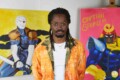 Larry Achiampong, KASKlezingenlectureAgendaArtistic activities
Larry Achiampong (b. 1984, London) is a British-born, Ghanaian artist who lives and works in Essex. His projects employ film, still imagery, aural and visual archives, live performance, objects, sound, and game design to engage with ideas surrounding class, gender, cross-cultural, and digital identity. With works that examine his communal and personal heritage, in particular, the intersection between popular culture and the residues of colonisation, Achiampong crate-digs the vaults of history. These investigations examine constructions of “the self” through splicing the audible and visual materials of personal and interpersonal archives, offering multiple perspectives that reveal deeply entrenched inequalities. In 2025, Tate Publishing released Achiampong’s debut monograph, If It Don’t Exist, Build It. He has had recent solo exhibitions at venues including Stanley Picker Gallery, Kingston, UK, 2024; a touring exhibition in the UK at Turner Contemporary in Margate, MK Gallery in Milton Keynes, and BALTIC Centre for Contemporary Art in Gateshead, 2022–23; and PHI, Montreal, 2021, and recently participated in Sonsbeek 2026, the oldest recurring large-scale public art exhibition in Europe. His work has also been commissioned by Art on the Underground, London, 2022; Liverpool Biennial, 2021; and The Line, London, 2020. Achiampong received the Stanley Picker Fellowship in 2020 and the Paul Hamlyn Award in 2019.
 Mike Sperlinger, Ian White, KASKlezingenlectureAgendaArtistic activities
Ian White – a British writer, curator, artist and performer – died in 2013 at the age of 41. He left behind a unique body of performance works, and a set of problems: How to treat the documentation of White’s performances – were they works in their own right? What status did White’s published scripts have? Could these works – full of intimate detail, delivered in White’s inimitable voice – be performed by others? In short: how, if at all, could these works have a life after his death? Mike Sperlinger, a friend and collaborator of White’s, has been reckoning with these questions and others whilst working on his artistic estate. That has included co-curating a posthumous gallery exhibition, overseeing restagings of White’s work by others and, most recently, preparing ‘scores’ of several of the performances for acquisition by an art museum. This process – informed by conversations with many of White’s collaborators as well as others – has been necessarily tentative, following the route of what White himself called “repetition and failure”. The result is not a formula to follow, but perhaps a new and more interesting set of dilemmas. In this talk, focussed on the work Black Flags, Sperlinger will talk about some of these dilemmas and their practical consequences, such as: which parts of a performance resist notation; whether it is possible to conserve qualities like irreverence; the difference between reproduction and transmission; the agency of the re-performer and its limits; and friendship as a form of art history.
 Minne Kersten, KASKlezingenlectureAgendaArtistic activities
Minne Kersten is an artist working with video, installation and paintings. Underneath these media lies a literary approach in which she combines several techniques to construct a world where objects and scenes hold traces of both facts and fiction. She speculates on how we can recall events, memories and stories, by tracing what is lost in what remains. Her work considers the relationship between the real and the imagined, the ordinary and the ephemeral, and poses questions about memory and reconstruction. By drawing attention to the act of construction in both our shared real and imagined world, her work offers a connection between intimate themes such as mourning, loss and desire, and the collective domain of fiction, fables and symbol making.
Painting and drawings are continuously made during a process of introspection and research. They serve as a form of visual note taking, made alongside her spatial approaches. In recent years, she has used the method of crafting an architectural environment, which reveals itself as a scenography, a film set, and subsequent sculpture. Often informed by personal encounters with spaces, these sculptures provide a tangible terrain to explore how a space can witness or distort stories and events. By staging situations that embed symbolic elements such as the appearance of animals or phantom presences, she refers to ways of how the past can leave impressions on the present. Subjecting her scenes to chaos, decay and disruption, she suggests different outcomes of the familiar circumstance of feeling unstable, losing control and reaching a state of transition.
Her work has been exhibited internationally, including solo presentations at UKS (NO, 2027); Ginny on Frederick (UK, 2026); Kasteel Wijlre Estate (NL, 2026); de Oude Kerk (NL, 2025); Annet Gelink Gallery (NL, 2025); Glasgow International (UK, 2024) and the Bonnefanten Museum (NL, 2023). Selected group exhibitions include: UKS (NO, 2026), Stedelijk Museum Schiedam (NL, 2025), CAPC Musée d’Art Contemporain de Bordeaux (FR, 2024); and the 16th Lyon Biennale (FR, 2022). Her films have been screened at Eye Filmmuseum, Rencontres Internationales, among others. In 2022 she received the Volkskrant Visual Arts Audience Award and was nominated for the Royal Award of Modern Painting. She has participated in residencies at De Ateliers, Amsterdam (NL), Triangle Astérides, Marseille (FR) and Cité Internationale des Arts, Paris (FR) and is represented by Annet Gelink Gallery in Amsterdam. Kersten currently lives and works between Amsterdam and Paris.
 Paola Verhaert, Studium GeneralelectureAgendaArtistic activities
The digital society seems like an unstoppable express train. But who laid the tracks, who sets the speed, and where is the journey headed? In this lecture, Paola Verhaert deconstructs the dominant metaphors of our digital society. Metaphors, such as that of the digital express train, which wrongly suggest that technology is a neutral tool, rather than a currency of power.
Drawing on the work of thinkers such as Nancy Fraser and Paulo Freire, Paola makes a case for digital justice. For a digital society in which technology serves people, rather than the other way round, and in which citizens themselves can decide which technologies they wish to embrace, build or reject.
The evening begins with a lecture by Paola Verhaert, followed by an artistic intervention by Maria Magdalena de Cort. Finally, there will be a post-event discussion with panellist Judith Zoë Blijden, moderated by Annelies Bontjes.
- Paola Verhaert is a researcher and writer with ten years’ experience working at the intersection of technology and social justice. In her work, she studies the political and social impact of digital technologies, with a particular focus on the impact on citizens, marginalised groups and the government. As a writer, she explores themes related to technology, politics and culture. Her work has been published in outlets including Hard//hoofd, de Reactor, Knack, Samenleving & Politiek and MO*, and in 2025 her first book, entitled ‘Technology is politics: The struggle for digital justice’, was published. In 2024, Paola was appointed ‘Scherpsteller’ by the Flemish-Dutch house of literature and debate, deBuren, and the Hannah Arendt Institute, with the remit to focus on social developments over a two-year period.
- Judith Zoë Blijden is a Dutch lawyer and philosopher. She works at the intersection of research, policy and art. She is the founder of Is This Art Maybe and the creator of The Digital Period, a philosophical project that explores the relationship between humans and technology. She also works as a senior legal adviser at Hooghiemstra & Partners, a consultancy specialising in law and technology.
- Maria Magdalena de Cort works as an actress, writer and theatre maker. In 2023, she completed her Master’s in Drama at KASK & Conservatorium. She is a founding member of the feminist thinking-and-creating Magdalena Collective. In 2024, together with Jonas Baeke and Mats Van Droogenbroeck, she created INFINITYFOREVER (Kopergietery). She writes short stories and poetry as part of the techno-poetry project Moenen & Mariken (i.c.w. Robbe Embrechts), with which she has performed as a vocalist at events including Crossing Border, Suikerrock and the Bronzen Uil awards ceremony. Since 2023, she has been a member of the Ostend-based writers’ collective De Letteristen. She has a passion for electronic music, feminist literature and unreliable narrators. In 2025, she took part in the writers’ residency at deBuren.
- Annelies Bontjes is the Belgium correspondent for the Dutch newspaper *Trouw* and a freelance presenter. She also writes for *De Standaard* and can be heard weekly on ‘De Ontdekking van België’ on VRT Radio 1. Her interests lie in social and political issues, with a particular focus on the relationship between Belgium and the Netherlands.
This lecture is a collaboration between deBuren and Studium Generale Gent and will take place in the MIRY Concert Hall. The venue is wheelchair accessible via a lift to the first floor. A Flemish sign language interpreter will be provided for this lecture. Anyone with further questions about accessibility facilities can contact the organisers: helena.verheye@hogent.be. On the day, questions can be addressed to the student assistant at the reception desk.
9000 Gent
 Laure Prouvost, KASKlezingenlectureAgendaArtistic activities
Language – in its broadest sense – permeates the video, sound, installation and performance work of French multi-media artist Laure Prouvost. Known for her immersive and mixed-media installations that combine film and installation in humorous and idiosyncratic ways, Prouvost’s work addresses miscommunication and things getting lost in translation. Playing with language as a tool for the imagination, Prouvost is interested in confounding linear narratives and expected associations among words, images and meaning. She combines existing and imagined personal memories with artistic and literary references to create complex film installations that twist fiction and reality. At once seductive and jarring, her unique approach to filmmaking employs layered storytelling, quick cuts, montage and wordplay and is composed of a rich, almost tactile assortment of pictures, sounds, spoken and written phrases. The films are most often nestled into carefully constructed environments filled with a dizzying assortment of found objects, from sculptures, painting and drawings to signs, furniture and architectural assemblages, that are connected to the overarching narrative yet act like relics.
gLaure Prouvost was born in Lille, France (1978) and is currently based in Brussels. She received her BFA from Central St Martins, London in 2002 and studied towards her MFA at Goldsmiths College, London. She also took part in the LUX Associate Programme. Prouvost won the MaxMara Art Prize for Women in 2011 and was the recipient of the Turner Prize in 2013.
 Farah Focquaert, Studium GeneralelectureAgendaArtistic activities
What if nobody truly chooses freely who they become or what they do? Farah Focquaert challenges us to rethink punishment and retribution. Our current legal system relies heavily on the idea that people ‘deserve punishment’ purely on the basis of personal responsibility. Focquaert explores an alternative: a form of justice that does not revolve around revenge or moral guilt, but around restoration for all those involved, the protection of society and early prevention. What does that mean in practical terms for prisons, punishments and policy? Can we move towards a more humane system that focuses on change and genuine social safety? Can we, and are we willing to, recognise that repression not only makes our society less safe, but is, moreover, inherently unjust?
Following the lecture, Farah Focquaert will be in conversation with Sibo Rugwiza Kanobana.
- Philosopher Farah Focquaert works as a visiting professor in the Department of Philosophy and Moral Sciences at Ghent University, and as a lecturer in the Applied Psychology programme at Artevelde University College. She is an expert in, amongst other things, research into free will and moral responsibility, punishment and detention. She is the author of ‘A Better Life Without Free Will.’ (B&L, 2025)
- Sibo Rugwiza Kanobana is a senior lecturer in sociolinguistics and postcolonial studies at the Open University of the Netherlands. He is co-author of The Bastards of Our Colony: Untold Stories of Belgian Mestizos (2010), editor of the essay collection Black Pages: Afro-Belgian reflections on Flemish (post)colonial literature (2021) and author of *White Order: On Race, Class and Whiteness* (2024) and *Lumumba’s Dream: What His Legacy Can Teach Us Today* (2025). He was an editor at *rekto:verso* from 2016 to 2024.
This lecture will take place at MIRY Concert Hall. The hall is wheelchair-accessible via a lift to the first floor. A Flemish sign language interpreter will be provided for this lecture. Anyone with further questions about accessibility facilities can contact the organisers: helena.verheye@hogent.be. On the day, questions can be put to the student assistant at the reception desk.
This lecture takes place in Dutch
9000 Gent
 [cancelled] Julian Abraham "Togar", KASKlezingenlectureAgendaArtistic activities
Due to visa issues, this KASK lecture has been cancelled.
Julian Abraham "Togar" is a drummer and visual artist whose practice flows with visual art, sonic practice and experimental filmmaking. Togar's practice often focuses on the demystification and dissemination of specialist scientific knowledge to broader communities through sound, installations and collaborative practices.
Togar's works have been presented at the 17th Istanbul Biennial; 15th Gwangju Biennale; 13th Taipei Biennale; 58th Carnegie International (Pittsburgh); and in public institutions and museums such as De Appel (Amsterdam), KHOJ (New Delhi), SculptureCenter (New York), Nottingham Contemporary and Cemeti (Yogyakarta), among others.
 Norbert Peeters, Studium GeneralelectureAgendaArtistic activities
British biologist Charles Elton is often regarded as the founder of research into animals and plants that colonise new areas. His 1958 book The Ecology of Invasions by Animals and Plants is considered the official starting point for this field of study. However, naturalists had been observing life forms establishing themselves in unfamiliar environments long before that.
As early as the eighteenth century, the famous Swedish scholar Carolus Linnaeus observed that exotic plants sometimes spread on their own and take root in the wild. He was the first to map how these newcomers spread across the world. Humans in particular play a key role in this.
Unlike today, Linnaeus did not see these successful exotic species as a threat, but as an enrichment of the native nature. It was none other than Charles Darwin who was the first to label a successful exotic species as “invasive”.
During his voyage on the Beagle, he saw how a European garden plant was rapidly spreading across the pampas of South America, displacing typical pampas plants. Not long after, Europe was hit by its first real plant invasion: a seemingly innocent aquatic plant from North America captivated science, politics and the press.
In this lecture, botanical philosopher Norbert Peeters will talk more about this forgotten history of thinking about plants that establish themselves in new areas. He will base his talk on his recent doctoral research. After the lecture, Norbert Peeters will talk to Tim Adriaens, a landscape ecologist specialising in invasive species. Helen Weeres, Saïda Ragas and Malika Soudani will provide literary and cinematic interventions on the subject of being exotic.
- Norbert Peeters is a botanical philosopher, writer and university teacher in Philosophy at Wageningen University & Research. Peeters studied Archaeology and Philosophy. At Leiden University, he is writing a dissertation on the conceptual history of invasion ecology, in which he writes about the earliest developments in thinking about invasive plants. As a botanical philosopher, he is interested in the extraordinary world of plants. Following Darwin's vision of the plant kingdom, Peeters argues for a different way of looking at and describing plants. In 2016, he made his debut with Botanical Revolution: The Plant Theory of Charles Darwin. He subsequently wrote Rumphius' Herbarium: Stories from the Ambonese Flora (2020) and Wilderness Varnish: A Philosopher in the Vondelpark (2021), among other works. In 2023, he co-edited the reissue of Flora Batava: the wild plants of the Netherlands.
- Helen Weeres has a background in poetry, literary and cultural analysis, and gender studies, and works in the (research) arts alongside regenerative farmers, scientists, and other artists. Helen's practice is fuelled by poetry and a fascination with artefacts and instruments that inspire regenerative interactions between humans and a broader ecosystem. Themes such as human-inclusive ecosystems, lost (pagan) rituals and folklore, queer ecology, and human-soil relationships are often central to Helen's evocative poems, performances, installations, and (inter)active gatherings. Helen is co-organiser and coordinator of Queer miQ, an “open” stage that invites FLINTAQ* people to “queer” the microphone. In 2025-2026, Helen will develop new literary work outside the book in collaboration with TILT, made possible in part by the Dutch Foundation for Literature.
- Saïda Ragas is an illustrator and comic strip artist. Her work is based on her idealistic, sex-positive and feminist ideas. Through playful and colourful images, she shares personal experiences, social footnotes and dream images. In 2024, Saïda was a finalist in the annual illustration competition De Stoute Stift (The Naughty Pencil) organised by deBuren. Together with Kato Kagenaar, Saïda is part of the sex-positive art collective HALFNAAKT.
- Malika Soudani is an author and teacher of creative writing in primary and secondary education in the Netherlands. In 2021, she graduated in Creative Writing at ArtEZ Arnhem with the poetry collection Waar ik een slaapkamer heb gehad (Where I had a bedroom). She did an internship at production house SLAA and worked as a PR assistant for Read My World. In the summer of 2019, Malika took part in deBuren's annual writing residency in Paris.
- Malika organises writing workshops and courses on themes such as spirituality, sexuality and (solo) intimacy. She recites her work at various venues and enjoys participating in panel discussions on social issues. In the summer, she is one of the writing workshop staff at Buitenkunst, where she also works as a cook.
- Tim Adriaens started as a landscape ecologist at the Institute for Nature Conservation in 2000, working on area visions and ecological networks. He then started a project on invasive species at the institute. He coordinates research on invasive species and is very active in international projects on sustainable control, setting up surveillance and warning systems, citizen science, horizon scanning and risk analysis, impact research and human dimensions research of biological invasions. He has many international projects in his portfolio, such as LIFE, Interreg and Horizon projects, as well as assignments for the European Commission and the IUCN. Tim has been part of the INBO management team since 2024. He is responsible for the Species Diversity, Open Science Lab for Biodiversity, Wildlife Management and Invasive Species teams. Tim is very active in the public debate on invasive species and their management. He often comments in the media on invasive species such as raccoons, Asian hornets, African clawed frogs and plant invasions, and their impact on nature conservation and management.
This lecture will take place in the Botanical Garden of the GUM. More information about the accessibility of the venue can be found on their website. A sign language interpreter will be provided for this lecture. If you have any further questions about accessibility facilities, please contact the organisation: anais.vanertvelde@hogent.be. Questions can be asked at the reception desk on site.
Ledeganckstraat 35
9000 Gent
 Margrit Shildrick, Studium GeneralelectureAgendaArtistic activities
This lecture is part of the Dag van de Filosofie, tickets will be available starting from February 10 via www.dagvandefilosofie.be
Monsters and the monstrous have always evoked the contradictory responses of fascination and fear. The boundaries between the human and the monstrous are dangerously porous and how these boundaries are drawn works to define who we are and how we define the normal (body). A sense of ontological, epistemological and ethical uncertainty and confusion that can resolve either in outright horror at the human inability to control a seemingly threatening materiality, or in a move towards alternative and more hopeful modes of becoming.
It’s little exaggeration to say that the representation of the monstrous/the anomalously embodied/the strange leaks and flows across material, political, philosophical, artistic and bioscientific imaginaries alike. The very excessiveness of corporeality that promises to productively transgress conventional expectations and boundaries can be both scholarly and fun, and under conditions of promise can revalue what has been figured as the excluded other.
Following the lecture, Margrit Shildrick will engage in a conversation with Professor of Ethics and Moral Philosophy Seppe Segers. This afternoon is a collaboration between the Dag van de Filosofie, Ghent University and Studium Generale Gent.
- Margrit Shildrick is Guest Professor of Gender and Knowledge Production at Stockholm University and works mainly in the field of biophilosophy. Her projects include an ongoing collaboration with Queer Death Studies; excursions into bioart and its posthumanist implications; and rethinking the concept of the gift as far more than exchange. Books include Leaky Bodies and Boundaries (1997), Embodying the Monster: Encounters with the Vulnerable Self (2002), Dangerous Discourses: Subjectivity, Sexuality and Disability (2009), and Visceral Prostheses: Somatechnics and Posthuman Embodiment (2023).
- Seppe Segers is a professor of ethics and moral science at the Department of Philosophy and Moral Science at Ghent University. He teaches ethics, moral science and feminist criticism, exploring the open meaning of “morality”, the relationships between description and prescription, and between moral value and non-moral value (if such a thing exists). Most of his published work deals with applied ethics.
This lecture and aftertalk will be in English and will take place in the Zwarte Zaal at KASK & Conservatorium. The Zwarte Zaal is located on the ground floor and is accessible to wheelchair users, there’s also an accessible toilet in the hallway of KASKcafé. In case you use a wheelchair, go via the entrance of KASKcinema instead of the Louis Pasteurlaan entrance. There are works in the street of KASKcinema, but it’s possible to pass bu the entrance at Godshuizenlaan 4. A translation into Flemish sign language will be provided. If you have any further questions about accessibility facilities, please contact the organisation: anais.vanertvelde@hogent.be
 Miko Revereza, KASKlezingenlectureAgendaArtistic activities
Miko Revereza is a filmmaker born in Manila, Philippines, who currently lives in Oaxaca, Mexico. His upbringing as an undocumented immigrant and his current exile from the United States have shaped his relationship with moving images.
During the next edition of the Courtisane festival, Miko Revereza will visit Ghent and present several films and a performance. In No Data Plan, he uses the resources immediately at his disposal—his camera, his smartphone, his nomadic existence, and his unique perspective as a stranger in a strange land—to construct an evocative meditation on home and homeland. After his decision to leave the United States, he charted his return to the Philippines in Distancing using superimpositions of intimate 16mm images of the airport, his home, and his family. The performance FOLDS is a film poem consisting of a series of superimpositions/double exposures and a live soundtrack. Just like a folded map, distances are collapsed and placed opposite each other. By superimposing years of images of portraits of people and places, the separation between borders disappears.
In this KASK lecture, Miko Revereza talks about his work and the impact of exile and boundaries on his oeuvre.
“It’s complicated to call any place home. Mexico is a place that’s not my home as it is for other people who have lived here for generations. Every place I live, it’s hard to connect to as home, like the US and the Phillippines, but I also feel like there’s so much weight to the word “home,” and it doesn’t need to be such a priority.”
 Gaëlle Choisne, KASKlezingenlectureAgendaArtistic activities
Sensitive to contemporary issues, Gaëlle Choisne’s practice considers the complexity of the world, its political and cultural disorder, whether it be the over-exploitation of nature, its resources, or the vestiges of colonial history, where Creole esoteric traditions, myths and popular cultures mingle.
Her projects are conceived as ecosystems of sharing and collaboration, pockets of «resistance» where new possibilities are created, notably with the «Temple of Love» project. Initiated from Roland Barthes’ original essay on love, «Fragments d’un discours amoureux» (1977), Gaëlle Choisne adds a political dimension to the concept of love by paying homage to invisible bodies, minority and fragile souls, and dispossessed hearts. «Temple of love » is an evolutionary project defining itself through its modes of appearance and genesis according to its invitations and its location.
The works/installations of Gaëlle Choisne have been exhibited in many institutions: (Vitry-sur-Seine), Centrale Powerhouse (Montreal), CAFA Museum (Beijing), Pera Museum (Istanbul), MAM - Musée d’art moderne de Paris, Musée Fabre (Montpellier), Zacheta Gallery (Warsaw), The Mistake Room (Los Angeles), Bétonsalon (Paris), Gr-und project space (Berlin), MAMO - Centre d’art de la Cité radieuse de Marseille, La Villette x Pompidou (Paris), Centre d’art contemporain La Halle des bouchers (Vienne), Musée archéologique Henri-Prade (Lattes), Musée des Beaux-Arts de Lyon etc.
She has also participated in several biennials and triennials: 15th Gwandju Biennial (2024), 3rd Toronto Biennial of Art (2024), 5th New Museum Triennial (2021), 11th International Biennial of Contemporary Art (GIBCA), 13th International Biennial of Lyon (2015), 12th Havana Biennial (2015), Sharjah Biennial 13 (2017) and 14th Curitiba Biennial (2017).
In 2024, Gaëlle Choisne won the Marcel Duchamp Prize and, in 2021, the AWARE Prize. In 2019 she is nominated for the Ricard Foundation Prize and the Sam Art Project.
 Andrius Arutiunian, KASKlezingenlectureAgendaArtistic activities
Andrius Arutiunian is an Armenian-Lithuanian artist and composer based between The Hague and Paris. Working across installation, sound, and sculpture, Arutiunian's practice explores hybrid forms of listening, vernacular knowledges, and contemporary cosmologies.
In 2022, Arutiunian represented Armenia at the 59th Venice Biennale. Solo presentations include Fondation d'entreprise Hermès (Tokyo, 2026), Dat Bolwerck (Zutphen, 2025), and Meduza (Vilnius, 2023). Arutiunian has participated in biennials including the 14th Shanghai Biennale, 15th Gwangju Biennale, 17th Lyon Biennale, 15th Baltic Triennial, and Performa NYC, with group exhibitions at Centre Pompidou, Palais de Tokyo, M HKA, Kadist Paris, and Pinchuk Art Centre, among others. In 2024, he was shortlisted for the Future Generation Art Prize and was a DAAD artist-in-residence fellow in 2023.