 Yasmine Ostendorf-RodríguezlectureAgendaArtistic activities
The lecture will draw from the different chapters of Yasmine Ostendorf-Rodríguez’s latest book, Mycelium Teachings in the Arts, as well as concepts from her current research and forthcoming book on relational practices. The discussion will raise questions about the need of addressing decay and decomposition, potentially connecting these notions to the former hospital site and its history of bodies and burials. It will also explore ideas of body-territory, alignment with agricultural time, and relational well-being; in this case approached through a critical reflection on collective practices instead of the productivity of self mind fullness work that proliferates in the capitalist systems.
Yasmine Ostendorf-Rodriguez
Yasmine Ostendorf-Rodríguez is interested in exploring the application of a mycological lens in defining fair models of collaboration and (self) organization. Her book, Let's Become Fungal! Mycelium Teachings and the Arts, shares twelve teachings of the world of fungi. She is the founder of the Green Art Lab Alliance; a decentralized and non-monetary network of mutual exchange between eighty art organizations across Europe, the Americas, the Caribbean and Asia. The mission of the alliance is to foster relationships that contribute to social and environmental justice, akin to the interconnected nature of mycelium. She is currently working on a new book on relational well-being.
This lecture invites students and staff from KASK & Conservatorium to converse about teaching and learning from experimental, experiential and embodied perspectives. It’s the final chapter of the educational development research project Glass-House and Soft Stones; Explorations on grafting and pruning as epistemological tools for pedagogical transformation by Laura Palau and Jana Haeckel.
 One-Day Assembly 'Pedagogies of the Orchard'research presentationAgendaOnderzoek
What if we approached teaching and learning as practices of grafting, pruning, and growing sideways? The Assembly invites students and staff from KASK & Conservatorium to explore how we might cultivate different ways of learning, knowing, and working together. At a time when educational and research spaces face growing constraints, we ask what it means to nurture academic and artistic freedom, make room for unexpected connections, and unlearn the habits that limit our collective imagination. Through experimental, embodied, and relational approaches, the Assembly opens up space to rethink how knowledge is produced, shared, and transformed.
The day concludes with an
open lecture by artist and educator Yasmine Ostendorf-Rodríguez at 18:00 in the Cirque auditorium. She draws on the intelligence of mycelial networks to explore
collaboration, the generative power of metaphors, and our entanglements with
the more-than-human world.
Opening lecture by Daniela Vicherat Mattar, for educational master students
The need for a feeling-thinking turn in education
Current enthusiasm about critical pedagogies (feminist, decolonial) and interdisciplinarity dialogues have as a common underpinning the idea that knowledge is not only logical and scientific, it is also affective and aesthetic. That might not be a big discovery for artists themselves, but it is a major turn in education – from curatorial studies to social sciences – following the so called “affective turn”. In this opening talk I connect those ideas to the notion of sentirpensar (feel-thinking), coined by the Colombian scholar Orlando Fals Borda in the 1970s. The lecture is an interactive provocation aimed at reflecting about what we miss in a teaching/learning relationship. After all, if knowledge is necessarily always partial and incomplete, what is the importance of what we miss in how we teach & learn? And what do we need to see differently in order to teach & learn otherwise? Engaging deeply with critical and affective approaches implies a feel-thinking relation to what we learn, with whom we do so, when & where, and very importantly, what for. The talk is an invitation to engage with these questions together.
Daniela Vicherat Mattar
Daniela Vicherat Mattar is a Chilean sociologist. She works as Associate Professor In the Global Challenges Programme of Leiden University College in The Hague. Her teaching and research focuses on 3 C's: cities, citizenship and care, from inter- and trans-disciplinary perspectives. Her interest in exploring the limits of disciplinary knowledge, and alternative pedagogical approaches to teaching and learning, respond to the urgent need to engage with the world in more attentive and less extractive ways.
Lecture with Yasmine Ostendorf-Rodríguez, open for everyone
Mycelium as a Model for Relational Research
The seminar will draw from the different chapters of Yasmine Ostendorf-Rodríguez’s latest book, Mycelium Teachings in the Arts, as well as concepts from her current research and forthcoming book on relational practices. The discussion will raise questions about the need of addressing decay and decomposition, potentially connecting these notions to the former hospital site and its history of bodies and burials. It will also explore ideas of body-territory, alignment with agricultural time, and relational well-being; in this case approached through a critical reflection on collective practices instead of the productivity of self mind fullness work that proliferates in the capitalist systems.
Yasmine Ostendorf-Rodriguez
Yasmine Ostendorf-Rodríguez is interested in exploring the application of a mycological lens in defining fair models of collaboration and (self) organization. Her book, Let's Become Fungal! Mycelium Teachings and the Arts, shares twelve teachings of the world of fungi. She is the founder of the Green Art Lab Alliance; a decentralized and non-monetary network of mutual exchange between eighty art organizations across Europe, the Americas, the Caribbean and Asia. The mission of the alliance is to foster relationships that contribute to social and environmental justice, akin to the interconnected nature of mycelium. She is currently working on a new book on relational well-being.
Context of the Project Glass House & Soft Stones conducted by Laura Palau under the supervision of Jana J. Haeckel
The project was developed within KASK & Conservatorium’s educational development initiative, established in 2024 to support experimentation, critical reflection, and innovation in arts education. The initiative provides staff with the time and resources to question existing teaching practices and explore new pedagogical approaches. Within this framework, Glass-House and Soft Stones investigates how horticultural practices and embodied, land-based knowledge can contribute to the development and transformation of arts education.
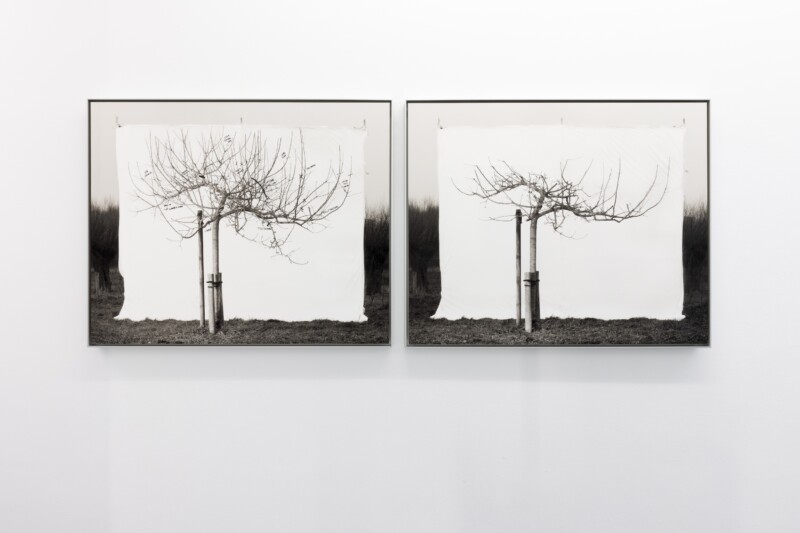
Glass-House and Soft Stones emerges from an interest in interdependence, multispecies thinking, and ecofeminist approaches to knowledge within the arts. The project draws on the horticultural practices of grafting and pruning as both metaphors and hands-on tools to rethink artistic and pedagogical processes. Through workshops with Bijloke’s ancient fruit trees, students and teachers from photography, film, design and music will explore embodied, tactile, and multisensory forms of learning, bringing land-based knowledge into the academy. By connecting agricultural practices with artistic research and teaching, the project seeks to challenge habitual ways of producing knowledge and foster more relational, ecological, and experiential approaches to arts education.
9000 Gent
Laura Palau (Benlloc, 1993) studied Fine Arts in Valencia, Spain (UPV), she also joined national and international master programmes, seminars and workshops, such as MA Photography & Society in The Hague, The Netherlands, and MA Artistic Production in Valencia, Spain (UPV). As well as workshops conducted by Joan Foncuberta, Laia Abril, Isidoro Valcárcel Medina, among others.
Her image-based and time-based practice reacts to climatic and social emergencies, it is often collaborative and participatory. She collaborates with the public and communities by turning them into participatory laboratories. Based on feminist and indigenous thinking and the rural knowledge in which she grew up, her work weaves together rituals of care, trying to reconcile dichotomies such as human vs. nature, rural vs. urban and local vs. global, intending to deconstruct such distinctions, established primarily by Western academia.
Since 2017, her work has been shown internationally in PhotoEspaña (ES), Dupho (NL), Helsinki Photomedia Conference (FI), IVAM (ES), CCCC (ES), Torino PhotoFestival (IT), EAC (ES), PALMA Festival (FR), among others. And lately awarded by La Caixa Fellowships Abroad, and 30 women under 30 by ARTPIL. Currently, she is developing research on grafting and pruning applied to artistic practice in the academic context of KASK & Conservatorium.