

Register and follow these steps
upcoming dates
12.09.26 – 22.11.26, Veva Leye, Jelle Martens, KIOSKexpoAgendaArtistic activities
Drawing from seemingly endlessly proliferating word sequences—which arise from a single word through a simple rule and through association—Veva Leye creates montages that present the same words in completely different ways. Uncannily coagulating, these word images expand and contract in an accordion-like movement. A similar rhythm characterizes Jelle Martens’ (photo)graphic registrations that combine fragments, reproductions and trivial observations into layered prints and drawings. Every print layer, every drawing operates as a temporary frame bringing together images that only temporarily solidify, overlap, and fall apart again. Image and language tumble along, stumble upon. Letters form words form images reading looking.
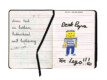 Stress Test, KIOSKexpoAgendaArtistic activities
What happens to an artistic practice when you become a parent? And what happens to an arts institution when an artist’s life disrupts its plans?
Stress Test reflects on how the birth of a child can affect both an artist and an institution. When an artist asked KIOSK to consider postponing his exhibition so he could care for his child, his request also became a stress test for KIOSK: how flexible can an institution be? What responsibility does it bear towards the people it works with?
KIOSK made room for his circumstances and chose to create something new in place of his exhibition. With the help of artists close to KIOSK and its network, a group exhibition took shape around fathers, fatherhood, fathering, and artistic practice. Works based on personal experiences and intimate stories explore care, the love and tension between father and child, and the desire to have or not to have children.
An open call for birth announcement cards designed by artist-fathers extended the invitation to contribute beyond KIOSK’s network. These cards bring together intimate and public moments: the arrival of a child, the announcement of a new life… and an artist becoming a father.
With works by
Ava Pudelek-Hoffman + Nicholas Hoffman, Chloë Delanghe, Danilo Zocatelli, Edouard Peeters-Wintein, Eva Maria Bouillon, Fabrice Schneider, Henry Andersen, Herman Van Ingelgem, Jacques Lizène, Julia Schouten, Laurens Mariën, Leen Voet, Marthe Merckx, Odette & Jasper Rigole, Paul Casaer, Sambasiva Rao Patchineelam & Vijai Maia Patchineelam, Trudo Engels, Vaast Colson, Vanya, Johan & Willem Vermeersch, Veronika Eberhart, Willy Van Ingelgem, and all the artists who contributed birth announcement cards
Louis Pasteurlaan 2
9000 Gent
Mon-Sun, 12:00-18:00
Do you have more questions? paul.lamont@hogent.be MAIL
To start in the master in music, you need either a bachelor in performing music (for the master in classical music or jazz/pop), or a bachelor in composing music (for the master in music production, composition or music theory).
diploma rating
After submitting your application for a master's program, the admissions officer and track counselors will evaluate your degree. This may affect the program you can attend.
Evaluation Criteria
To determine whether your bachelor's degree is a professional bachelor's degree or an academic bachelor's degree, we look at the length of your undergraduate studies, the course load, the courses you took, the school's mission statement, the possibility of pursuing a master's degree in the school where you earned your bachelor's degree, etc. ... We also consult various national and international diploma rating databases ...
We classify your degree into one of the following categories: an academic bachelor's degree (or equivalent), a professional bachelor's degree (or equivalent), an academic bachelor's degree earned in another artistic discipline, a master's degree or a post-master's degree. This determines which program you are admitted to.
Academic bachelor's degree
Holders of an academic bachelor can gain direct admission to the master's program when they pass the orientation interview/audition/intake.
Professional bachelor
Holders of a professional bachelor will need to complete a transition program before gaining admission to the master's programs. The transition program consists of a set number of courses from the third bachelor year. The curriculum is determined by the orientation committee in consultation with the track counselors. In some cases a part of the transition program can be exempted and a combination with subjects from the master's program is possible.
Academic bachelor in another artistic discipline
Holders of an academic bachelor's degree in another artistic discipline may have to take a preparatory program before they are admitted to the master's programs. The preparation program consists of a number of courses from the bachelor's programs. The composition of the program is determined by the jury of the orientation committee and track counselors. In some cases this program can already be combined with part of the master program.
bridging program for the master
If you wish to begin a master's program, but do not have the appropriate underlying bachelor's degree, you may, in some cases, follow a bridging program. In such cases, it is best to contact your study program supervisor. Applying for a bridging or preparatory program follows the same procedure as for the master program.
Dutch or English language requirements
You can study all our master's programs in Dutch or English. There are no formal level requirements for English in the master programs, but the Vantage B2 level is strongly recommended.