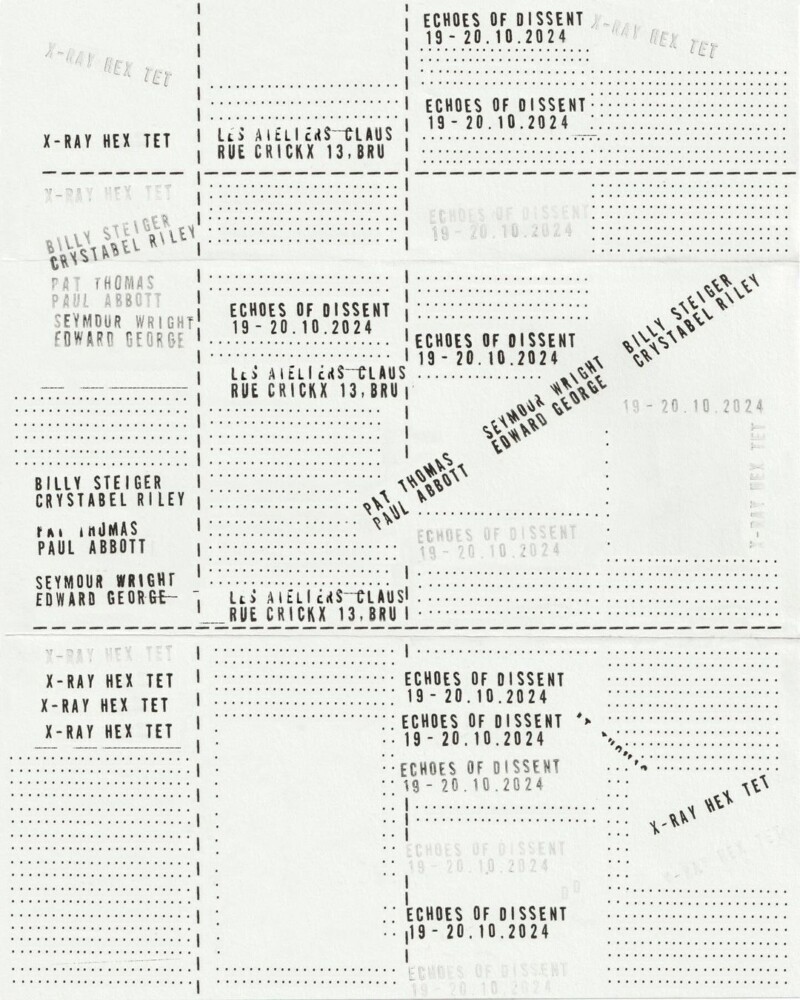
19.10.24 – 20.10.24, 20:00, Echoes of Dissent (vol. 5), X-ray hex tet
Wat zou het kunnen betekenen om politiek te bedrijven door muziek uit te voeren? Hoe zou muzikale improvisatie — als een proces van collectief zoeken naar geluiden en naar de reacties die daaraan verbonden zijn, in plaats van ze te bedenken, voor te bereiden en te produceren — ons besef van de wereld kunnen herconfigureren? Hoe kunnen we muziek ervaren en begrijpen, niet simpelweg als wat zich aandient in de context van geluidsfenomenen die in tijd worden georganiseerd en voor geld worden geruild in de fabriek van het postindustriële kapitalisme, maar ook als een esthetisch-poëtisch-politieke manier van onderzoeken, een manier van waarnemen, een manier van leren en delen — binnen en buiten de trillingen van geluid of de tekens van taal?
Deze en andere vragen zullen gedurende twee dagen worden onderzocht door middel van de praktijk van X- Ray Hex Tet — een voortdurende samenwerking tussen:
- Billy Steiger - celeste en viool
- Crystabel Riley - drums
- Edward George - woorden en muziek
- Pat Thomas - piano en elektronica
- Paul Abbott - drums en synthetische geluiden
- Seymour Wright - altsaxofoon (actueel en potentieel)
Zes musici met verschillende achtergronden die werken in de marge van wat (voor velen) aanvaardbaar is in termen van muziek, genre, techniek, interpretatie, geschiedenis en 'traditie'; een reeks subjectiviteiten, energieën en filosofieën die, in dialoog met elkaar, de lastige rijkdom en frictie van onderzoek wagen en aftasten, en plezier (en schat) vinden in het zoeken naar het verborgene, geheime en mysterieuze aan de randen van muziek en betekenis.
Ze zullen in oktober een opname uitbrengen via Reading Group (New York)
Stoffel Debuysere is als artistiek onderzoeker verbonden aan KASK & Conservatorium, de school of arts van HOGENT en Howest. Het onderzoeksproject Echoes of Dissent werd gefinancierd door het Onderzoeksfonds Kunsten van HOGENT.
i.s.m. Courtisane, Auguste Orts en In Vitro
met de steun van Flanders State of the Art, VGC (Vlaamse Gemeenschapscommissie) and Q-O2.
Rue Crickxstraat 15
1060 brussels
20.10.2024, 14:00
 publicatieLees, kijk, luisteronderzoekEchoes of Dissent #1 Breath, rhythm, silence, resonance: listening beyond seeing in the films of Trinh T. Minh-ha
 publicatieLees, kijk, luisteronderzoekonderzoeker Figures of Dissent: Cinema of Politics / Politics of Cinema
 publicatieLees, kijk, luisteronderzoek
 Echoes of Dissent (Vol. 7)onderzoekspresentatieAgendaOnderzoek
Fred Moten en Brandon López spelen sinds 2018 samen muziek. Ze hebben twee opmerkelijke albums uitgebracht met drummer Gerald Cleaver op het Reading Group label. Hun eerste duo-opname komt binnenkort uit op TAO Forms.
“It’s poetry as music and music as poetry. Moten’s words lead, lyrically, timbrally, poetically – but the bass and percussion loosen the grammar. Associative inflections elevate the raw sound of each player, which at root – even if they were stripped of meaning or mood – runs each part in a constantly moving triangulated constellation of sound and meaning, evolving and repeating; stretching, infilling, and expanding.”
- Jennifer Lucy Allen
Fred Moten is a cultural theorist and poet creating new conceptual spaces that accommodate emergent forms of Black cultural production, aesthetics, and social life. Moten’s writing and wording are characterised by a refined opacity and a musicality that is inspired by jazz and goes to the limit of noise: “what it is I want to say is subordinate to the sound, subordinate to a kind of feeling, a content that only that sound can provide”. His books include In the Break: The Aesthetics of the Black Radical Tradition, the trilogy Consent Not To Be A Single Being , The Undercommons: Fugitive Planning & Black Study and All Incomplete, co-authored with Stefano Harney, as well as numerous poetry collections.
Fred Moten is een cultureel theoreticus en dichter die nieuwe conceptuele ruimtes creëert voor opkomende vormen van zwarte culturele productie, esthetiek en sociaal leven. Moten's schrijven en formuleringen worden gekenmerkt door een geraffineerde ondoorzichtigheid en een muzikaliteit die geïnspireerd is door jazz en tot de grens van ruis gaat: “what it is I want to say is subordinate to the sound, subordinate to a kind of feeling, a content that only that sound can provide”. Zijn boeken zijn onder andere In the Break: The Aesthetics of the Black Radical Tradition, de trilogie Consent Not To Be A Single Being , The Undercommons: Fugitive Planning & Black Study en All Incomplete, geschreven samen met Stefano Harney, en talrijke dichtbundels.
Brandon López is bassist, componist en improvisator op het snijvlak van jazz, vrije improvisatie, noise en nieuwe muziek. Zijn muziek is geprezen als “brutaal” (Chicago Reader) en “meedogenloos” (The New York Times). Zijn verkenning van nieuwe sonische mogelijkheden op de contrabas heeft hem ertoe gebracht samen te werken met grootheden uit de hedendaagse avant-garde zoals John Zorn, Nate Wooley, Tyshawn Sorey, Leila Bordreuil en Cecilia López. Hij was een van de solisten van de New York Philharmonic en ontving vele prijzen.
Programma
- 14:00, Conversatie met Fred Moten en Brandon López in Pianofabriek (gratis)
Een uitgebreid gesprek met Fred Moten en Brandon López over hun denken en doen, muziek en taal, improvisatie en politiek, jazz en studie. - 20:00, Performances in les ateliers claus (12 euro)
Rue du Fortstraat 35
1060 Sint-Gillis
Rue Crickxstraat 15
1060 sint-gillis
 Echoes of Dissent (vol. 6)onderzoekspresentatieAgendaOnderzoek
Derek Jarman gebruikte archeologie graag als metafoor in zijn werk: in zijn schilderkunst, in zijn geschreven memoires en in zijn cinema, die hij meer dan eens karakteriseerde als een “archaeology of soul”. Een treffende metafoor voor het werk van een kunstenaar die er altijd naar streefde om diep in de verborgen keerzijdes van Engeland te graven, onvermoeibaar en onverzettelijk op zoek naar de fragmenten van een wereld die hij uit elkaar zag vallen, inclusief zijn eigen privéwereld. Kort nadat hij een HIV-diagnose kreeg, kocht hij een stukje land in Dungeness, te midden van een schijnbaar onherbergzaam landschap dat bekend staat als “de woestijn van Engeland”. Daar ging Jarman door met het opgraven van industriële en politieke overblijfselen, en het afschuimen en verbouwen van de grauwe woestenij om een scenografie van vergeten rijkdommen en nieuwe bloesems te creëren. Het is moeilijk om zijn tuin in Prospect Cottage niet te beschouwen als de ultieme bewaarplaats van Jarmans leven en werk. Net als zijn cinema was de tuin wild maar toch zorgvuldig onderhouden, Engels en buitenaards, verfijnd en subversief, zonder muren of hekken. Het is een viering van groei en bestaan, schoonheid en veerkracht, maar ook een gedenkteken voor stilte en teloorgang.
De benadering van veel van Jarmans films is vergelijkbaar met de gelaagdheid van de palimpsest — het oproepen van oude en nieuwe vormen op een palimpsestueus oppervlak waar ze elkaar ontmoeten en bestrijden. Dit geldt met name voor de inventieve gelaagdheid van de soundtracks van zijn films, het resultaat van een proces dat hij ooit bestempelde als “the archaeology of sound”. De klankbanden, variërend van speels en citerend, onstuimig en weemoedig, elektronisch en klassiek, versterkten het tijdreiseffect van zijn films, heen en weer pendeldend door de geschiedenis, terwijl ze de beeldsporen animeerden met een soort sympathieke resonantie of kortstondig mutueel dromen. Zoals Dan Barrow opmerkte: “Net zoals individuele shots, personages en narratieve fragmenten in Jarmans films, halfverbijsterend, uit hun voorlopige context pingelen en de kijker bij elke stap dwingen om de vorm van de film opnieuw te bedenken, zo lijkt de muziek vaak te verdwijnen in haar eigen spel van mijmering en verleiding voordat ze de vleselijke grillen van het beeld even aanraakt.”
Van de punk esthetiek van zijn tweede langspeelfilm Jubilee (1978) tot samenwerkingen met muzikanten en bands als Throbbing Gristle, Psychic TV, Brian Eno of Coil: het werk van Jarman was instrumentaal in het overbruggen van de magische kloof tussen de Britse experimentele muziek underground en de avant-garde film- en kunstwereld. Maar Jarmans meest duurzame en vruchtbare sonische samenwerking was ongetwijfeld die met Simon Fisher Turner. Hun vriendschap begon toen Turner als chauffeur werkte tijdens de productie van The Tempest (1979), waarna Jarman hem uitnodigde om soundtracks te componeren voor een reeks Super 8 films en de speelfilm Caravaggio (1986). Hun samenwerking duurde voort tot in de jaren 1990, met als hoogtepunt Jarmans afscheidsfilm, het weergaloze en bevrijdende Blue (1993). Geïnspireerd door Robert Bressons notitie over geluid uit zijn Notes sur le cinématographe: “de klanken moeten muziek worden”, vermengt Turners werk veldopnames — die hij “life recordings” noemt — met klassieke en moderne elementen, waarbij hij een verscheidenheid aan instrumentaties, texturen en kleuren samenbrengt in rijke sonische fresco’s die, net als het werk van Derek Jarman, elke vorm van afbakening en categorisering tarten. Een palimpsestische poëtica die de veelzijdigheid van het heden herbergt, met ruimte voor de spoken van het verleden en de beloftes van de toekomst.
Met dit programma van vertoningen, gesprekken en performances willen we een eerbetoon brengen aan het werk van Derek Jarman en Simon Fisher Turner.
 Ways of ListeningonderzoekspresentatieAgendaOnderzoek
Doc's Kingdom is terug in Odemira (Portugal) van 19 tot 23 november 2024, met een programma van vertoningen, debatten, installaties, geluidsperformances en collectieve maaltijden.
Onder de titel “Ways of Listening” wil het programma van dit jaar, samengesteld door onderzoeker Stoffel Debuysere, tegenwicht bieden aan de traditionele focus op beeld door kritische perspectieven op documentaire te ontwikkelen vanuit het oogpunt van geluid. Om de politieke en ethische mogelijkheden en implicaties van het sonische te verbeelden en te bespreken, zal Doc's Kingdom worden ingezet als een ruimte voor collectief onderzoek die aandringt op meer dan het oog kan zien; een ruimte voor het bekijken en herbekijken van cinema in de sleutel van het luisteren.
 Echoes of Dissent (vol. 4)filmonderzoekspresentatieAgendaOnderzoek
Onze stem is tegelijkertijd wat ons van elkaar onderscheidt en wat ons met elkaar verbindt. De stem heeft betrekking op de keel, speeksel, en de ademhaling, de borst en de longen, het patina van het ervaren leven, het plezier van het vormen van geluidsgolven, de akoestische uitingen die worden uitgezonden van mond naar oor, in de vorm van korrel, timbre, vibratie, ritme, taal. Ze resoneert op het snijvlak van het individuele en het collectieve, het fonetische en het semantische, het innerlijke en het uiterlijke, klank en teneur.
De stem is lichaam en spraak, gezucht en gehuil, gekreun en gekerm, geneurie en gegrom. De stem is de ziel. Stem is stennis. Een stem maakt ons uniek als individu en sterk als gemeenschap. Als we het over verzet hebben, over meningsverschillen en herverdeling, dan ligt de nadruk vaak op het geven van een stem, je stem laten horen, in opspraak komen, op de politieke daad van de tegenstem, eisen stellen, klachten kenbaar maken. Maar wat betekent het om je stem te gebruiken? Hoe kunnen we de stem interpreteren en begrijpen als iets politieks?
Met deze vragen in het achterhoofd nodigden we vocaliste, componiste, stem- en bewegingskunstenares Elaine Mitchener uit om een programma samen te stellen met performances en gesprekken die de stem in al zijn poëtische en politieke kracht tot leven wekken.
Curated by Elaine Mitchener
 Courtisane festival 2024, ResidentiesfilmAgendaArtistieke werkingOnderzoek
We zijn blij om aan te kondigen dat het Courtisane festival 2024 plaats vindt van 27 tot 31 maart in Gent. KASKcinema is één van de locaties van het festival. In het kader van het onderzoeksproject Echoes of Dissent, rond de politiek van klank en de klankband, staat er tijdens het Courtisane festival (27- 31 maart) heel wat events gepland, waaronder de programma’s Thinking with Dub Cinema (Met Kodwo Eshun, Louis Henderson en Lynnée Denise) en Politics of the Voice (met Loré Lixenberg, Audrey Chen, Nhã Thuyên, Jay Bernard, Esi Eshun, Elaine Mitchener, Neil Charles), alsook tal van gesprekken met kunstenaars en filmmakers over klank in hun werk, waaronder Pedro Costa, Kamal Aljafari, Claudia von Alemann, Manon de Boer en Annik Leroy.
Tijdens het festival komt een nieuwe publicatie uit in de Echoes of Dissent reeks: 汾阳的喧嚣 Ironic Resonance, Anti-sound Design and Radical Cacophony in Jia Zhangke's 小 Xiao 武 Wu van Morgan Quaintance.
Courtisane is een platform voor film en audiovisuele kunsten. In de vorm van een jaarlijks festival, filmvertoningen, gesprekken en publicaties onderzoeken we de relaties tussen beeld en wereld, esthetiek en politiek, experiment en engagement.
 Echoes of Dissent (vol. 3)filmonderzoekspresentatieAgendaOnderzoek
Hoe te denken over dub cinema? Hoe te denken over dub in, als, met cinema? Hoe en op welke manieren kunnen we over cinema denken aan de hand van dub? Hoe en op welke manieren maakt dub, niet begrepen als een genre maar als een sonisch proces dat het wezen van de song ontbindt, de tijdsstructuren van cinema ongedaan?
Op welke manieren nodigt cinema uit om na te denken over de manier waarop dub, niet enkel opgevat als een sonisch maar ook als een cine-sonisch proces, de onverbondenheid dramatiseert van zwarte cinema met, of voor, de instituten van de esthetiek, het voorouderlijke, het archivale, de auteur, het authentieke, de avant-garde, het lichamelijke, het communitaire, het formele, het gender- specifieke, het generieke, het historische, het militante, het narratieve, de natie, het orale, het poëtische, het politieke, het populaire, het raciale, het verzetbare, de strijd, het seksuele of het traditionele waarop het denken een beroep doet om de samenhang van cinema te organiseren?
Denk aan Thinking with Dub Cinema als twee studiedagen, een filmprogramma en een dub sessie gewijd aan deze vra- gen. Een uitnodiging tot studie die zich wijdt aan een praktijk van luisteren naar cinema, mogelijk gemaakt door het kijken naar Handsworth Songs (Black Audio Film Collective, 1986).
Tijdens studiesessies onder leiding van Kodwo Eshun, Louis Henderson en Lynnée Denise vertrekt Thinking with Dub Cinema van een uitnodiging om na te denken over Handsworth Songs. Elke sessie nodigt deelnemers uit om hun kijk-, lees- en luisterpraktijken af te stemmen op het ontwikkelen van een dub-methodologie voor de verbeelding van auditieve blackness, zwarte auditie, collectieve auditie en filmische collectiviteit die Handsworth Songs aankondigt.
Denk aan Thinking with Dub Cinema als een bijeenkomst rond een idee van dub cinema dat in eerste instantie werd voorgesteld door Greg Tate in 1988 en vervolgens door Okwui Enwezor in 2007. In ‘Never Mind the Sex Pistols, Here Comes Sankofa,’ gepubliceerd in The Village Voice op 30 augustus 1988, schreef Tate:
“Black Audio Film’s Handsworth Songs is dub cinema — dub, voor niet-ingewijden, is die vorm van reggae waarbij de leadzang is verwijderd en de ruimte op de voorgrond is gevuld met geregenereerde en vervallende geluiden die een mythisch Afrikaans verleden en toekomst willen oproepen. Het is ogenschijnlijk een documentaire, maar de free-floating en spectrale behandeling van historisch beeldmateriaal getuigt van de mystiek van de zwarte Britse burger en bekritiseert tegelijkertijd de commercialisering van het zwarte imago. Handsworth Songs is een gecomprimeerd koor van zwarte Britse stemmen, die door het op de voorgrond plaatsen van de witte media en de politie in de positie van being Other worden geplaatst.”
In ‘Coalition Building: Black Audio Film Collective and Transnational Post-colonialism’ (verschenen in The Ghosts of Songs: The Film Art of the Black Audio Film Collective onder redactie van Kodwo Eshun en Anjalika Sagar, 2007), betoogde Enwezor:
“Hoewel Handsworth Songs ogenschijnlijk de politieproblematiek behandelt, weerspiegelt het diepgaander de agency van de onderdrukten; het vertelt hun verhalen, niet alleen vanuit het gezichtspunt van de gebeurtenis waaraan het zijn naam ontleent, maar ook door middel van een archeologie van het visuele archief van minderheden in Groot-Brittannië. Zoals zo vaak het geval is in het werk van Black Audio Film Collective, informeren de spoken van die verhalen het idee van een historisch gekleurde dubcinema waarvan de ruimtelijke, temporele en psychische dynamiek de verspreide trajecten van immigrantengemeenschappen weerspiegelt.”
Denk aan Thinking with Dub Cinema als een uitnodiging om de “free-floating en spectrale behandeling van historisch beeldmateriaal” die Tate voorstelt en het “idee van een historisch gekleurde dubcinema” die Enwezor naar voren schuift, te horen als suggesties of, beter nog, als suggestures, om Ian Penmans term te gebruiken, voor het bedenken van een cine-poesis van de echo en een cine-praktijk van de version.
Handsworth Songs horen als dub cinema is het uitwerken van de manieren waaropHandsworth Songs zijn versie van cinema en zijn cinema van de versie beoefent. Handsworth Songs horen in en als een cine-mix is aandacht schenken aan de manieren waarop Handsworth Songs filmversies maakt. Naar dub cinema luisteren in Handsworth Songs is luisteren naar de latente dimensies van het retroactieve en het proleptische die beschikbaar worden voor het denken in de geluiden en de beelden die Handsworth Songs inzet.
Handsworth Songs beluisteren vanuit de plaats van de queer epistemologie van Isaac Julien’s Territories, de televisie-ballade van Philip Donnellan’s The Colony, het negrofobe Pathé-journaal van Our Jamaican Problem en de begrafenispoëtica van Sir Collins & The Versatiles is het denken oriënteren op de manieren waarop Handsworth Songs in de archieven duikt om het leven en sneven van zwarte burgers te behoeden voor de dreigende vergetelheid.
Denk bij Thinking with Dub Cinema aan een uitnodiging om in te gaan op de manieren waarop Handsworth Songs een cinema van vervreemding en ontheemding aankondigt. Een uitnodiging om te belichten, te verklaren en op te helderen op welke manieren en langs welke wegen cinema zijn dub-epistemologieën, dub-kosmologieën, dub-akoestemologieën, dub-ontologieën, dub-psyches en dub-affinititeiten dramatiseert.
Curated by Kodwo Eshun and Louis Henderson
 Echoes of Dissent (vol. 2)concertonderzoekspresentatieAgendaOnderzoek
To mark the closing weekend of Trevor Mathison: From Signal To Decay: Volume 4, argos presents a special event with Trevor Mathison and Nkisi. Highlighting two distinct yet related approaches to radical Black sound and its interweaving aesthetic explorations, both artists respond to and extend Mathison’s exhibition.
This is the second iteration of a series of gatherings gravitating around the question: How to think of the sonic as a site of dissent? It also indicates the launch of Trevor Mathison's second record on Purge Records, which is called From Signal to Decay, Volume 5.
Schedule
- 17:00–18:00 Sonic intervention by Trevor Mathison
- 18:00–19:00 Talk with Trevor Mathison and Nkisi
- 19:00–20:00 Break with food and drinks
- 20:00–[...] Hybrid live/DJ set by Nkisi
Stoffel Debuysere is affiliated as an artistic researcher to KASK & Conservatorium, the school of arts of HOGENT and howest. The research project Echoes of Dissent was financed by the HOGENT Arts Research Fund.
Werfstraat 13 Rue du Chantier
1000 Brussel
 Echoes of Dissent (Vol. 1)onderzoekspresentatieAgendaOnderzoek
In the context of the research project Echoes of Dissent, artistic researcher at KASK & Conservatorium Stoffel Debuysere organises an eponymous event at Beursschouwburg in co-operation with Argos, Auguste Orts and Courtisane. This is the first iteration of a series of gatherings gravitating around the question: How to think of the sonic as a site of dissent?
This two-day program proposes to think and experience the sonic as a site of refusal, insurgency and world-making. How could a poetics of the undercommons sound like? How to make it re-sound? How can we shape modes of fugitive listening and forms of attunement attending to sonic practices that refuse the call to order? How can we organize collective discursive spaces where we can share and expand the emancipatory operations performed by sound and music?
The Listening Sessions, modeled on the practice of Le Mardi Gras Listening Collective, take Stephen Henderson's overlooked 1972 book, Understanding the New Black Poetry: Black Speech and Black Music as Poetic References, as a basis for jam-like conversations around “the form of things unknown”. We will imagine and discuss the political charge of the audial and the aural; of hearing and listening.
Throughout the program, sound takes on different shapes, from embodied soundings (Hannah Catherine Jones) to sonic autobiographies (Ain Bailey). We will explore how the secret life of sonic forms circulates within khuaya-rings (Simnikiwe Buhlungu) and how it reverberates in Trevor Mathison’s work for the Black Audio Film Collective (Kodwo Eshun).
– Listening sessions, performance workshop, DJ-sets and film installation with Le Mardi Gras Listening Collective (Dhanveer Brar Singh, Louis Moreno, Paul Rekret, Edward George), Ain Bailey, Hannah Catherine Jones, Kodwo Eshun, Bhavisha Panchia, Rokia Bamba and Simnikiwe Buhlungu.
PROGRAMME
FRIDAY 2.06
13:00 - 13:30 Slow arrival
13:30 - 15:30 Listening Session 1 (golden space +2)
16:00 - 18:00 Listening Session 2 (golden space +2)
18:30 - 19:30 lecture by Kodwo Eshun on the aesthetic of Black Industrialism in the work of Trevor Mathison (golden space +2) The lecture is associated with the exhibition Trevor Mathison: From Signal to Decay, Volume 4 at argos (27.05.23—24.09.23)
22:00 - 3:00 Out Loud x Echoes of Dissent: performative set by Foxy Moron (Hannah Catherine Jones) & DJ sets by Ain Bailey & OJOO GYAL (rooftop +5)
SATURDAY 3.06
13:00 - 13:00 Slow arrival
13:30 - 15:30 Sonic Stories, workshop by Ain Bailey (beurscafé 0)
16:00 - 17:30 Listening Session 3 (golden space +2)
18:00 - 19:30 Listening Session 4 (golden space +2)
20:30 - 21:30 Embodied Listening Session by Hannah Catherine Jones (beurscafé 0)
22:00 - 3:00 Out Loud x Momsnightout: DJ sets by Clara!, Tatyana Jane, NMSS, Illsyll & Fatoosan (rooftop +5)
LISTENING SESSIONS
FR 2.06 & SA 3.06
without reservation
Through sonic and discursive contributions, the listening sessions engage with a text entitled “the form of things unknown,” which is the introduction to Stephen Henderson's anthology Understanding the New Black Poetry: Black Speech and Black Music as Poetic References. Drawing inspiration from Henderson’s portrayal of “the other side of the tradition” of black poetry, the sessions propose to collectively draw out our own “unwritten songs, rhythms and speech”. Rokia Bamba, Bhavisha Panchia, Kodwo Eshun and Hannah Catherine Jones join the listening sessions facilitated by Le Mardi Gras Listening Collective (Dhanveer Brar Singh, Louis Moreno, Paul Rekret, Edward George).
SONIC STORIES
SA 3.06, 13:30 - 15:30
reserve your spot
Ain Bailey invites visitors to participate in a “sonic autobiography” workshop, which explores the role of music in the formation and mobilization of memory. The interactive session will focus on collaborative listening to individually collected sound elements. Bailey, thus, opens up a space of sensory resonance in which forms of communication and exchange about experiences are explored beyond the predominant realm of spoken language. Please bring a small selection of music that carries personal meaning. If you do not have a USB stick, a list of music titles should be supplied in advance, and we will endeavour to source them.
EMBODIED LISTENING SESSION
SA 3.06, 20:30 - 21:30
without reservation
Hannah Catherine Jones will present a triangular dialogue between the resonating chambers of our bodies, singing bowls tuned to 432 Hz, and a carefully selected playlist of healing sounds also tuned to 432 Hz, creating an embodied experience of HCJ’s research into the physiological healing potentials of tuning down.
ONGOING INSTALLATION
13:00 - 23:00 CINEMA The Khuaya by Simnikiwe Buhlungu (2022, 6 min 16)
We're dropped mid-conversation of friends discussing a recent neighbourhood story that's been going around, of holes that have been dug into which neighbours have been tripping and falling.
Woven into this is a context where the thoughts/commands/questions/replies and voices of the sun, plants, water etc. are taken in equal measure and seriousness as the four friends.
This is a chapter in a larger project which looks at the ways in which we come to know (other chapters include a puddle, a lost wallet, a library and honey bees). The Khuaya here (rethinking how 'choir' is spelled and situated) functions not as a noun (i.e. a khuaya of people singing) but rather a verb (i.e. khuaya-ring; a gesture of gathering to share/disseminate and store knowledges through the form of useful gossip, inconsistent stories, trivia, daily news, announcements, things to remember by storing them, through which, song/sound becomes a welcome byproduct), but also as a space where listening takes place. As a backbone to this happening is a clear historical and cultural lineage of singing-to-store and the resilience of languages being passed on transgenerationally.
ARTISTS’ BIOS
Le Mardi Gras Listening Collective, named after a bar in Pittsburgh where the collective first gathered , comes together irregularly to play music publicly, and to talk about that music. The work of the Collective is based on an idea that music can be studied together as an embodied form of theorizing, and as an insurgent tradition of social and aesthetic communication. The collective features Fred Moten, Stefano Harney, Dhanveer Brar Singh, Fumi Okiji, Ronald Rose-Antoinette, Louis Moreno, Paul Rekret and Edward George. Four members of the collective will participate in Echoes of Dissent (Vol. 1).
The research of Dhanveer Singh Brar focuses on histories of black diasporic culture and politics from the mid-twentieth century onwards. His work approaches the histories of black diasporic culture through modes of artistic experimentation with sound and the politics of intellectual production, paying attention to the relationships between popular and experimental music, art practice, cinema, publishing and political organisation. To this effect, he has published two books: Beefy’s Tune (Dean Blunt Edit) (The 87 Press, 2020) and Teklife, Ghettoville, Eski: The Sonic Ecologies of Black Music in the Early Twenty-First Century (Goldsmiths Press / MIT Press, 2021). He is currently a Lecturer in Black British History at the University of Leeds.
Louis Moreno’s research explores the spatial, historical and cultural modes of financial capitalism with a particular focus on architecture, urbanism and music. Louis is a Lecturer in the Department of Visual Cultures and the Center for Research Architecture at Goldsmiths University of London, London. He is a member of the collectives freethought, Le Mardi Gras Listening Collective and Unspecified Enemies.
In order to understand the global politics of contemporary cultures, Paul Rekret's work embraces cultural and political theory and global political economy to interrogate changing relationships between mind and body, thought and world, broadly conceived. This involves exploring questions such as how changing experiences of work might be expressed in art and popular cultures or be experienced in the culture industries themselves. His latest book, Take This Hammer: Work, Song, and Crisis (Goldsmiths/MIT Press), investigates changing representations of labour and leisure in an epoch of economic and environmental crisis. From May 2023 he teaches in the School of Social Sciences at Liverpool Hope University.
Edward George is a writer and broadcaster. A founding member of Black Audio Film Collective, he wrote and presented the ground-breaking science fiction documentary Last Angel of History (1996), an examination of the hitherto unexplored relationships between Pan-African culture, science fiction, intergalactic travel, and rapidly progressing digital technology. In his acclaimed series The Strangeness of Dub on Morley Radio, George dives into reggae, dub, versions and versioning, drawing on critical theory, social history, and a deep and wide cross-genre musical selection. He is the host of Kuduro – Electronic Music of Angola, for Counterflows and NTS. George was also a member of the electronic music group Hallucinator, which released a series of influential 12"s and the album Landlocked on Basic Channel's Chain Reaction label.
Ain Bailey is a London-based artist, composer and DJ. Her practice explores sonic autobiographies and the constellation of sounds that form individual and community identities. Her compositions encompass field recordings and found sounds and are often inspired by reflections on silence and absence, feminist activism and architectural acoustics, particularly of urban spaces. She has developed numerous collaborations with performance, sonic and visual artists, creating multi-channel and mixed media installations and soundtracks for moving images, live performance and dance.
Rokia Bamba is a Brussels-based sound creator, explorer and curator, a radio host, the voice and words of the podcast Sororités, Conversations with my Sistas, an actress, a director and an ARTivist. Bamba started as a radio host, at the age of twelve, for Radio Campus where she, later, co-founded one of the first Hip-Hop radio shows in Belgium: Full Mix ! She realized only belatedly that she wasn’t only a good radio DJ but that she could also make people dance. Bamba is not DJ-ing in just any circle, but picks out the activist circles. Her sound exploration has also deepened through art and theater.
Simnikiwe Buhlungu is a multidisciplinary artist from Johannesburg, South Africa. She is currently based in Amsterdam, Netherlands, where she was a resident at the Rijksakademie van Beeldende Kunsten (2020 - 2022). She nurtures an interest in knowledge[s] production[s] — how it is produced, by whom and how it is disseminated. Buhlungu locates sociohistorical and everyday phenomena by meandering through these questions and their inexhaustible potential answers. The use of sound, text, installation and print-based media (in their respective non-linear forms) serve as the ‘other ways’ in which epistemological presences and everyday phenomena manifest and exist. Through this, she maps points of cognisance; i.e. how do we come to know?, by positing various layers of awareness as an ecology — one which is syncopated and reverberated. Lately, she has been listening to some modular synthesis and has been thinking about apiaries.
Hannah Catherine Jones (aka Foxy Moron) is a London-based artist, scholar, multi-instrumentalist, broadcaster and DJ (BBC Radio/TV, NTS - The Opera Show), composer, conductor, founder of Peckham Chamber Orchestra – a community project established in 2013 and founder of Chiron Choir - a queer diasporic choir established in 2022. Jones completed her AHRC DPhil scholarship at Oxford University for which the ongoing body of work The Oweds was presented as a series of live and recorded, broadcast, audio-visual episode-compositions, using disruptive sound as a methodology of institutional decolonisation and was awarded with no corrections in 2021. Dr. Jones was a recipient of the BBC Radiophonic Oram Award for innovation in music (2018) and was nominated for the Paul Hamlyn Award composer award (2014).
Kodwo Eshun is a filmmaker, theorist and artist. In 2002, he co-founded The Otolith Group with Anjalika Sagar. They have observed a research based methodology that studies events, archives, movements, compositions, materials, performance, vocality, and space-time in moving and non-moving images, sounds, musics and texts, often departing from the existing works of composers, musicians, poets, and artists, such as Julius Eastman, Codona, Drexciya and Rabindranath Tagore. He is author of such works as Dan Graham: Rock My Religion (Afterall, 2012) and More Brilliant than the Sun: Adventures in Sonic Fiction (Quartet Books, 1998), and co-editor (with Anjalika Sagar) of The Ghosts of Songs: The Film Art of the Black Audio Film Collective (Liverpool University Press, 2007). He is Lecturer in Contemporary Art Theory at Goldsmiths, Department of Visual Cultures, University of London and Professor of Visual Arts at the Haute Ecole d'Art et Design, Geneva.
Bhavisha Panchia is a curator and researcher of visual and audio culture. Her work engages with artistic and cultural practices under shifting global conditions, focusing on anti/postcolonial discourses, imperial histories, and networks of production and circulation of media. A significant part of her practice centres on auditory media’s relationship to geopolitical paradigms, particularly with respect to the social and ideological signification of sound and music in contemporary culture. She is the founder of Nothing to Commit Records, a label and publishing platform committed to the production and expansion of knowledge related to the intersection of contemporary art, literature and music within and across the global South.
Stoffel Debuysere is affiliated as an artistic researcher to KASK & Conservatorium, the school of arts of HOGENT and howest. The research project Echoes of Dissent was financed by the HOGENT Arts Research Fund.