Graduating in distance education
the story of eight interior designers
With Thomas Braem, Bert Derudder, Ine Haerick, Katrien Meersschaert, Laure Mestré, Isabelle Vanwest, Floor Veltman, Els Warlop – and Mieke Van De Woestyne (author).
For eight interior design students, the past few years have been not only an academic challenge, but also a surprisingly personal journey. They followed their programme through distance learning and grew into “the group of 8”, or as they tongue-in-cheek call themselves: the grateful 8. After the graduation ceremony, we spoke to them, tired but satisfied, with their diplomas in hand. Despite their diverse backgrounds and individual styles, their story ultimately revolves around one thing: connection. They inspired each other, pushed each other forward and proved that distance learning does not have to be distant at all.

From flax mill to guest house
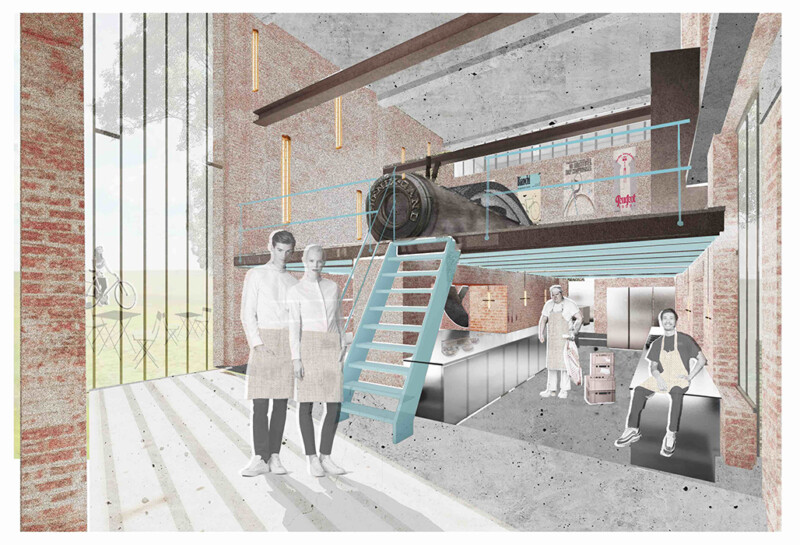
The flax mill in Kortrijk, one of the best preserved in the region, was the setting for this year's bachelor's thesis within the Concept & Spatiality focus. The assignment was clear but challenging: design a public function that respects the heritage and gives the site a new narrative. The striking retting room, with its compelling architecture and rhythm, steered the students in the same direction: they all opted for a guest house. But how exactly that should look led to three completely different interpretations.
Floor Veltman found the silence of the mill a natural breeding ground for peace and reflection. They designed a place that lends itself to retreat and contemplation, where simplicity and purity are central. “The flax history is inherently linked to West Flanders. In a way, the rotary exudes simplicity, purity and tranquillity,” she explains her choice of seclusion over encounter. That atmosphere prompted her to choose seclusion over busy forms of encounter. It even earned her design an award, presented by the De Smet Legate.

For Bert Derudder, the mill should not only be a reminder of the past, but also be future-oriented and commercially viable. He came up with a bicycle hotel that responds to the rise of cycle tourism and the connection with the landscape. “Flax is a material that is also used in design,” they say, "so I wanted to create something that refers to both tradition and innovation." In his design, a large central hall forms the beating heart, where all the rooms open onto and where the bicycle literally takes centre stage. “A bit like when you go for a walk with your dog in a park – the conversation can revolve around the dog. Here, the conversation could revolve around the bicycle.”
Thomas Braem took his time choosing a target audience and was guided by the power of the existing building. He integrated a significant part of the mill and the machinery into a public meeting space, surrounded by hotel rooms that weave around the heritage site. A striking element in his design is the old steam boiler, which had been rusting away in the field for years. Thomas gave the structure a new lease of life in a light-filled extension, a kind of greenhouse with a transitional climate that fits in perfectly with the towpath along the Leie. “I wanted to preserve it as a historical meeting point,” he says, “so that the historical value of the building remains visible, the techniques used can be displayed and walkers on the towpath are naturally drawn to each other.”
A chapel as meeting space
Within the focus on Interior Finishing & Advice, the students worked around the St. Francis Chapel in Sleidinge. One basic condition was set: food distribution had to take place at least once a month. That social approach was already established, but because it only happened sporadically, the students were given the freedom to come up with an additional function. This resulted in four very different interpretations, each starting from the question of how a chapel can be meaningful to its surroundings today.
Laure Mestré designed a sustainable, multi-purpose chapel. She conceived a sample library where visitors can discover sustainable materials, complemented by space for young artists, lectures and parties. She also provided a compact space for a design agency that can go through the sample library together with clients. The modular library allows for flexible use. “Actually, the most important thing was to reuse materials and show that sustainability can also be trendy, in a chapel,” she says. Her design largely preserves the chapel as it is, but adds thoughtful structures around the existing whole.
Because the building is located on the site of a residential care centre, Ine Haerick saw it as an excellent opportunity to give the chapel a new place in the neighbourhood. She designed an accessible meeting place for residents, passers-by and visitors. In her proposal, the chapel will have a coffee bar, a small hairdressing salon and a multipurpose room for neighbourhood activities. This would create a lively space where people can meet, help and strengthen each other.

Isabelle Vanwest started from the food-related aspect that was already part of the assignment. They designed a social restaurant combined with a market hall, where meeting people around food and local products is central. Their interpretation creates a warm, inclusive place that seamlessly intertwines food and connection.
Els Warlop returned to the original meaning of the chapel: a place where people can go with their concerns and feel safe. She provided consultation rooms for therapists as the main function, in addition to the monthly food distribution. A waiting room also serves as a meeting place for the neighbourhood, bringing care and community back together.

An installation re-thinking the square
While most students worked on permanent redesigns of existing buildings, Katrien Meersschaert followed a unique path via temporary installations. During her internship at an art gallery, she designed frames to display art, and her work quickly expanded from her own gallery to the conversion of an old barn into Atelier 1868.
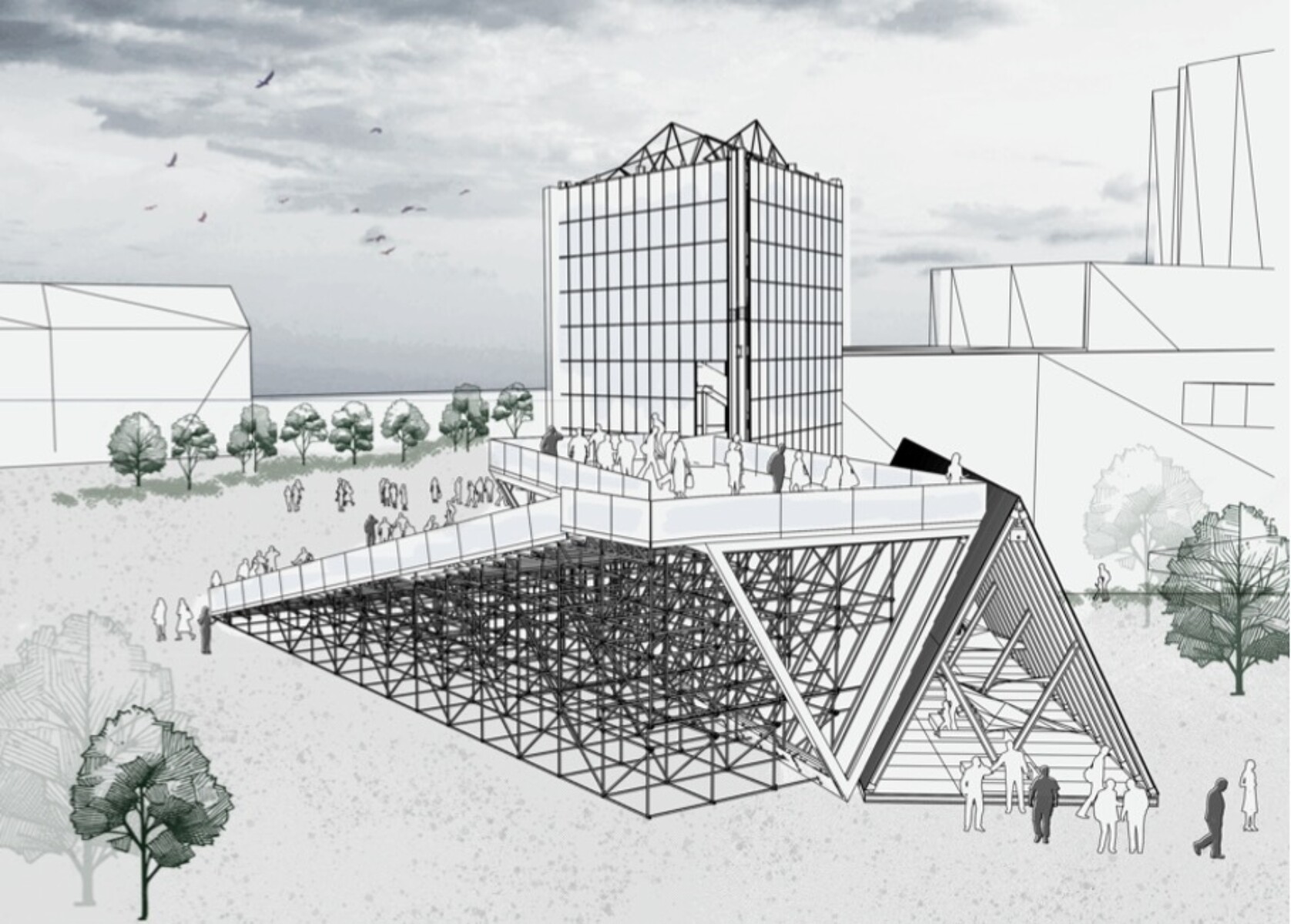
For her bachelor's thesis, she was assigned Woodrow Wilson Square in Ghent, with the task of designing a temporary installation that would strengthen the community. Since the arrival of the new city offices, the square has become chaotic and uninviting. Her answer: Triangulum, a place where people can pause and meet each other. Three large triangles, each twenty metres high, form the heart of the design, each with its own function: a greenhouse overlooking the hidden park, a space with video screens and hammocks for Belgian video art, and a platform with wide steps for lunch or views. All three triangles are connected to form a coherent whole, flexible enough to be placed elsewhere.
The power of experience and collaboration
What stands out about the designs is the maturity that the students bring with them. Each project not only gives a building or place a new function, but also the student's personal signature, imbued with experience and passion. This professionalism was reinforced by the mutual dynamics of the group. Friday afternoons in the studio often resulted in moments of coming together, reflecting and motivating each other. The joint P.INT trip to Rotterdam also brought them closer together and created a sense of connection that was palpable throughout the entire trajectory.
That social cohesion was crucial, Floor emphasises: “There were so many moments when you thought: what am I doing this for? That's when you need each other, because it makes it real, supportive and valuable. But not only that, also in terms of content and professionalism. When you looked at each other's jury presentations, you were always so pleasantly surprised by the work the other person had done, all in their own unique way.”
The group created a safe bubble, separate from the hustle and bustle of everyday life, where students found support, learned from each other and strengthened each other. Through this mutual inspiration, each retained their own signature style, while at the same time being able to grow through each other's expertise and experience. The result is a powerful combination of individual creativity and collective strength, visible in every design.
After graduating
After graduating, the eight interior designers each went their separate ways, but the bond remains. Together, they still form “the group of 8” and see each other both professionally and privately. Some work as freelancers or at a studio, others combine work with further study or are employed full-time. Their projects range from temporary installations to redesigning public spaces, and a number of them dream of future collaborations within the group.
In a few words
When asked to summarise their journey over the past few years, a variety of words come to mind: pride, intensity, a bumpy ride, sometimes even rock and roll. For the group, it was not just about individual efforts, but also about collaboration, inspiration and motivation. They created a bubble in which everything outside the studio temporarily disappeared, which could be intense for themselves and those around them. The journey was challenging and demanding, but also transformative: they learned to put things into perspective, appreciate each other's work and surpass themselves. What began as an individual journey became a shared, close-knit group story that changed them not only professionally, but also personally. Bert sums it up succinctly: “Interior design in distance education is 100% inadvisable and 200% advisable.” To which the group nods in unison as proof of the above.
Text: Mieke Van De Woestyne
 ExhibitionexpoAgendaArtistic activities
Spread out over the Bijloke campus, you can discover the work of students in photography, graphic design, autonomous design, fine arts, textile design, fashion, musical instrument making, interior design, landscape and garden architecture, landscape development, digital design and development, curatorial studies, educational master in audiovisual and visual arts and the educational master in music and performing arts.
Fri, Sat, Sun, 12:00 – 20:00
 film and animationfilmAgendaArtistic activities
Our audiovisual arts master students will project their final works into the world during the avant-premières at Sphinx Cinema on 24 June. You can book tickets here.
Later, from 26 to 29 June, we will repeat the films at KASKcinema. Admission is free, no need to make a reservation.Sint-Michielshelling 3
9000 Gent
9000 Gent
 Fashion and textileeventAgendaArtistic activities
Fashion students from KASK & Conservatorium present their graduation projects during 2 shows in the Floraliënhal.
From 20 to 21 June, you can visit the exhibition of fashion and textile design students at the same venue.
You only need to buy a ticket for the shows on Saturday 21 June, the exhibition is free to enter.
Citadelpark
9000 Gent
21.06.25
 MastersoundsconcertAgendaArtistic activities
Mastersounds is known among connoisseurs as the holy grail of up-and-coming musical talent. During this festival, part of Graduation 2025 at KASK & Conservatorium, graduating students in jazz, pop and music production present their own projects. Between 16 and 25 June 2025, they will shake the foundations of the Minard theatre and De Centrale. They were preceded by Ramkot, Balthazar, Tomàn, Senne Guns, Douglas Firs, Nordmann, Amatorski, Faces on TV, Shht... In addition, every year we celebrate the birth of the new Masterworks LP, a compilation album that brings together all that talent. Get your copy at the festival.
Romain Deconinckplein 2
9000 Gent
Ham 70
9000 Gent
 Drama, KASK DramadramaAgendaArtistic activities
During the Drama Festival, drama master’s students present their graduation work. Offbeat and classical drama, crossovers, performances and multidisciplinary work can be seen at de Kazematten, CAMPO, Minard and Arsenaalsite. The Drama Festival runs from 14 to 21 June 2025.
 Classical music, MIRY Concert hallconcertAgendaArtistic activities
Our classical music students hone their skills until they are ready for their exam recitals. You can attend this joyous occassion, as the exam concerts of master’s students of classical music and composition are open to the public. Postgraduates musical performance practice will also spoil your ears. All concerts take place in our very own MIRY Concert Hall.
 For some time I’ve been standingexpoAgendaArtistic activities
For some time I’ve been standing is an exhibition curated by curatorial studies 2024-2025 participants that takes place at the Old House, Kunsthal Gent from May 30 to August 31, 2025.
Bringing together works by Chupan Atashi, Manon de Boer, Michael Kleine, Brigitte Louter, a workshop by Emma Ydiers and a performance by Astrid Specht Seeberg, the exhibition sets out to trace gestures of rehearsal, repetition, and return, exploring what it means to pause, to stand still, or to remain in motion.
By entering into dialogue with the fresco on the back wall of the Old House, the artworks reiterate its significance as a palimpsest — responding to, echoing and reimagining it. Immediately drawing the gaze, the fresco tends to direct a body’s movement in the space. Between the other white walls, it attracts the eye, inviting it to wander over its worn, bodily surface, to follow the contours of the gaps and cracks, to glide over the smooth areas and to acknowledge its most vulnerable parts.
The exhibition takes its title from a passage in Kathy Acker’s 1993 novel My Mother: Demonology, “For some time I’ve been standing, in front of a white stucco wall, on a white road that is raised above all the surroundings and the dirt underneath, as though it’s a platform. All around me are masses of luggage, suitcases and bags”. Integral to Acker’s writing is the process of rewriting and reinterpreting, often plagiarising other sources as her own. This reflects the impetus of the exhibition to enter into conversation with the fresco on the back wall of the Old House, reiterating its significance as a palimpsest with artworks that respond, echo, and reimagine.
Accessibility statement
For some time I’ve been standing is located in the Old House, which is wheelchair accessible through the main entrance, if accompanied. Michael Kleine’s “Plateau” is only accessible via stairs, but is available in video format that can be accessed by scanning the QR code on the wall next to the work. Feel free to speak to a staff member if you need help. General exhibitions at Kunsthal Gent do not currently have an audio guide. However, the volunteers do give explanations to those who want and a room plan is available at the entrance. During opening hours, you will find visual signage to the different areas of Kunsthal Gent. Do you have any questions/remarks or would you like more information on the accessibility of Kunsthal Gent? Please feel free to contact us at info@kunsthal.gent.
Lange Steenstraat 14
9000 Gent
 articleLees, kijk, luistereducation Prize winners
 newsLees, kijk, luistereducationstudents landscape and garden architecture The answer is already present in the landscape.
 articleLees, kijk, luistereducationstudent classical music The piano is never far away
 articleLees, kijk, luistereducationstudents musical instrument making The transfer of a piece of history
 articleLees, kijk, luistereducation Drama Masters 2025Evelyne Coussens and Simon Van Schuylenbergh in conversation about the graduation performances
 articleLees, kijk, luistereducationstudent photography Who Am I Without You Mister Man?
 articleLees, kijk, luistereducationstudent graphic design emese veszely, master of graphic design
 articleLees, kijk, luistereducationstudent jazz & pop About a feral child and a bass guitar
 articleLees, kijk, luistereducationstudent film As far as we imagine
 articleLees, kijk, luistereducationstudent music production A producer has to be a jack-of-all-trades
 articleLees, kijk, luistereducationstudent autonomous design The Sock Puppet Screaming Choir & The Craftivist Analmanac Vol. 1
 articleLees, kijk, luistereducationstudent fashion being
 articleLees, kijk, luistereducationstudent animation film Overripe
 articleLees, kijk, luistereducationstudent jazz Alver
 articleLees, kijk, luistereducationstudent fine arts Film Titel Proposition; Einmalig
 Lees, kijk, luisterstudent jazz & pop The Light and His Intergalactic Stars
 articleLees, kijk, luistereducation Masterworks Vol. 14
 publicationLees, kijk, luistereducation