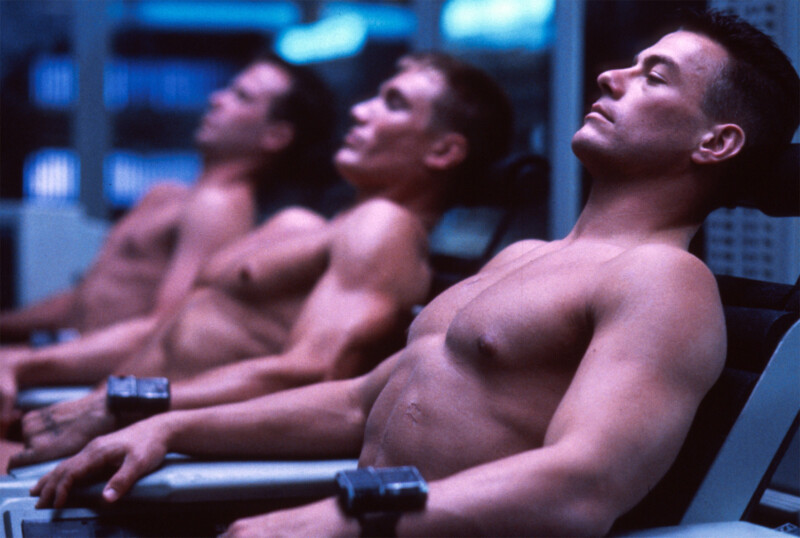
12.02.25, Universal Soldier (1992)
Studium Generale and KASKcinema join forces for an anthology of cinematic corporeality. Although cinema deals in immortality, few bodies have been so successfully preserved for eternity as that of Jean-Claude Van Damme. As Belgium's most sought-after export, JCVD melted celluloid prints throughout the 1980s and 1990s with glimpses of his glutes, abs and biceps muscles. Fresco-like fight manoeuvres and eyes full of childlike innocence made him stand leg-split and shrugged above the hunks of ungainly flesh that made up action cinema.
Universal Soldier lets us behold an actor and a body at the top of their game. Soaked in techno-paranoia as only the nineties felt, this small-scale sci-fi epic outlines the story of a cyborg soldier on the run from the government agency that created him — as well as a gruff Dolph Lundgren. This breakthrough film by genre craftsman Roland Emmerich has the same genetic material as his later hits, such as Independence Day (1996), but is distinguished by its more intimate scale and flesh-toned characters. Van Damme takes centre stage here as Emmerich's supreme Vitriviusman; a body exposed from all sides to exhibit the bliss of action anatomy.
This film will be introduced by KASKcinema programmer Lennart Soberon.
The film also plays at 18:00 at KASKcinema as part of Studium Generale
i.c.w. Studium Generale
Cloquet
Godshuizenlaan 4
9000 Gent
 Offside (2006), KASKcinemafilmAgendaArtistic activities
During a nail-biting World Cup qualifier, a group of young women gather outside the stadium in Tehran. Inside, 100,000 men cheer along to the intense emotions that the ‘king of football’ evokes in them. As the women are not allowed into the stands, the friends find creative ways to experience the match up close nonetheless.
In Offside, Iranian New Wave filmmaker Jafar Panahi weaves humour, gender roles and social engagement into a vibrant portrait of an Iranian society in flux. The blurred line between fact and fiction remains ever-present in his exploration of filmmaking.
i.c.w. Film-Plateau
Cloquet
Godshuizenlaan 4
9000 Gent
 The Golden Spurtle (2025), KASKcinemafilmAgendaArtistic activities
Meet your new favourite film about… porridge! The Porridge Making World Cup may sound just as dull as the porridge this championship is all about, but nothing could be further from the truth. Every year, the competition draws a host of eccentric contestants from all over the world to the picturesque village of Carrbridge in the Scottish Highlands.
Director Constantine Costi brings the village to life in a Wes Anderson-esque style, using symmetrical frames and picturesque compositions. With a mix of humour, heartfelt stories and endearingly eccentric character portraits, the film proves how you can make the most of a simple concept using nothing but porridge, salt and water.
This screening comes with a free bowl of homemade porridge.
Cloquet
Godshuizenlaan 4
9000 Gent
 Love That Moves the Slug, KASKcinemafilmAgendaArtistic activities
Animation is a strange beast, often quite literally. Things that really shouldn’t move do move. The impossible becomes possible, the fantastical becomes real. With this collection of short creature features, we’re writing a colourful love letter to everything that crawls, wriggles and squirm. Expect Marcel the Shell, the hip-swinging sea snail from Babobilicons (1982), a driving kettle and a coffee pot with lobster claws. As well as a Moomin episode featuring a new soundtrack created by synthesiser sensation Vessel.
This programme has been carefully curated by experimental artist Anouk De Clercq, in the wake of her solo exhibition Love That Moves The Sun. The exhibition runs from 7 October to 13 December 2026 at STUK, Naamsestraat 96 in Leuven.
 KIDScinema, KASKcinemafilmAgendaArtistic activities
The very best short films from the Filem’On Festival!
KIDScinema presents cinema for the youngest moviegoers! Parents and children from 4 years old are welcome to this screening in which we show a series of short, wacky films.
 Apolline (1959), Bruges-La-Morte (1978), KASKcinemafilmAgendaArtistic activities
To mark a research seminar on the visual representation of Georges Rodenbach’s Symbolist novel Bruges-La-Morte (1892), Film-Plateau presents the visually stunning 1978 adaptation by the American multi-artist Ronald Chase. Chase’s film is paired with Apolline (1959), a short film by Lucien Deroissy.
This little-known gem of Belgian auteur cinema is based on a novella by Franz Hellens, which offers an interesting variation on the plot structure of Rodenbach’s novel. Filmed on location in Ghent, it tells the story of a painter who becomes fascinated by a melancholic woman gazing at the tranquil canals of the historic city centre. A remarkable double bill for aspiring art historians.
This screening will be introduced by art history lecturer Steven Jacobs.
i.c.w. Film-Plateau
Cloquet
Godshuizenlaan 4
9000 Gent
 Mortu Nega (1988), KASKcinemafilmAgendaArtistic activities
Set against the backdrop of Guinea-Bissau’s twenty-year war of independence, Mortu Negafollows thirty-year-old Diminga, whose husband is fighting on the front line against the Portuguese colonists. The war is drawing to a close, but it soon becomes clear that, in many respects, the struggle has only just begun, and that the new burdens rest on the shoulders of the women. Mortu Nega (those who refuse death) bear the responsibility of reshaping the devastated country.
This political parable is the first feature film in independent Guinea-Bissau and also the first fictional film to depict the experiences of the war. Director Flora Gomes, in a subdued tone, weaves history with mythology in small stories that demonstrate how film served as an important weapon in the decolonial struggle.
Cloquet
Godshuizenlaan 4
9000 Gent
 Damned if You Don’t (1987), Dildotectónica (2023), KASKcinemafilmAgendaArtistic activities
Lesbian nuns in 1980s New York embark on a quest through historical texts to uncover the history of the dildo. Their journey runs parallel to the melodramatic conventions of film history. These two films each weave together different narratives and timelines in a quest for desire, pleasure and their expression outside the norm. How can a subversive cinematic experiment offer an answer to a Catholic upbringing? How can a ceramic dildo distance itself from phallic expectations? And what if we shape our own sexual pleasure, literally, with handmade silicone dildos?
The words of Puk Bennie complement the cinematic narratives of Su Friedrich and Paula Tomás Marques in this exploration of what pleasure and desire can mean.
Cloquet
Godshuizenlaan 4
9000 Gent
 Night of the Horror, KASKcinemafilmAgendaArtistic activities
Sleazeballs from all over the world can treat themselves this Halloween to a night that pumps hallucinogenic horror hits straight into your veins. Bad Trip snorts, licks and smokes its way to hell and back with a trilogy of drug-induced nightmares. First, we’ll chill out in the free-spirited 1970s with A Lizard in a Woman’s Skin; a giallo by Italian genre master Lucio Fulci. No peace, love and understanding here, but murderous intent, psychoanalysis and the twists and turns of the subconscious. Carol is annoyed by the hedonistic escapades of her free-spirited hippie neighbour Julia. When she dreams of murdering Julia, she realises the next morning that Julia has actually been stabbed.
After this taster, the party can begin with MadS, a strobe-lit, single-take descent into madness. On his way to a rave, Romaine is offered a mysterious substance by his dealer. What initially feels like psychedelic side effects gradually transforms into a more sinister battle with reality. Finally, we’ll wind down with Brain Damage. In this trashy horror-comedy, a young man enters into a symbiotic relationship with an alien parasite. It promises him sensory ecstasy in exchange for the brains of his neighbours. So find your trip sitter and join us for this night of sensory-overloading torments.
 Veronique Aicha, Studium Generale, KASKcinemalectureAgendaArtistic activities
Garrett Bradley once said: “The tendency to forget is humanity’s Achilles’ heel. But trying to remember is the driving force and the seed of constant revolution.”
Some films cannot be summarised easily. They demand attention, time and a different way of looking at things. ‘Time’ is one such film. Without passing explicit judgement, ‘Time’ raises fundamental questions about how we view justice.
The past plays a central role in Bradley’s films, and the concept of time lies at their heart. Her use of the camera reflects an abstraction of reality. In ‘Time’, the wives of men in detention – and the detained men themselves – are constantly drawn back to that one moment in the past for which they have been condemned, whilst at the same time being swept towards the future.
What unfolds in ‘Time’ is not a classic tale of guilt and punishment, but an intimate and multi-layered exploration of what it means to live with the consequences of a single moment. The film moves between the past and the present, revealing how time itself plays a central role in the prison system. During this evening, Garrett Bradley’s film ‘Time’ serves as the starting point for a broader reflection on prisons and perceptions, not only in the United States, but also closer to home in Belgium and Europe. What does it mean to lock someone up in prison? And what are the alternatives?
Veronique Aicha will give an introduction to Garrett Bradley’s documentary ‘Time’, followed by a screening of ‘Time’.
- Veronique Aicha works at the intersection of art, justice and philosophy. In her work, she explores and develops new perspectives on criminal law. She has worked on criminal law projects across Europe, visited prisons and detention centres throughout the continent, and taught philosophy to people in detention for many years. She is also active as a writer, presenter and programme maker, and develops cultural and social programmes centred on justice, imagination and systemic change.
- Garrett Bradley uses narrative, documentary and experimental film forms to address themes such as race, class, family relationships, social justice, the culture of the American South and the film history of the United States. Bradley has won numerous awards, including the 2019 Prix de Rome and the 2017 Sundance Jury Prize for the short film ‘Alone’, which was released by The New York Times OpDocs and was nominated for an Oscar in the short non-fiction film category, having been shortlisted by the Academy.
Bradley’s work has been featured in various venues, including her role as second unit director on Ava DuVernay’s ‘When They See Us’ and the 2019 Whitney Biennial. In December 2019, Bradley’s first solo exhibition opened at the Contemporary Arts Museum Houston (CAMH), curated by Rebecca Matalon. In January 2020, Bradley became the first African-American woman to win the Best Director award at the 2020 Sundance Film Festival for her debut feature-length documentary, ‘Time’.
This talk and film screening will take place at KASKcinema. The auditorium is wheelchair accessible and a limited number of spaces are provided within the auditorium. The wheelchair-accessible toilet is located on the first floor and is accessible via a lift (90 cm wide, 1.35 m deep). There is another toilet available further down the corridor, past the KASKcafe, for those using a wider wheelchair. Anyone with further questions about accessibility facilities can contact the organisers: helena.verheye@hogent.be.
free for students and staff at HOGENT, Howest, Ghent University and KASK & Conservatorium
Cloquet
Godshuizenlaan 4
9000 Gent
 Un Soir de Joie (1955), KASKcinemafilmAgendaArtistic activities
In the 1930s, Gaston Schoukens was renowned as a writer of popular Brussels comedies. With Un Soir de Joie, he enjoyed one final major success. The film, based on a true story of a Resistance operation in November 1943, recounts how the Belgian Resistance distributed a forged issue of the pro-German newspaper Le Soir, full of mockery and parody of the occupying forces. It is striking that Schoukens largely avoids the hardships of war, opting instead for a light-hearted approach in the tradition of Tijl Uilenspiegel. Yet the film is not purely cheerful: a few bittersweet moments reveal that the war had left its mark even on this comedy.
This screening will be introduced by film history lecturer Gertjan Willems.
i.c.w. Film-Plateau
Cloquet
Godshuizenlaan 4
9000 Gent
 Cat City (1986), KASKcinemafilmAgendaArtistic activities
In the year 80 AMM (After Mickey Mouse), a group of mafia cats hatches a plot to wipe out the mouse population on the animal-ruled Planet X. Mouse scientist Professor Fushimishi seems to have found the weapon to counter the threat to his people’s survival and enlists agents Intermouse and Nick Grabowsky to retrieve the plans from the cat city of Pokyo.
This Hungarian gem is a little kitten that won’t let itself be caught without a fight. With nods to 1970s spy films and a funky colour palette, Cat City is an anthropomorphic James Bond adaptation that refuses to be tamed. Produced during the heyday of the Hungarian animation industry, Cat City is regarded as a triumph of great daring on a shoestring budget.
This screening will be accompanied by a selection of cheeses to taste.
i.c.w. Open Cinema
Cloquet
Godshuizenlaan 4
9000 Gent
 Teorema (1968), KASKcinemafilmAgendaArtistic activities
This masterpiece by Pier Paolo Pasolini is based on a simple premise: ‘What if Christ were to return as a sexy anarchist in tight-fitting jumpers?’ One day, a mysterious stranger, played by Terence Stamp, turns up at the door of a bourgeois Italian family. One by one, the family members become obsessed with his presence and replace their bourgeois morals with revolutionary sentiments. When the stranger suddenly disappears, the emptiness of their existence can no longer be denied.
For this screening, our guest speaker uses Teorema as a canvas to analyse Pasolini’s art-historical inspirations. Drawing on religious motifs and Renaissance imagery, Pasolini weaves a web of visual allusions that lay bare the catechism of capitalism.
This screening will be introduced by art historian Fien Vrolix.
i.c.w. Kinoautomat
Cloquet
Godshuizenlaan 4
9000 Gent
 Film-Olympiade, KASKcinemafilmAgendaArtistic activities
Film-Plateau opens its ‘Sport and Stamina’ semester series with a colourful bouquet of short films. From the boxing ring in Combat de boxe (Charles Dekeukeleire) to the diving board in Taris, Roi de l’eau (Jean Vigo), this programme navigates its way through various competitive sports. It features silent film and sound recordings, and alternates between factual reports (Clemens De Landtsheer) and the politically charged documentary Dood van een Sandwichman(Robbe De Hert), in which cycling takes centre stage. To round off the programme, we’ll be screening a few stunningly beautiful sports science research films on human movement, which were donated to the Boekentoren by UGent-HILO in 2024.
This screening will be introduced by members of Film-Plateau and accompanied by live music.
KIDScinema, KASKcinemafilmAgendaArtistic activitiesPak je knutseldoos bij de hand, vol krijt, lijm en plakband.
KIDScinema schotelt knotsgekke filmpjes voor aan de kleinere filmbezoeker. Ditmaal wordt de cinemazaal een grote knutselruimte waar maffe filmpjes in elkaar worden gezet.
 Party Girl (1995), KASKcinemafilmAgendaArtistic activities
Before Parker Posey played a benzodiazepine-addled trophy wife in White Lotus (2025), she cemented her reputation as the 1990s ‘girl next door’ in Party Girl. Posey’s character Mary, the eponymous party girl, is trying to make the transition to a job at the New York Public Library. Dressed in an abundance of leopard print and ecstasy-coloured shades, she throws herself into life as a librarian.
Filled with parties, flirtations and falafel, the film is an ode to the rhythms of the night — as well as the hangovers that follow. Director Daisy Von Scherler Mayer conducted interviews with both DJs and librarians and combined these with her own experiences as a party animal to create a lively, insider’s perspective on the highs and lows of New York in the small hours.
Prior to the screening, we’re organising a book swap in the foyer in collaboration with De Krook library.
This screening will be introduced by librarian Maike Somers.
Cloquet
Godshuizenlaan 4
9000 Gent
 The Happiness of the Katakuris (2001), KASKcinemafilmAgendaArtistic activities
With the start of a new academic year, our Weird Wednesday series is also back in full swing. This time, we’re kicking off with a cacophonous horror musical directed by Takashi Miike. When a family man loses his job due to cutbacks, he and his family set up a bed and breakfast. However, life as a small business owner turns out to be no picnic either. Summer guests die in the strangest of circumstances, whilst the romantic advances of a sea captain threaten to tear the family apart.
Known for violent spectacles such as The Audition (1999) and Ichi, the Killer (2001), Miike is Japan’s foremost ambassador for all things strange, grubby and carnal. The Happiness of the Katakuris is perhaps his most eccentric creation yet: a perverse pop song peppered with claymation and karaoke sing-alongs.
Cloquet
Godshuizenlaan 4
9000 Gent
 Beau Travail (1999), KASKcinemafilmAgendaArtistic activities
Beau Travail, a sensory meditation on power, oppression and lust, is Claire Denis’ transformation of the novel Billy Budd (1924) . When Galoup, an officer in the French Foreign Legion in Djibouti, falls under the spell of the charismatic Sentain, military order begins to crumble slowly. Amidst colonial remnants and vast desert landscapes, a rhythmic and sensual choreography unfolds.
With her camera, Denis gets unnervingly close to her characters’ often bare skin, exploring how every glance and movement is charged with desire, jealousy and rivalry. More than twenty-five years on, Beau Travail remains one of the most fascinating and inimitable films of her generation.
This screening will be introduced by film scholar Alexander De Man.
i.c.w. Film-Plateau
Cloquet
Godshuizenlaan 4
9000 Gent
 Lurker (2025), KASKcinemafilmAgendaArtistic activities
KASKcinema is stepping out of the shadows and straight into the spotlight. As the seasoned divas we are, we’re kicking off the season with a grotesque dose of glamour. Lurker is the feature film debut of Alex Russell, known for the series Beef (2023), and follows the story of Matthew, a young music fan who tries to work his way into the inner circle of his favourite pop star. What begins as a blossoming friendship soon takes a more precarious turn, with Matthew going to ever greater extremes to prove his worth.
Russell once again showcases his skill in dynamically portraying love-hate relationships and distils narrative poetry from passive-aggression. With morally complex characters, sultry cinematography and enough cringe-worthy moments to make you grit your teeth. Lurker is a satire on fame and intimacy in the TikTok era that is as incisive as it is danceable.
Dress to impress. Before the screening, we’ll be holding a boyband-style photo shoot in the foyer.
This screening will be introduced by KASKcinema’s hosts Elisa De Schepper and Lennart Soberon.
Cloquet
Godshuizenlaan 4
9000 Gent
 Decasia (2002), KASKcinemafilmconcertAgendaArtistic activities
There is no better way to bring the season to a close than in a state of collective decay. Decasia is experimental filmmaker Bill Morrison’s ode to decay. Over the years, he has collected archive material on the theme of entropy and edited it together into a melancholic visual poem. From travel journals and dance performances to images of natural phenomena, Morrison’s examples of early cinema consistently show humanity in conflict with its own mortality. This spiritual degradation is formally emphasised by the tactility of the film material itself. The film stock of the films we are shown is so battered that it continues to tear apart and burn up as it plays. The result is a film that devours itself before the viewer’s eyes.
The evening starts at 19:00 with the screening of Decasia featuring the original soundtrack by Michael Gordon. At 20:30, this Re:Score gives the film a fresh musical treatment. Songwriter Stan Antheunis (Softboy/Thans) takes to his sound machines for a musical journey into the heart of darkness. Using loop stations and eerie sound effects, he creates a melancholic yet warm soundscape that celebrates the film’s transformative beauty. Cheers and see you in September.This film will be accompanied by live music from Stan Antheunis. Both screenings are free of charge.