Samira Alirezabeigi
Stories to be written…
In this text, Samira Alirezabeigi casts a curatorial gaze on the graduation show and investigates how writing comes into being in the work of this year’s fellow final-year students.
As a researcher who scrutinizes the materialities of writing and its technological transformations, she argues that writing as an artistic practice emerges not so much as a means of communication or merely as a mode of reflection. Rather, the materiality and embodiment, rhythmicity and memory, become an integral part of writing as an artistic practice - all of which opens up a different ontological space for writing.
The act of writing, its materiality and embodied significance, its technological development over the centuries and the meanings it carries both as a medium and topic for artistic practice might not be so prominent in the art world. However, it is a highly important one. At this particular moment when writing is increasingly reduced to a sheer act of communication and instruction which can be delegated to Gen AI and chatbots, what remains of writing raises urgent questions to reflect upon and play with.
During the graduation show, I was bewildered to find valuable works that engage with writing both as a medium and as a theme. Three works specifically were highlighted and I had a chat with Hana Hassanzadeh Kiani (graphic design), Ulysse Potet (photography) and Arthur De Boever (educational master) to dive deeper into their practice. What the works of these art graduates have in common is that writing is not so much a matter of literary endeavor or what we most commonly associate with writing, as ‘creative writing’. In all the works, it is the writing itself, its labor, its worldmaking potential and its materiality that are explored at the center. Writing appears as a rhythmic ritual that needs to be repeated, is an intimate form of attention formation, and it engages with generational and embodied memories.
The remembrance of writing
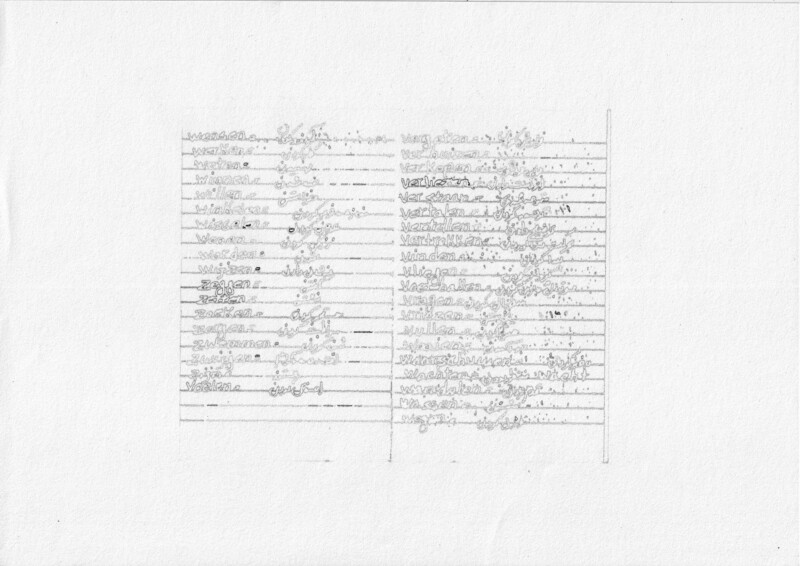
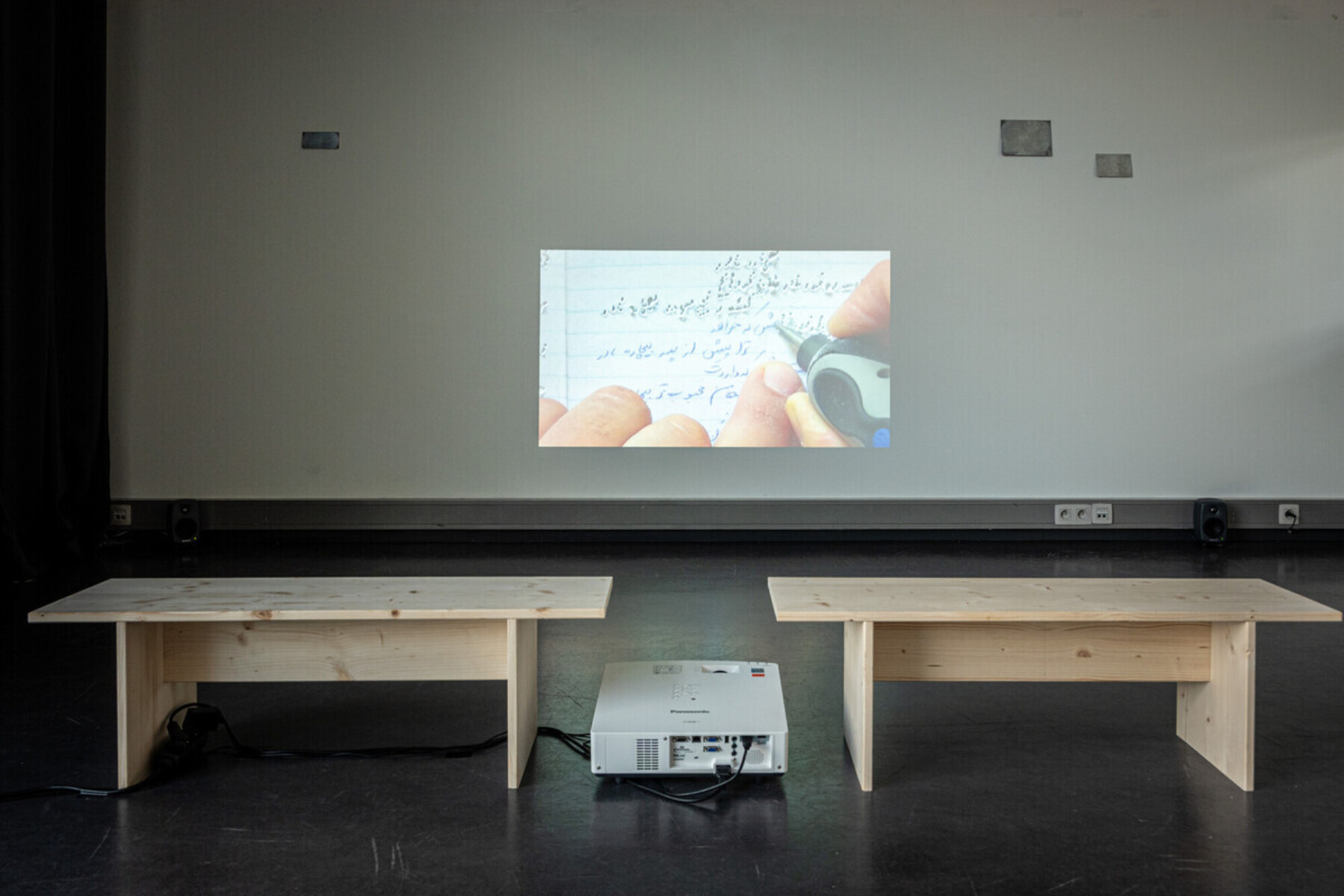
A moving hand inscribes words on the paper, pinning down the dancing shape of ‘فراموش کردن’ (Persian verb: to forget) on a notebook. Words appear and disappear as subtitles on the video, as the hand keeps repeating and mimicking, a gesture that shows what it is like to actually not forget. Next to the video display, there lies steel surfaces with an imprint of a series of poems, words, and verbs, all of which are legacies of a generational narrative that Hana gets close too in her graduation work titled From alef (آ) to ye (ی).
In this work, Hana treats writing itself as an artefact of remembrance which functions as a movement of double tension. On the one hand, by engaging with the notebook of her father who immigrated from Iran to the Netherlands, she externalizes a generational memory by constantly leaving a trace in another spacetime. Mimicking on a paper and on metal she plays with the idea of a lasting surface, like with how writing started as inscriptions in stones. On the other hand, by the act of copying the words of her dad’s notebook and repeating words again and again, she internalizes the gestures of writing and the memory it signifies into the body.
The labor of writing
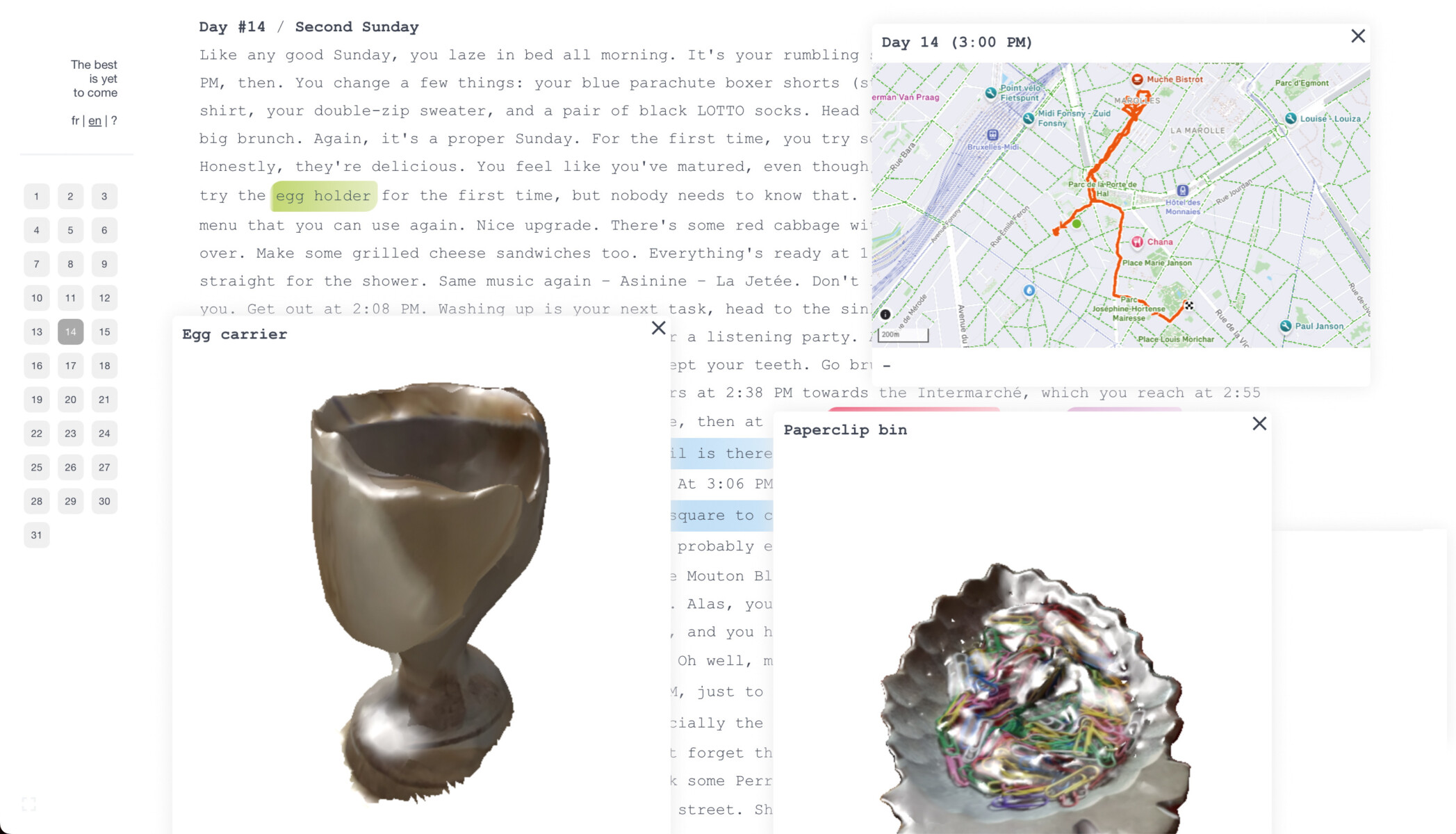
Three colorfully framed screens display lines of text that the visitor can scroll through. Getting closer, there is a text associated with each day of a month-long calendar. In his graduation work THE BEST IS YET TO COME, Ulysse scripted his activities of one full month in order to render it productive. The writings function as instruction to be reenacted the month after. Next to the screens at a lower-level pictures of the reenacted events accompany the text.
While notions of productivity and labor are at the heart of his work, placing text at the center of space is also a way for Ulysse to reflect on the imperialistic nature of photography. Ulysse says that “through writing he can trace where and how his attention is being formed” as a way of engaging with his own subjectivity more consciously. In our conversation, he pointed to Vilém Flusser’s idea of the duality of the world. The world of images and the textual world which embrace a different form of consciousness.
Writing appears also here in a double movement; on the one hand, it is an approach to form an artistic attention which is ethical. He drew on Geoffroy De Lagasnerie, to problematizes documentary photography as an impossible endeavor that brings a sense of shame. On the other hand, writing itself appears as a labor that alienates Ulysse from the unmediated happenings of everyday life.
The commoning of writing
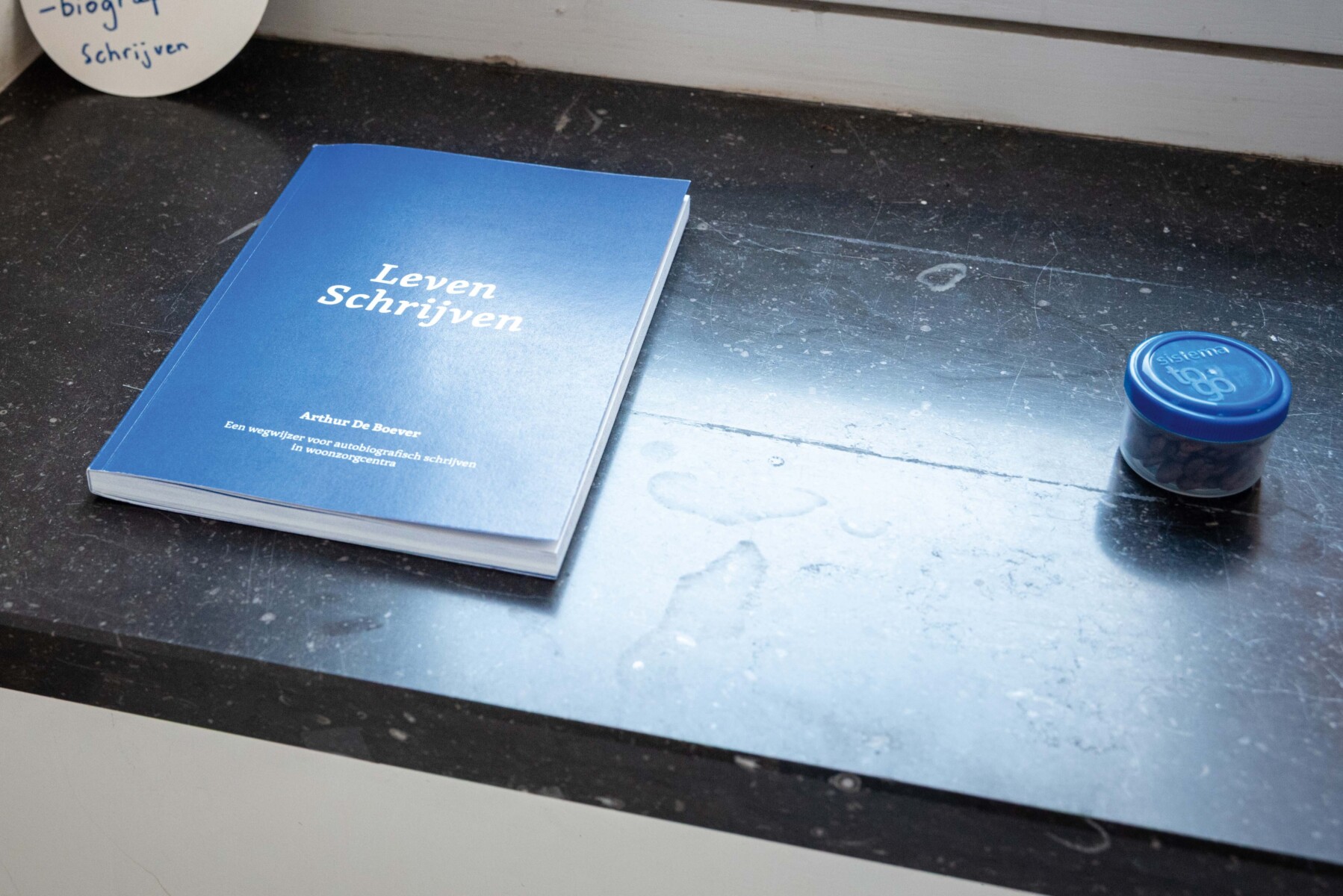
Arthur’s graduation work of creating what he calls the blue book (titled as Leven Schrijven – Living Writing), a manual for care, is not really a manual but an invitation to indulge in the discovery of an interpersonal world of elderly people through the writing of personal stories. With a background in illustration, Arthur chose the medium of writing for his graduation work. “Artistic practice is barely centered around writing” he attests and continues that writing for him is a way to get intimate. His starting point is the loss of his grandmother and the longing to have had kept her stories. He then transforms this longing into a journey at an elderly house in which he co-writes the stories of two elderly figures. This way he gives an homage to life lived in different epoch through transcribing and writing their stories.
Arthur’s work takes writing from an isolated practice into something that goes beyond the space of the individual towards a common worldmaking. Writing only happens after sessions of trust making. “Your lives matter, that’s what I tried to convey with writing their stories” he said. This is as much about trusting someone to be the pen of someone else’s stories. The blue book is a guideline for whoever wants to go through the journey of writing, to be the pen of someone’s story.
All these works highlight the poetics and politics attached to writing which needs to be further explored and practiced. My conversation with Arthur ends with a shared wish for the future of art school: a shared wish and perhaps a necessity to develop a program around writing as a medium of artistic practice, a medium which is not only a support in the process of artistic creation, but the main focus of it. A medium which undergoes huge technological transformations and needs artistic care.
text: Samira Alirezabeigi
 FashioneventAgendaArtistic activities
Fashion students from KASK & Conservatorium present their graduation projects during 2 shows on Campus Bijloke, for the first time in the Gent Jazz tent.
Godshuizenlaan 2
9000 Gent
 ExhibitionexpoAgendaArtistic activities
Spread out over the Bijloke campus, you can discover the work of students in photography, graphic design, autonomous design, fine arts, textile design, fashion, musical instrument making, interior design, landscape and garden architecture, landscape development, digital design and development, curatorial studies, educational master in audiovisual and visual arts and the educational master in music and performing arts.
 film and animationfilmAgendaArtistic activities
Our audiovisual arts master students will project their final works into the world during the avant-premières at Sphinx Cinema on 23 June. Tickets will be available soon.
Later, from 25 to 28 June, we will repeat the films at KASKcinema. Admission is free, no need to make a reservation.
9000 Gent
9000 Gent
 MastersoundsconcertAgendaArtistic activities
Mastersounds is known among connoisseurs as the holy grail of up-and-coming musical talent. During this festival, part of Graduation 2026 at KASK & Conservatorium, graduating students in jazz, pop and music production present their own projects. Between 15 and 25 June 2026, they will shake the foundations of the Minard theatre and De Centrale. They were preceded by Ramkot, Balthazar, Tomàn, Senne Guns, Douglas Firs, Nordmann, Amatorski, Faces on TV, Shht, Yong Yello, Loverman, Iskander Moon... In addition, every year we celebrate the birth of the new Masterworks LP, a compilation album that brings together all that talent. Get your copy at the festival.
Romain Deconinckplein 2
9000 Gent
Kouter 29
9000 Gent
Romain Deconinckplein 2
9000 Gent
 Drama, KASK DramadramaAgendaArtistic activities
During the Drama Festival, drama master’s students present their graduation work. Offbeat and classical drama, crossovers, performances and multidisciplinary work can be seen at various locations in Ghent. The Drama Festival runs from 15 to 20 June 2026.
 Classical music, MIRY Concert hallconcertAgendaArtistic activities
Our classical music students hone their skills until they are ready for their exam recitals. You can attend this joyous occassion, as the exam concerts of master’s students of classical music and composition are open to the public. Postgraduates musical performance practice will also spoil your ears. All concerts take place in our very own MIRY Concert Hall.
 As If More Could Save UsexpoAgendaArtistic activities
As If More Could Save Us emerges from the inhabitation of Curatorial Studies 2025-2026 in Kunsthal Gent. As one of the main partners of Curatorial Studies, Kunsthal Gent has hosted exhibitions from the postgraduate program since 2023. Building on this ongoing collaboration, this year’s exhibition is shaped by the building’s spaces, its internal dynamics, and both existing and new works. It takes place from 29 May to 28 June, 2026.
At the heart of Kunsthal Gent lies the story of Sarah Winchester, the heiress to a weapon manufacturer’s fortune, who relentlessly expanded her house with its endless rooms under the belief that she was haunted by restless spirits. Her house, with its endless rooms, staircases leading nowhere and looping corridors, translates as a ritual of building in response to uncertainty.
Mirroring this spatial imagery, Kunsthal Gent itself reads like a manuscript constantly written and rewritten; a fragmented landscape in which exhibitions unfold over time. After being built as a carmelite monastery in the 13th century, the building which now houses Kunsthal Gent underwent many transformations from opera storage to archaeological museum, and even to a squatting site.
In the spirit of Sarah Winchester, As If More Could Save Us reintroduces a selection of objects from STAM – Ghent City Museum to Kunsthal Gent, where they were previously exhibited during a time when the site still served as an archaeological museum, alongside objects from Huis van Alijn, which enter this context for the first time. Placing the past alongside the present, this ever-changing environment also gains an additional layer through contemporary works by Danai Anesiadou, Pélagie Gbaguidi, Mélina Ghorafi, Leto Keunen, Susu Laroche, Pàpoo Thibau and Julie Vanlook.
By bringing together historical objects, contemporary artworks and the spatial complexity itself, As If More Could Save Us explores how meaning is never fixed but continuously renegotiated. The exhibition builds on this evolving structure. Each space is shaped by what came before; a layering of gestures and intentions across centuries. Things accumulate here, like they always have.
Curators
Eline Adriaensen, Samira Ali Reiza Beigi, Houda Ben Azzouz, Anna Bruni, Cristina Carnelos, Alex Celis, Emma Crombé, Anaïs Du Champs, Tess Ego, Youssef Elkhiar, Zinnia Fay Fay, Nora Franco, Charlotte Frenay, Val Holfeld, Théo Jack Scherer, Bruna Martins, Antoine Meffre Chol, Sutanee Panyajai, and Alice Zitelli.
Supported by
curatorial studies and Kunsthal Gent
Many thanks to
Sonia D’Alto, Laura Herman, Isabel Van Bos and Curatorial Studies KASK Team; Valentijn Goethals, Danielle van Zuijlen, Jana Vasiljević, Tomas Lootens, Aike Roodenburg, Bert Bossaert, Klaartje Van Thuyne, Jens Wijnendaele, Tim Bryon, Mark Kokotov and Kunsthal Gent Team; STAM Ghent and Huis van Alijn.
Lange Steenstraat 14
9000 Gent
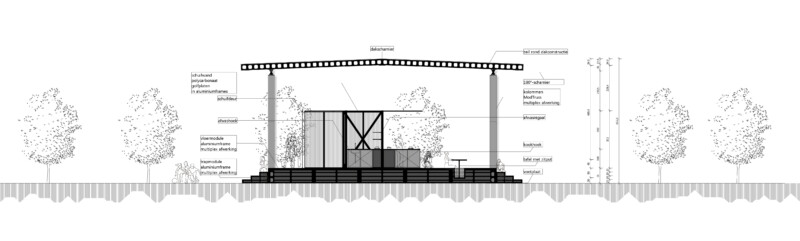
 articleLees, kijk, luistereducationstudents interior design The parasitic pavilion, The inner landscape, The contemporary temple
 articleLees, kijk, luistereducationstudent classical music Two years in Messiaen’s World
 articleLees, kijk, luistereducationstudent graphic design Master Year
 articleLees, kijk, luistereducationstudents landscape development Could you sketch out your vision for Bijloke 2.0 in 2100?
 articleLees, kijk, luistereducationstudent jazz & pop Er was altijd veel muziek in huis
 articleLees, kijk, luistereducationstudent photography እሺ እሺ Eshi Eshi, About the observer
 articleLees, kijk, luistereducationstudent classical music I think music’s most important role is one of connection
 articleLees, kijk, luistereducationmaster instrumentenbouw 19th Century Banjos: S.S. Stewart and Horace Weston
 presentationLees, kijk, luistereducation